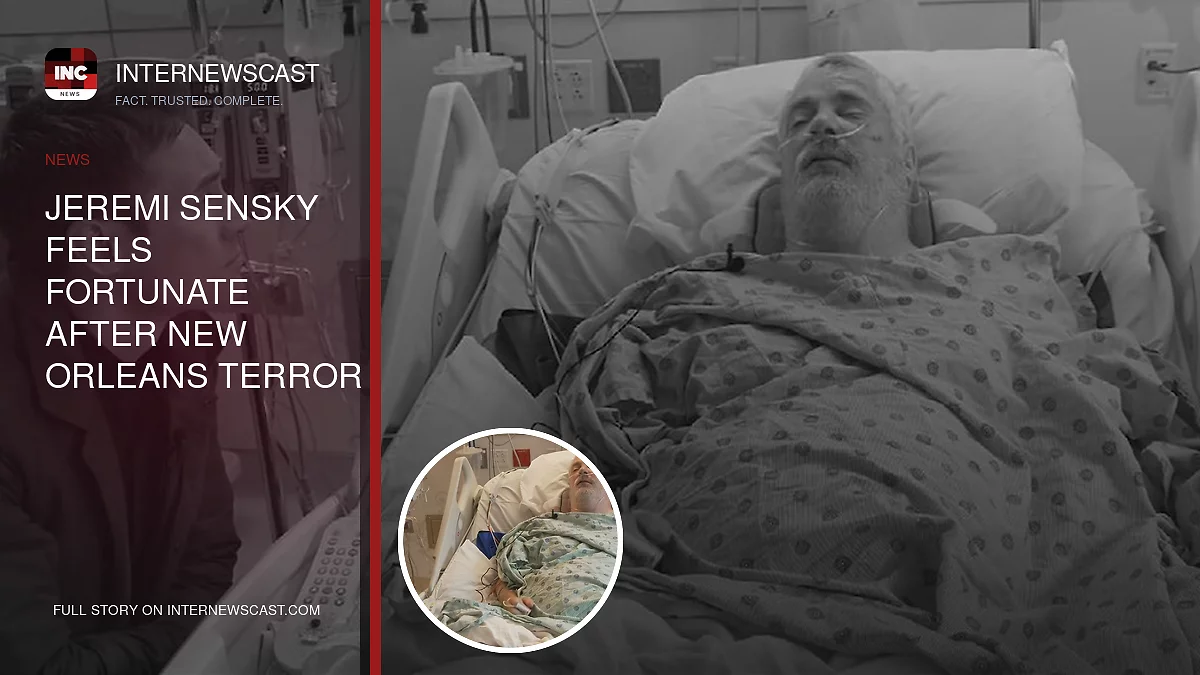

Jeremi Sensky survived the January 1, 2025, terror attack on Bourbon Street in New Orleans with both legs badly broken, hours of surgery ahead of him, and his wheelchair destroyed. Yet from his hospital bed, the Pennsylvania father said he considered himself fortunate because he was alive and his family and friends had survived as well.
Sensky, 51 at the time of the attack, was using a wheelchair after becoming paralyzed from the waist down in a 1999 car crash. He was visiting New Orleans with relatives to celebrate the New Year when a pickup truck driven by Shamsud-Din Jabbar struck pedestrians on Bourbon Street.

What happened to Jeremi Sensky in New Orleans?
Sensky was on Bourbon Street early on New Year’s Day when the truck moved into the crowd. He said he heard a loud noise and initially did not understand what was happening. Moments later, he found himself on the ground, separated from his wheelchair.
He initially thought the commotion might have been an explosion. When he looked down, he realized that one of his legs was badly injured. Debris from his wheelchair was scattered around him, and he was unable to move away from the truck or the gunfire that followed.
The attack killed 14 people and injured dozens of others. After driving into the crowd, Jabbar exchanged gunfire with police and was killed at the scene. Federal investigators described the incident as an act of terrorism.
Sensky’s injuries included fractures to both legs. His family said he underwent more than 10 hours of surgery, including treatment for severe damage to his femurs and a bone that had broken through his shin.
Why did Jeremi Sensky say he felt fortunate?
Sensky’s comments were striking because they came while he was facing a long and difficult recovery. Despite the severity of his injuries, he focused on surviving the attack rather than describing himself only as a victim.
In an interview from University Medical Center in New Orleans, he said he felt “lucky” because he was alive and the people he had been with were alive. He also credited first responders and hospital workers with helping him after he was found on the street.
His perspective was shaped by earlier trauma. Sensky had already spent years adapting to life in a wheelchair after the 1999 car accident. He told reporters that the crash had been one of the worst experiences of his life, but that history also appeared to inform his determination after the Bourbon Street attack.
His message was not that the injuries were minor. They were life-changing and required extensive medical treatment. Rather, Sensky was describing gratitude in the narrowest and most immediate sense: he had survived an attack that killed and wounded many other people.
How serious were Sensky’s injuries?
Sensky was thrown from his wheelchair when the truck hit him. Reports from his family and interviews with news organizations described extensive fractures in both legs, including injuries above and below the knees.
He spent more than a week in the hospital and was released on January 9, 2025, according to local reporting. His recovery involved orthopedic treatment, mobility planning, and the need for a replacement wheelchair because the chair involved in the attack had become evidence.
A custom motorized wheelchair was donated to him shortly after the attack through assistance from disability and disaster-relief organizations. The replacement was important not only for his independence but also for his ability to return home and continue medical care.
What did Sensky remember about the attack?
Sensky said his memory of the incident was fragmented. He remembered hearing people react and then waking up on the ground. At first, he believed he might have fallen while trying to avoid gunfire.
He did not immediately understand that the truck had hit him. The realization came when he noticed his damaged wheelchair and recognized the condition of his legs.
While he was still lying near the crash site, gunfire broke out between the attacker and police. Sensky said being on the ground made him hope he was below the line of fire. His fear increased when authorities became concerned that explosives might be inside or near the truck.
He later described the experience as confusing and frightening, particularly because he could not move himself to safety. His account also highlighted the vulnerability of people who cannot quickly run or take cover during a mass-casualty attack.
What is known about his recovery?
CHECK THIS OUT: McColm: Unity Is the First Thing to Fall Apart in Parties Like Reform
Sensky was discharged from the hospital after surgery and continued his recovery with the support of his family. Images shared by relatives showed him preparing to leave the hospital in a wheelchair, wearing orthopedic boots on both legs.
His family also raised money to help cover travel, lodging, medical, and accessibility-related expenses. The campaign described his recovery as unpredictable and emphasized the practical challenges created by the loss of his wheelchair.
Public reporting has not provided a complete medical account of his long-term condition. It is therefore not possible to say from verified information how fully his legs healed or what his current physical abilities are. His pre-existing paralysis and the seriousness of the new fractures made the recovery especially complex.
Did Sensky’s wheelchair affect the attack?
After the attack, members of Sensky’s family wondered whether the weight of his wheelchair may have contributed to the truck stopping near a construction lift. That idea circulated as a possibility, but it has not been established as an official finding about how the vehicle came to a halt.
The confirmed facts are more limited: Sensky was struck, thrown from the chair, and found near the vehicle after it crashed. Any claim that his wheelchair definitively stopped the attack or saved other lives remains unconfirmed.
That distinction matters because the attack involved a rapidly unfolding chain of events, and later explanations can easily become simplified. Sensky’s survival is documented. The precise mechanical role of his wheelchair in the vehicle’s final movement is not.
What happened in the New Orleans terror attack?
In the early hours of January 1, 2025, a pickup truck was driven into a crowd celebrating the New Year on Bourbon Street in the French Quarter. The attack killed 14 people and injured dozens more.
The driver, identified as Shamsud-Din Jabbar, left the truck and opened fire. Police officers returned fire and killed him. Investigators later said Jabbar had acted alone and characterized the incident as terrorism.
The attack prompted renewed scrutiny of security barriers and vehicle access on Bourbon Street. For survivors such as Sensky, however, the aftermath was also defined by surgeries, mobility needs, emotional trauma, and the loss of people who had been celebrating nearby.
Frequently Asked Questions
- Who is Jeremi Sensky?
Sensky is a Pennsylvania father who survived the January 1, 2025, terror attack on Bourbon Street in New Orleans. - What injuries did Jeremi Sensky suffer?
He suffered severe fractures to both legs after being struck by the attack vehicle and thrown from his wheelchair. - Was Jeremi Sensky already using a wheelchair?
Yes. He had been paralyzed from the waist down since a 1999 car accident and used a wheelchair before the New Orleans attack. - Why did Sensky say he felt fortunate?
He said he felt fortunate because he survived and the family members and friends with him also remained alive. - How long was Sensky in the hospital?
He underwent more than 10 hours of surgery and was reported to have been released on January 9, 2025, after spending more than a week in the hospital. - Did Sensky receive a replacement wheelchair?
Yes. A custom wheelchair was donated after his original chair was destroyed and retained as evidence from the attack. - How many people died in the Bourbon Street attack?
Fourteen people were killed. The attacker was also killed by police, but he is not included in that victim count. - Is there a confirmed long-term update on Sensky’s health?
Public reporting confirms his hospital discharge and replacement wheelchair, but it does not provide a complete, verified account of his long-term recovery.
Jeremi Sensky’s story is both a survival account and a reminder of the practical consequences of mass violence. He endured catastrophic injuries, a difficult operation, and the loss of essential mobility equipment. Even so, he said he considered himself fortunate because he was alive. That view does not erase the seriousness of what happened; it explains how he chose to face it.