
With tensions rising over Donald Trump’s faltering Iran ceasefire, Tehran has issued warnings that it may block the Bab el-Mandeb Strait, a crucial global shipping channel, to retaliate against the United States and Israel. Such a move could have severe repercussions, potentially triggering a worldwide economic downturn.
On Monday, Iranian officials announced that all diplomatic discussions with the U.S. have been halted, as reported by the state-run Tasnim news agency. The suspension comes in response to Israel’s recent military actions in Lebanon, which Iran claims breach the terms of the ceasefire.
Tasnim also indicated that Iran is prepared to mobilize its Shiite resistance groups in Yemen, Lebanon, and Iraq to obstruct the Strait of Hormuz. This passage is vital for the transportation of about 20% of the world’s oil supply.
Iran’s strategic interests extend to the Bab el-Mandeb Strait as well. Known as the ‘Strait of Tears,’ it poses risky sailing conditions due to its unpredictable winds, strong currents, and concealed reefs, adding to its notoriety.
According to Reuters, should Houthi rebels in Yemen broaden their military efforts, the Bab el-Mandeb Strait would likely become a prime target for disruption.
This narrow, approximately 18-mile-wide waterway serves as a critical junction between Yemen and the Horn of Africa, connecting the Red Sea to the Gulf of Aden. It is a vital passageway for nearly all cargo and energy shipments traveling between Europe and Asia.
Its closure would have a devastating effect on the global economy, with energy analysts warning that oil could spike to $180 per barrel if peace talks collapse entirely.
‘Let’s assume that there is no deal and fighting restarts between the U.S. and Iran, we’ve seen a scenario of $180 per barrel by August, and that will mean a severe global economic recession, particularly in Europe and particularly in emerging Asia,’ Jorge León, head of geopolitical analysis at Rystad Energy, told CNBC.
The regime warned that any violation there would be treated as a violation of the entire ceasefire, and that the US and Israel would face the ‘consequences’ of their actions
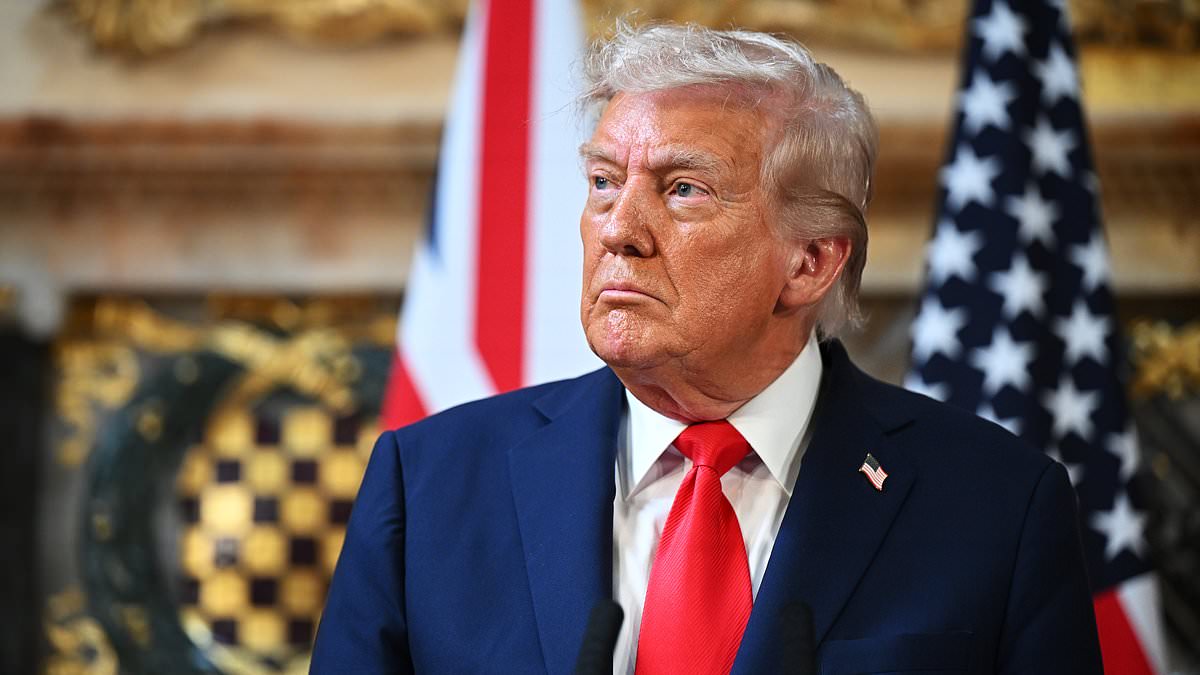
Trump has said he does not care if talks with Iran collapse, but also claimed that negotiations remain ongoing
The Bab el-Mandeb Strait is a roughly 18-mile-wide chokepoint between Yemen and the Horn of Africa that links the Red Sea to the Gulf of Aden. It is the gateway through which nearly all cargo and energy shipments traveling between Europe and Asia must pass
In response to the latest cut off all diplomatic talks by Iran, Trump said he did not care if negotiations fall apart.
‘I really don’t care. I couldn’t care less,’ Trump told CNBC.
The President also said he was not worried about energy prices spiking over Tehran’s threats to shut down the Strait of Hormuz.
‘I think the oil will be dropping like a rock in the very near, you know, the very near distance,’ Trump said.
Oil markets went into a frenzy following news of the ceasefire’s collapse, with crude prices climbing more than six percent.
Trump held a phone call with Israeli Prime Minister Benjamin Netanyahu on Monday following Tehran’s announcement.
The President said he was ‘going to ask’ Netanyahu about ‘what’s going on with Lebanon.’
Trump said on Truth Social that, after speaking with Netanyahu, no troops would go to Beirut and any en route had been recalled.

The Strait’s closure would have a devastating effect on the global economy, with energy analysts warning that oil could spike to $180 per barrel if peace talks collapse entirely
‘Likewise, through highly placed Representatives, I had a very good call with Hezbollah, and they agreed that all shooting will stop — That Israel will not attack them, and they will not attack Israel,’ Trump added.
Trump later claimed that ‘talks are continuing, at a rapid pace, with the Islamic Republic of Iran.’
Israel remains hesitant to include Lebanon in the ongoing ceasefire with Tehran, viewing that conflict as separate from the broader war.
The US has tried to mediate between Israel and Lebanon over the past few weeks, pushing for a temporary ceasefire while Trump negotiates a long-term peace agreement with Tehran.
Israeli forces over the weekend captured a strategic site in Lebanon, marking their deepest military incursion into the country in over 26 years.
Israel captured Beaufort Castle, a medieval fortress in southern Lebanon that it had held until its withdrawal from the country in 2000.


