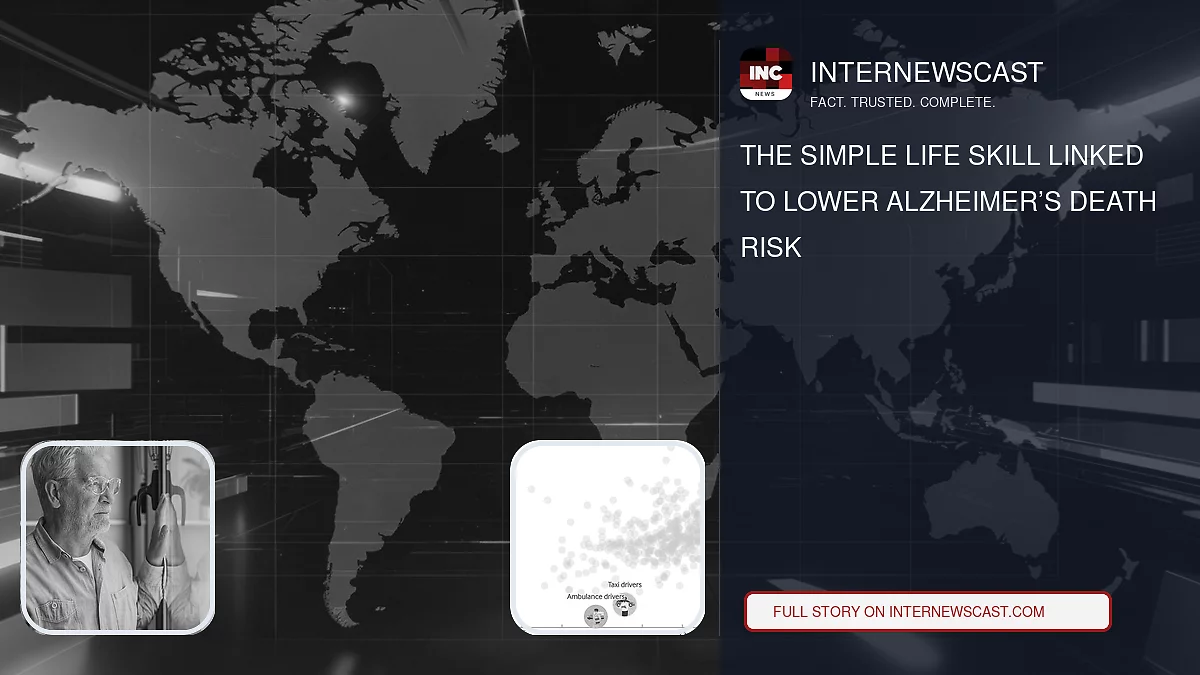

Taxi drivers and ambulance crews may have a lower risk of dying from Alzheimer’s disease than people in nearly every other line of work, according to striking new research.
The finding came from a 2024 study that analyzed death certificate data for almost 9 million people across the United States.
Scientists suspect the link may lie in the mental demands of the job: constantly finding routes, reading maps and making split-second navigation decisions while on the road. Experts suggest that this kind of real-time spatial problem-solving could offer the brain a meaningful workout.
Among the nearly 9 million death certificates reviewed from January 2020 through December 2022, taxi and ambulance drivers had the lowest likelihood of Alzheimer’s disease being listed as a cause of death across 443 occupations. The condition currently affects about 7 million Americans.
After researchers accounted for factors including age, sex, race, ethnicity and education, about one in 100 taxi and ambulance drivers had died of Alzheimer’s disease, compared with roughly one in 60 people in the overall study population.
The apparent benefit did not apply broadly to all professional drivers. That led researchers to argue that the protective factor may not be driving itself, but the constant act of navigating in real time: knowing where you are, tracking where you need to go and repeatedly adjusting your mental map as traffic and road conditions shift.
Workers who typically follow fixed or preplanned routes, such as bus drivers and aircraft pilots, did not show the same reduced risk.
Researchers believe the connection between navigation-intensive jobs and lower Alzheimer’s mortality may involve the hippocampus, the region of the brain closely tied to memory formation and spatial navigation.

Alzheimer’s disease is a type of dementia that affects 7 million Americans
It’s one of the first brain regions that Alzheimer’s damages: Problems with spatial navigation and orientation are among the earliest signs of the disease, sometimes surfacing before obvious memory loss.
In one landmark 2000 study, neuroscientists compared the brains of licensed London taxi drivers with those of people who did not drive cabs.
Their findings provided the first evidence via structural imaging that regions of the adult brain can measurably change under sustained navigational demand.
To earn a license, London cab drivers must memorize more than 25,000 streets within a 6-mile radius of Charing Cross, a challenge known as ‘The Knowledge’ that takes three to four years.
The researchers found that London taxi drivers had measurably more gray matter in the posterior hippocampus, a brain area tied to storing large-scale spatial maps.
That volume tracked with experience – the longer someone had driven, the larger that part of the brain.
The change was built through practice, not inherited. While people who are good at navigation might gravitate to this kind of job, the job itself does have an impact on the brain.

The above graph shows the percentage of deaths from Alzheimer’s disease based on occupation, with ambulance and taxi drivers showing some of the lowest rates

The above graph shows the percent risk of dying from Alzheimer’s disease based on occupation, with ambulance and taxi drivers showing some of the lowest risk rates
Together, these two studies make a coherent case. Work that intensively exercises the hippocampus may reshape it, and that reshaping may protect against one of the most feared diseases of aging.
Cartographers, urban planners and geospatial analysts spend their working days in sustained spatial reasoning.
A geographic information system (GIS) specialist might use a computer to overlap population data on flood exposure maps to find who is at risk, or read satellite imagery to map land cover after a wildfire.
Researchers juggle several layers of data, coordinate systems and scales at once.
Does spatial reasoning through a screen engage the hippocampus the way moving through a real city does?
While a taxi driver navigates from inside the scene at street level, GIS researchers picture space from above as a map – what cognitive scientists call allocentric reasoning.
However, these two perspectives overlap in the brain. The hippocampus also builds maps from outside viewpoints, not just from a navigator’s own position.
Research on cognitive maps points toward the same conclusion as the study on taxi drivers.
In 2023, researchers ran a machine learning model on more than 22,500 people in a national dataset and were able to predict which zip codes had higher rates of Alzheimer’s with 84 percent accuracy based on how complex the environment was.
Those living in spatially complex surroundings – the kind that force active map building, such as dense street networks with numerous intersections, diverse points of interest and landmarks, and multiple path options – were less likely to develop Alzheimer’s.

The above graph shows the percentage of deaths from Alzheimer’s disease based on occupation, with ambulance and taxi drivers compared to other transportation-related occupations

The above graph shows the percent risk of dying from Alzheimer’s disease based on occupation, with ambulance and taxi drivers compared to other transportation-related occupations
A follow-up study tied geospatial complexity in one’s environment to greater volume in the brain’s spatial navigation regions.
The researchers hypothesized that routinely building cognitive maps exercises the very circuitry that Alzheimer’s attacks first. Repeatedly engaging the cognitive systems involved in spatial navigation could help delay symptoms of disease.
However, these two studies focus on where people live, not the work people do. Whether spatial reasoning through a screen exercises the same circuitry as real-life city navigation remains untested.
The implications of whether sustained spatial reasoning protects the brain reach beyond mapmakers and cab drivers. Studies have repeatedly found a link between mentally complex occupations and delayed cognitive decline and lower dementia risk, even after accounting for education.
Research on cognitive reserve – the brain’s capacity to continue functioning despite disease – can help explain why two people with a similar disease burden can show markedly different levels of cognitive impairment.
If demanding spatial thinking protects the brain, then how societies design schooling, professional training and retirement all become questions of brain health.
Spatial reasoning can be trained, and training opportunities are already widespread. GIS and remote sensing instruction are available through geography, engineering, public health and environmental science programs worldwide.
If sustained engagement with spatial reasoning can help the brain strengthen the circuitry that Alzheimer’s attacks first, its value reaches well beyond the technical skills it builds.
This article is adapted from The Conversation, a nonprofit news organization dedicated to sharing the knowledge of experts. It was written by Hatim Sharif, a professor of Civil and Environmental Engineering at The University of Texas at San Antonio. It was edited by Alexa Lardieri, the US health editor at Daily Mail.