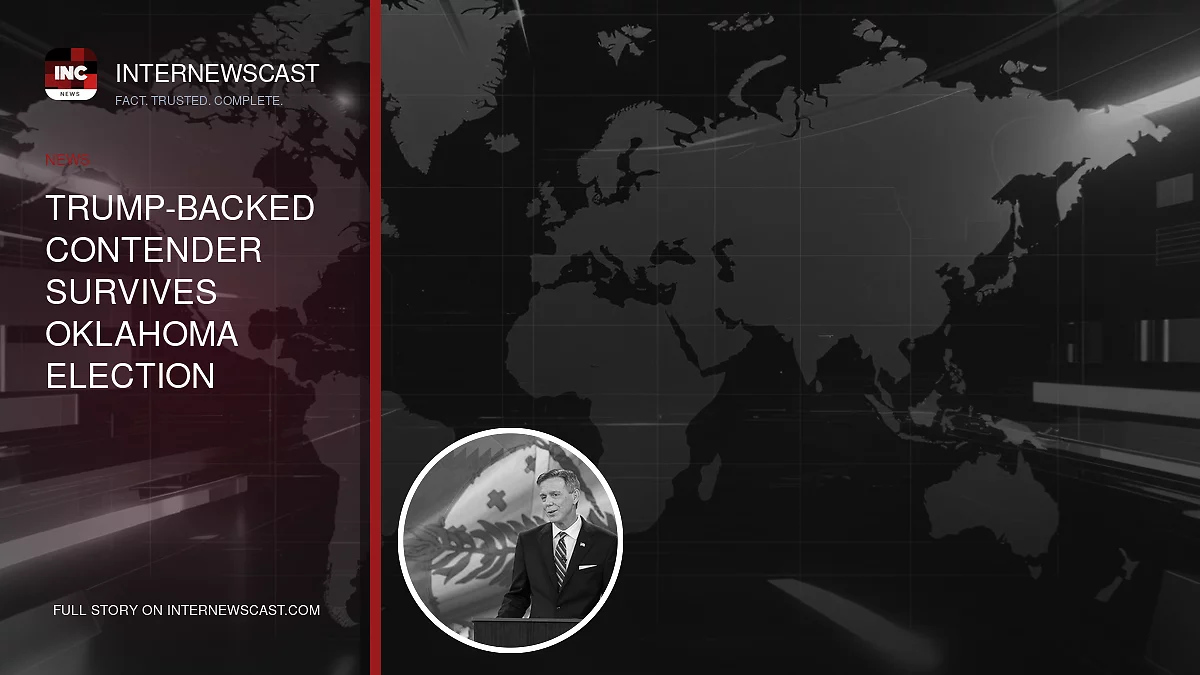

A Republican gubernatorial hopeful in Oklahoma, backed by Donald Trump, narrowly made it through a bruising runoff contest that became increasingly personal in its final stretch.
Mike Mazzei, a former state senator who also served as Oklahoma’s budget secretary, captured the GOP nomination Tuesday night, defeating state Attorney General Gentner Drummond in the runoff.
The Oklahoma governor’s race was defined by sharp-edged attacks, heavy campaign spending and an intense fight over the candidates’ medical histories and drug-testing disclosures.
Mazzei’s win came by an exceptionally slim margin, with the Trump-endorsed candidate finishing less than one percentage point ahead of Drummond.
The result marks another closely watched measure of Trump’s influence in Republican primaries, especially in gubernatorial contests, where his endorsement power has not always matched his track record in congressional races.
Trump threw his support behind Mazzei before the June primary and continued to inject himself into the race as the runoff approached, criticizing Drummond and pressing Oklahoma Republicans to rally behind his chosen candidate.
What initially looked like a standard GOP primary battle evolved into one of the most combative Republican campaigns of the election season.
Mazzei and Drummond sparred over their political records, their loyalty and ties to Trump, and, in the closing weeks, questions surrounding their personal health.
Following a debate discussion regarding candidate health and stamina, Drummond voluntarily released his health records and a negative drug test, then challenged Mazzei to do the same.

President Trump endorsed Mike Mazzei ahead of the June primary and repeatedly returned to the race in the weeks before the runoff, attacking Gentner Drummond and urging Oklahoma Republicans to back his preferred candidate

Mazzei ultimately outspent Drummond overall, with approximately $12.3 million spent across the primary and runoff compared with Drummond’s $9.1 million

Drummond argued that Mazzei’s drug test was not sufficient because it could not detect substances over a longer period. The dispute gained added significance following Mazzei’s serious 2008 car accident, though Mazzei has denied currently relying on pain medication
Drummond released financial and health records as he sought to demonstrate his fitness for office. He also released the results of a drug test, saying the test showed he was not taking any notable medications.
Mazzei responded with a clean drug test of his own.
But Drummond argued that Mazzei’s test did not go far enough because it did not use a testing method capable of detecting substances over a longer period.
The dispute carried added significance because Mazzei survived a serious car accident in 2008 and was prescribed pain medication afterward.
Mazzei has denied that he currently relies on pain medication and said he stopped taking it in early 2009.
The health controversy became an extraordinary feature of a governor’s race that had already been saturated with television advertising and personal attacks.
The race was also a spectacular money battle.
Mazzei largely financed his own campaign, loaning it an Oklahoma-record $11.6 million.
Drummond put $3 million of his own money into his campaign while attracting substantially more from donors.
Mazzei ultimately outspent Drummond overall, with approximately $12.3 million spent across the primary and runoff compared with Drummond’s $9.1 million.
Outside groups piled on as well.
Nearly $13 million was spent by outside organizations on the gubernatorial runoff since July 1.
The Club for Growth affiliate School Freedom Fund spent more than $3 million attacking Drummond, accusing the attorney general of refusing to defend Trump against impeachment.
An opposing super PAC, Put Oklahoma 1st, spent close to $3 million targeting Mazzei and accusing him of previously supporting tax increases.
The result was a campaign in which the candidates were barely able to breathe between waves of television advertisements, accusations and counterattacks.