Insiders reveal that Donald Trump reconsidered military action against Iran after advisers cautioned it might escalate into a prolonged conflict in the Middle East.
Earlier this week, Trump signaled potential strikes on Iran, declaring he was “locked and loaded,” and encouraged demonstrators to persist, promising that “help is on the way.”
The temporary closure of Iranian airspace on Wednesday fueled speculation that a U.S. attack was imminent. Meanwhile, White House Press Secretary Karoline Leavitt stated that “all options remain on the table” as Trump navigates the situation with Iran.
Despite the anticipation, sources indicate that Trump was dissuaded from launching an assault, leaving many puzzled over the sudden change in plans.
While Trump mentioned to reporters on Friday that he changed his mind after noting a halt in executions, The Wall Street Journal disclosed that he consulted a diverse group of advisors for their insights.
As Trump initially considered an attack on Tehran, reports suggest that officials expressed uncertainty about whether military strikes alone would effectively dismantle the Iranian regime.
US officials were also uncertain the strategy of going after Iran’s military sites would help the insurgents and worried they didn’t have the necessary arsenal to put together a sustained attack, sources said.
The apparent U-turn left protesters in Iran without the backup Trump had promised, as Suzanne Maloney, an Iran expert and vice president for foreign policy at the Brookings Institution, told the Wall Street Journal that Trump has ‘put American credibility on the line.’
‘There will be, and already has been, a sense of betrayal and backlash from Iranians that will last well beyond the life of this presidency,’ she said.

The possibility of another long, uncertain battle in a volatile part of the Middle East was what brought Donald Trump from ‘locked and loaded’ for strikes on Iran to putting them on the backburner

A brief closure of Iranian airspace Wednesday had many anticipating the US was set to strike a second country locked in unrest this month, as protests have raged in Tehran for weeks
Meanwhile, the Trump administration was also being consulted by officials from Israel, as well as other Arab nations in the Middle East, who saiwere too unstable in Tehran to be able to predict the outcome of strikes, and feared the regime had already put a lid on much of the protests.
They also feared that there was no obvious replacement for the current government if the US took out Supreme Leader Ali Khamenei’s regime, despite Iran’s exiled Crown Prince Reza Pahlavi saying he would be able to take power.
Part of the presentation included the possibility that the US’ regional allies, Qatar, the United Arab Emirates and Saudi Arabia, could face backlash on America’s military bases in those countries.
A group of Iranian leaders, including national security adviser Ali Larijani, reportedly was part of an effort to get counterparts in Iraq and Turkey to talk Trump out of the plan.
Israeli Prime Minister Benjamin Netanyahu also advised against an attack, telling Trump he believed it may have been too late to help the uprising in Tehran.
On Friday, Trump repeated that the pause on executions kept him from launching an attack but he maintained the right to do so going forward.
‘Nobody convinced me. I convinced myself. You had yesterday scheduled over 800 hangings. They didn’t hang anyone. They canceled the hangings. That had a big impact.’
The US sent military assets toward Iran on Thursday which leaves Trump with options should he decide to attack.
Trump, though, struck a conciliatory note, thanking Iran’s leaders for not executing hundreds of detained protesters, in a further sign he may be backing away from a military strike.
The president did not clarify who he spoke to in Iran to confirm the state of any planned executions.

An Iranian holds a placard depicting Reza Pahlavi, the son of Iran’s last shah and an Iranian opposition figure outside an Iranian embassy in Athens

US Defense Secretary Pete Hegseth speaks alongside Chairman of the Joint Chiefs of Staff General Dan ‘Raizin’ Caine
As Iran returned to uneasy calm after a wave of protests that drew a bloody crackdown, a senior hard-line cleric called Friday for the death penalty for detained demonstrators and directly threatened Trump — evidence of the rage gripping authorities in the Islamic Republic.
Executions, as well as the killing of peaceful protesters, are two of the red lines laid down by Trump for possible action against Iran.
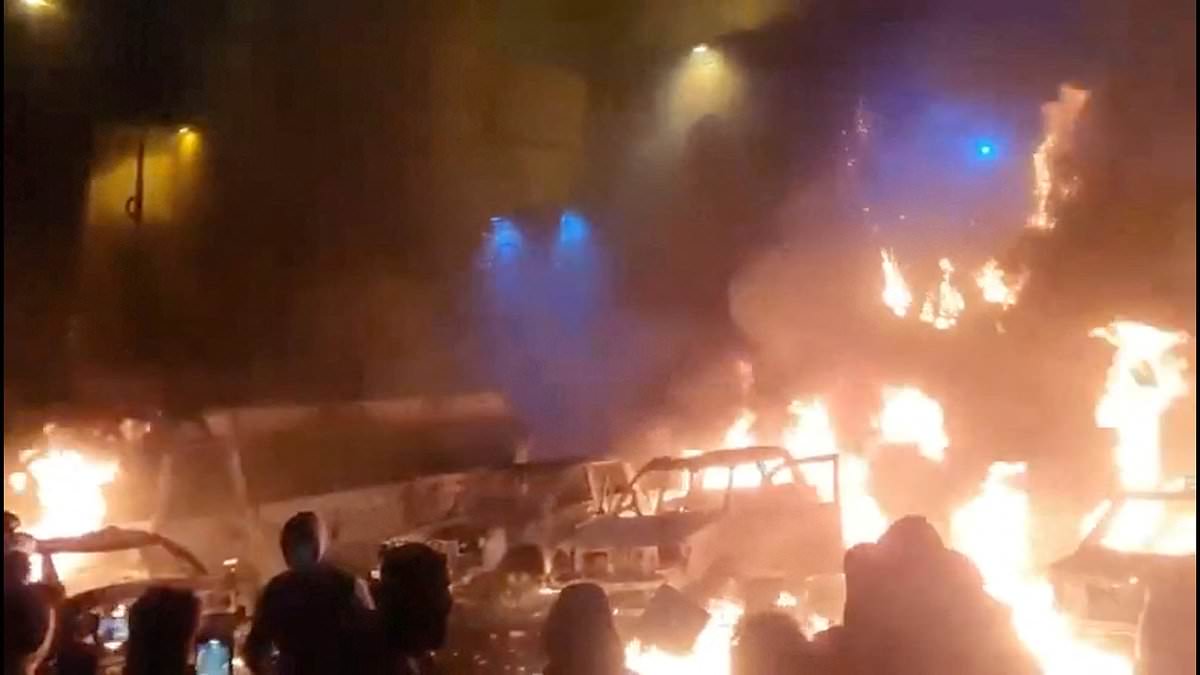
Harsh repression that has left several thousand people dead appears to have succeeded in stifling demonstrations that began December 28 over Iran’s ailing economy and morphed into protests directly challenging the country’s theocracy.
There have been no signs of protests for days in Tehran, where shopping and street life have returned to outward normality, though a week-old internet blackout continued. Authorities have not reported any unrest elsewhere in the country.
The U.S.-based Human Rights Activists News Agency on Friday put the death toll at 3,090.
The number, which exceeds that of any other round of protest or unrest in Iran in decades and recalls the chaos surrounding the 1979 revolution, continues to rise.
The agency has been accurate throughout the years of demonstrations, relying on a network of activists inside Iran that confirms all reported fatalities.
The unrest, sparked by dire economic conditions, has posed the biggest internal challenge to Iran’s rulers for at least three years and has come at a time of intensifying international pressure after Israeli and US strikes last year.

Protesters chant slogans during an anti-government protest in Tehran

Iran’s exiled crown prince Reza Pahlavi (pictured in Washington on Janury 16, 20260 has urged Donald Trump to carry out a ‘surgical strike’ on the Islamic Republic’s forces
Crown Prince Pahlavi urged the US to make good on its pledge to intervene. Pahlavi, whose father was overthrown by Iran’s 1979 Islamic Revolution, said he still believes the president’s promise of assistance.
‘I believe the president is a man of his word,’ Pahlavi told reporters in Washington. He added that ‘regardless of whether action is taken or not, we as Iranians have no choice to carry on the fight.’
‘I will return to Iran,’ he vowed. Hours later, he urged protesters to take to the streets again from Saturday to Monday.
Despite support by diehard monarchists in the diaspora, Pahlavi has struggled to gain wider appeal within Iran.
But that has not stopped him from presenting himself as the transitional leader of Iran if the government were to fall.
Trump, who has repeatedly threatened to intervene in support of protesters in Iran, this week expressed uncertainty over Pahlavi’s ability to muster support within the country.
Pahlavi met White House envoy Steve Witkoff last weekend, Axios reported, citing an unidentified senior US official.
Iran’s authorities have taken a dual approach, cracking down while also calling protests over economic problems legitimate.
So far, there are no signs of fracture in the security elite that could bring down the clerical system in power since the 1979 Islamic Revolution.
Britain, France, Germany and Italy all summoned Iranian ambassadors in protest over the crackdown.