
The United States military announced that it intercepted and brought down four Iranian drones heading towards the Strait of Hormuz on Friday. In a retaliatory move, they also targeted Iran’s coastal radar installations.
This incident escalates tensions and jeopardizes an already fragile ceasefire as the Trump administration increases its pressure on Iran.
“The attack drones posed an immediate threat to regional maritime traffic,” stated US Central Command on social media platforms.
The military’s actions are part of a blockade on Iranian ports, responding to Tehran’s control over the vital passageway for global oil and natural gas shipments. This situation has led to a spike in energy prices and presents political challenges for President Trump’s Republican Party as the midterm congressional elections approach.
US Central Command reported that the radar sites, including those on an island in the strait, were targeted “to defend against further attacks.”
This latest exchange of hostilities adds strain to the precarious ceasefire and complicates efforts to negotiate an extension of the truce.
Earlier this week, Iranian drones heavily damaged a passenger terminal at Kuwait’s main airport, killing one person, wounding dozens and briefly closing the airfield.
Despite the attacks raising new concerns that the ceasefire could collapse, Trump told reporters Friday that ‘the situation with Iran seems to be going quite well.’
‘We’re going to come out of Iran very quickly and it’s going to be very strong one way or the other, whether it’s a piece of paper or the very tough way,’ Trump said at an event in Wisconsin.
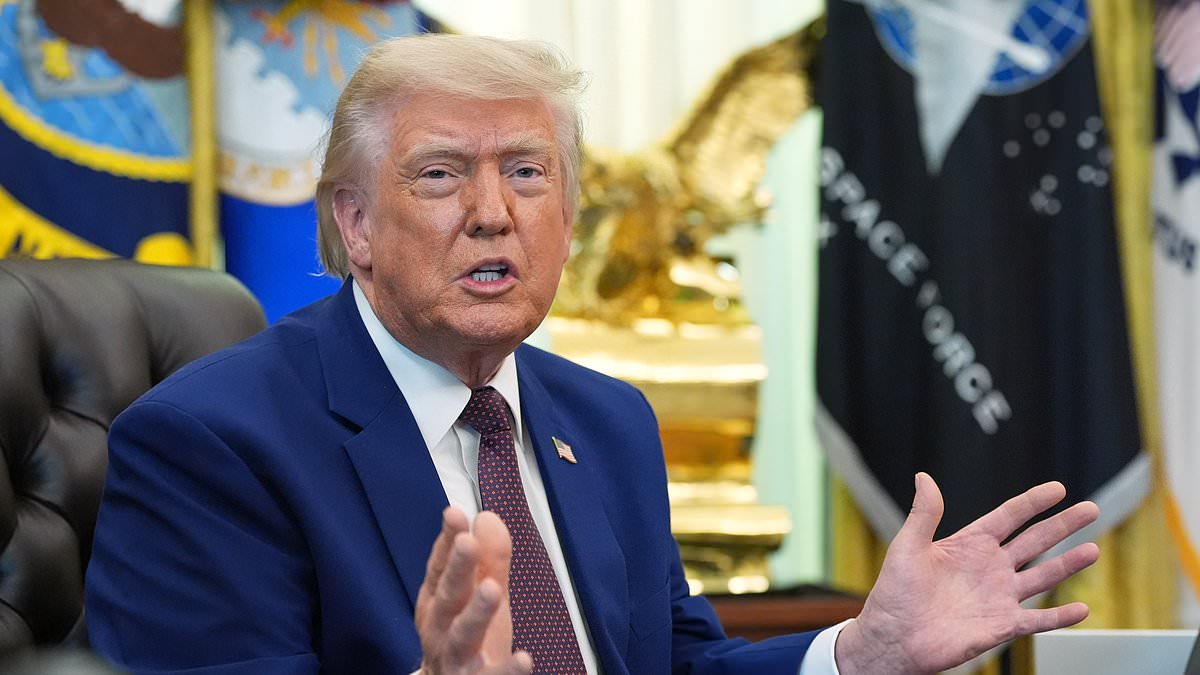
President Donald Trump arrives to speak to reporters aboard Air Force One on Friday
Smoke and fire rise from the site of US Israeli airstrikes in Tehran
‘The very tough way is maybe the easier way, but we’re going to come out, and your fertilizer prices are going to go way down, just like they were four months ago.’
Trump increasingly appears to be boxed in on a conflict that has settled into a holding pattern.
US and Iranian negotiators reached a tentative agreement a week ago to extend the ceasefire by 60 days and start a new round of talks on Iran’s nuclear program.
But Trump has called for unspecified changes and Iranian officials have shown no public signs of signing off on the deal.
Asked on Friday why it was taking so long, Trump told NBC’s Meet the Press it was because ‘it’s a very hard thing for them,’ citing their ‘great independence’ and the fact that ‘they’re strong, they’re proud.’
‘There are things they never thought they’d be doing that they’re going to have to do. They’ve got no choice, and it takes a little while,’ Trump said in the interview.
The commander-in-chief said the Iranians still have 21 percent to 22 percent of their missiles.
His administration also has touted the latest ceasefire agreed to this week by the Lebanese government and Israel after US-brokered talks in Washington.
However, the Iranian-backed Hezbollah militant group has rejected the agreement and new attacks have put it at further risk.
People gather on paddleboards in shallow water as cargo and service vessels are anchored in the Strait of Hormuz
Since mid-March, Trump has repeatedly claimed he is close to a deal to end the war

Donald Trump remains adamant that Iran cannot have a nuclear weapon
The Israeli military on Friday struck multiple parts of southern Lebanon and issued evacuation warnings for nine villages, including one that has sheltered thousands of people displaced by the fighting.
The strikes killed nine people in six locations in southern Lebanon, the state news agency reported.
The Israeli military said two soldiers were wounded, one severely, in an encounter Friday with militants in southern Lebanon.
The fighting in Lebanon, where Israeli forces have seized large swaths of the south, also threatens efforts to end the Iran war and reopen the Strait of Hormuz because Iran has demanded that any lasting truce extend to Lebanon.
Besides the drone interception in the Strait of Hormuz, the US military said earlier Friday that its forces boarded a sanctioned oil tanker linked to Iran in the Indian Ocean as the United States seeks to prevent Iran from profiting off its oil and other goods.
The US also targeted Iran’s energy sector with new sanctions on a group of people, firms and tankers.


