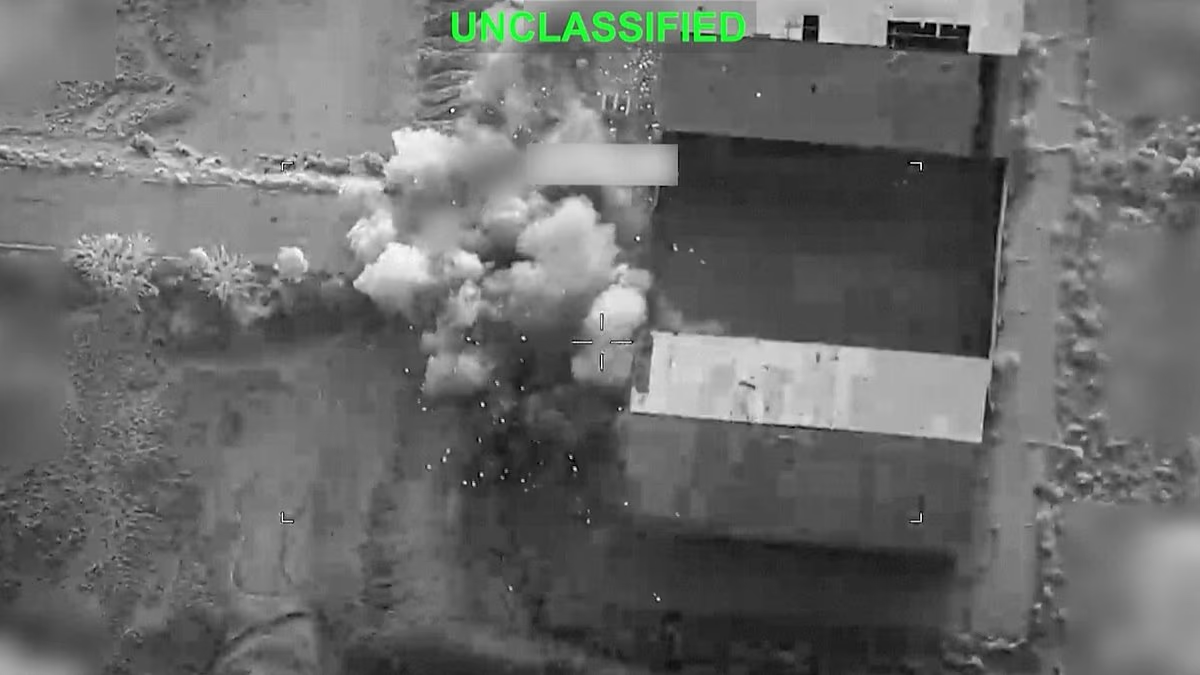

US forces have released footage showing an Iranian naval facility being hit by explosive-laden drone boats during a third wave of heavy strikes against the regime.
Three uncrewed vessels targeted a submarine and ship maintenance site near the Strait of Hormuz on Sunday, in what was described as Washington’s first use of sea drones in combat operations.
The assault was the latest escalation in a cycle of retaliatory attacks across the strategic waterway, as a memorandum of understanding signed by the opposing sides on June 17 has effectively collapsed.
Video published by US Central Command (Centcom) appears to show one of the slow-moving but lethal vessels advancing toward its target: the port at Bandar Abbas base, the main headquarters of Iran’s navy.
Moments after the uncrewed surface vessel (USV) reaches the port, a powerful blast erupts at the site.
The footage then switches to two additional USVs striking the naval base, in an operation Centcom called a “successful mission”.
“Last night’s strikes degraded Iran’s ability to continue attacking commercial shipping,” Centcom said Monday in a post on its official X account.
The Saronic Corsair, a 24ft autonomous vessel developed by Texas-based defence firm Saronic Technologies, was first deployed by the US in March.

This is the moment US forces blew up an Iranian naval base using kamikaze drone boats amid the third wave of punishing strikes on the regime

Three of the drones struck a submarine and ship maintenance facility near the Strait of Hormuz on Sunday, marking the first time Washington has deployed sea drones in combat operations

The attacks were the latest in a series of tit-for-tat strikes across the waterway as the memorandum of understanding signed by the warring sides on June 17 lies in tatters
Washington has been increasingly deploying the model, which can reach a speed of 35 knots (40mph), in operations in the Middle East as it tests new technology.
The USV can launch long-range strikes hitting targets as far as 1,000 nautical miles away.
The US announced a new round of strikes on Iran on Monday, hours after President Donald Trump said that Washington is ‘reinstating’ a blockade on Iran in the Strait of Hormuz.
‘We’re taking out all of their capability for anything having to do with the strait, the Hormuz Strait,’ Trump told CBS News Monday evening.
‘And I think in the end we will end up just controlling the whole thing.’
Trump said the US is prepared to hit Iran ‘very hard’ on Monday and Tuesday, saying the country’s heavily fortified nuclear facility at Pickaxe Mountain was a target.
‘Pickaxe is a possible target for a nice big fat shot right in the front door,’ Trump said in an interview with Salem News Channel’s Hugh Hewitt.
‘They have nothing going other than they have big mouths… I got to know them, and they’re stone cold crazy people.’

Central Command posts file footage of US Navy ships and aircraft operating in the Middle East
Trump further defended the now four-month-long war when speaking to the press in the Oval Office, saying they ‘knocked out’ Iran’s navy, air force, missile capabilities and drone manufacturing.
He said the new round of strikes were meant to keep Tehran from obtaining a nuclear weapon.
‘We’re going to hit them very hard tonight and we’re going to hit them hard tomorrow and there’s not a damn thing they can do about it,’ Trump said Monday.
He added that had they not struck Iran, not only would Tehran have a nuclear weapon but Israel and the remainder of the Middle East ‘would not be with us’.
The president said that Iran has dragged out negotiations ‘for 47 years’ but his administration isn’t falling for their act any longer.
‘The difference is nobody negotiated like I do. And this should have been done by Bush and Obama and Biden and people before them.’
Trump also said that allied nations should be paying for the United States’ protection of the Strait of Hormuz.
‘I want to be reimbursed because we’re protecting a very rich portion of the world,’ he said.
He also compared the conflict to the Vietnam war, claiming that the US military has done a lot of damage in a short time.
‘We were in Vietnam for 19 years. We’re here for four months, so I think we’ve done a lot,’ he said.
In response Monday night, Iran attacked Bahrain and two tankers associated with the United Arab Emirates traveling through the strait, killing one mariner and wounding eight others.
The Emirates threatened to retaliate against Iran, potentially drawing the nation home to Abu Dhabi and Dubai back into fighting with Tehran.
The attacks come as Iran and the US both vie for control of the strait through which a fifth of all crude oil and natural gas once passed in peacetime.
This is the third consecutive day with American strikes on Tehran and the fifth in the past week.
‘At 4:45 p.m. ET today, US Central Command began launching the third consecutive night of strikes against Iran, at the Commander in Chief’s direction,’ Centcom said in a statement.
‘These strikes will continue imposing a heavy cost on Iranian forces and degrade their ability to attack innocent civilians and commercial shipping in the Strait of Hormuz.’
Iran has insisted it controls the critical waterway, as another exchange of fire threatened a return to all-out war.
The US had until now said the strait should remain open to all without tolls, as it was before the US and Israel attacked Iran on February 28.
Any attempt by the US or Iran to charge fees would violate global norms on freedom of navigation and raise tensions, likely causing further economic disruption far beyond the region.
The new round of attacks followed Trump telling conservative radio host Hugh Hewitt: ‘We’re going to hit them very hard tonight and we’re going to hit them hard tomorrow – and there’s not a damn thing they can do about it.’
‘They have nothing,’ Trump added. ‘They have nothing going, other than they have big mouths.’
The price of benchmark Brent crude oil rose 7.8 per cent to $81.92 a barrel, still well below the nearly $120 reached at the height of the war but threatening to make costs everywhere higher.
The president also claimed the US would be paid a 20 percent tariff for securing safe passage for commercial vessels through the Persian Gulf. The details of Trump’s demand were not immediately clear.
Trump wrote on Truth Social that the US ‘will be, from this point forward, known as “The Guardian of the Hormuz Strait”‘.

US Central Command completed the latest wave of strikes against Iran at 10.15pm ET on July 13

This is the third consecutive day with American strikes on Tehran and the fifth in the past week
He added: ‘The process and formation will begin immediately. Thank you for your attention to this matter!’
The blockade will not take effect immediately: shipowners must be given 24 hours’ notice under maritime law.
Oil prices spiked by 5 percent, with Brent crude, the global benchmark, hitting $79.93 – its highest price since June 19.
Saudi Arabia launched strikes on Iran’s Houthi proxy terror group in Yemen, opening a new front in the war after Iran launched strikes against five US allies in the region.
Iranian-backed Houthi rebels say Saudi warplanes bombarded Sanaa International Airport in Yemen. The group’s spokesman declared an ‘end to the de-escalation phase’ and warned that the ‘aggression will not go unanswered or unpunished’.
The attack reportedly came as an Iranian aircraft attempted to land at the airport. Evacuation orders have been issued for the airport and surrounding areas.
A Saudi-led military alliance based in Yemen’s south for a decade has been fighting the Iranian-backed Houthi rebels based in the north.
Tehran says the fallout has already reached the negotiating table, with its foreign ministry claiming Trump’s memorandum of understanding with Iran has entered a ‘crisis phase’.

Iranian Foreign Ministry spokesman Esmaeil Baghaei speaks at a weekly press conference

Iran has insisted it controls the critical waterway, as another exchange of fire threatened a return to all-out war
Asked about the escalating strikes across the region, Trump told Fox News: ‘We’re taking over the strait.’
The Persian Gulf chokepoint has been a central flashpoint since the war began in February, sending markets spiraling with every escalation.
The truce collapsed last week when Iran struck three vessels in the Strait of Hormuz and the US retaliated with two rounds of strikes.
Trump pronounced the deal dead from the Nato summit in Ankara: ‘There’s something wrong with them. They’re cuckoo. As far as I’m concerned, it’s over.’
US strikes continued this weekend after Secretary of War Pete Hegseth vowed revenge for the Iranian strike and said: ‘Iran made a poor choice. Now they pay.’
Iran’s Islamic Revolutionary Guard Corps (IRGC) declared the strait closed until further notice after the attack, according to a statement cited by CNN.
Iran targeted various Middle Eastern countries that host US military bases, claiming responsibility for strikes in Bahrain, Jordan, Kuwait, Oman and Qatar.
Some of the targets attacked by US forces included missile and drone sites, naval capabilities, ammunition storage facilities, communication networks and coastal surveillance locations, US Central Command said.
A spokesman added that President Trump directed the attacks ‘to degrade Iran’s ability to attack civilian mariners and commercial vessels freely transiting the strait.’
Iran had said the strait was being shut down ‘given the precariousness that was caused by this unlawful interference by outside parties’.
The regime added that the waterway’s closure would be ‘until further notice and until regional interference by the US ceases’ and that ‘no vessel or naval craft will be allowed to pass’.
Iran said on Saturday it struck US facilities at Jordan’s Prince Hassan Air Base, claiming it destroyed a command center and drone hangars.
Washington denied the regime’s claim, with a US official stating no Americans were hurt and no serious damage was done.
Jordan said it shot down four missiles, and the three that landed caused only minor damage.


