
Electric vehicles (EVs) may not be the environmental savior they are often touted to be, at least in the UK, according to a recent study by scientists. The researchers from Queen Mary University have raised concerns about the actual carbon savings provided by EVs, suggesting the current approach might be flawed.
The study, which aims to serve as a reality check for Britain’s Net Zero goals, highlights a critical issue: the UK’s electricity grid has yet to fully transition to renewable energy. Consequently, EVs predominantly rely on electricity generated from fossil fuels at power stations, undercutting their environmental benefits.
In light of these findings, the researchers argue that hybrids or efficient diesel vehicles might be more environmentally friendly options under current conditions. This claim challenges the widespread belief that a shift to electric vehicles is the ultimate green solution.
The study, soon to be published in the journal Environmental Research, scrutinizes the UK’s 2030 Net Zero strategy by comparing it with actual data from 2023. The researchers discovered that government projections have significantly underestimated the variability and reliability of wind and solar power sources.
This insight calls for a reevaluation of the UK’s current energy policies and strategies, emphasizing the importance of considering real-world data in shaping a sustainable future. As the nation aims to meet its environmental goals, such studies are crucial to ensuring that efforts are both effective and aligned with the realities of the existing energy infrastructure.
They found that the variability of wind and solar power has been ‘grossly underestimated’ in the government’s plans.
On overcast or windless days, there are significant gaps in energy supply that have to be met by gas–fired power stations.
Since EVs increase demand for electricity during these periods, charging a new EV only results in more fossil fuels being burned to provide the extra electricity.

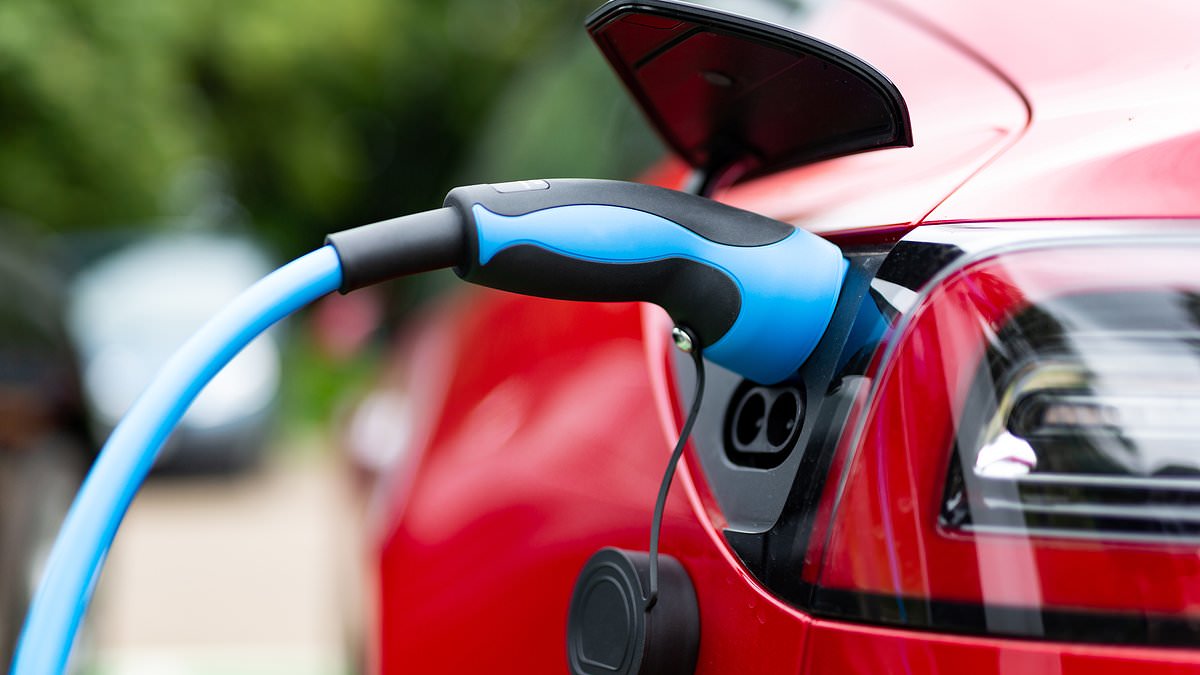
Electric vehicles (EVs) deliver ‘no proven carbon savings’ in the UK, scientists have warned (stock image)

Even though renewables like wind (light green) can provide 43.6 per cent of Britain’s electricity, new demand that exceeds capacity is met by burning gas. This means adding new EVs only means that more fossil fuels are burned
In 2024, the government announced that it was bringing forward plans to decarbonise British electricity generation from 2035 to 2030.
That would involve generating 43 to 50 GW of offshore wind power, 27 to 29 GW of onshore wind power, 45 to 47 GW of solar power, and significantly reducing demand for fossil fuels.
At the same time, the government has also been attempting to encourage the adoption of ‘clean’ electrified technology like EVs and heat pumps.
However, the researchers argue that this represents a fundamental error in planning.
Co–author Professor Alan Drew explained: ‘The UK urgently needs to rethink its priorities.
‘EVs and heat pumps will be valuable later – but for now, we must stop pretending they are reducing emissions when the data shows they aren’t.’
Most research into EV carbon savings calculates their energy consumption based on the total power mix in the UK grid.
In 2025, renewable energy made up 44 per cent of the UK grid’s power supply on average.
At the point of driving, recent research estimates that producing the energy to charge an EV creates 75 per cent less CO2 than the equivalent petrol or diesel fuel.
It might, therefore, look like buying an EV would result in less fossil fuel being burned.
However, the researchers argue that this is not the case.
Co–author Professor David Dunstan, also a physicist from Queen Mary University, told the Daily Mail: ‘The mix of current generation is not what is relevant. Adding electricity demand – by adding EVs – does not increase the amount of low–carbon and renewable generation. It can only be met by increasing the fossil gas burn.’
In other words, buying a new EV simply adds one extra car–worth of demand to the UK’s energy grid.
If there were plenty of surplus renewable energy to meet that demand, then you would make some emissions savings by going electric.
However, in the UK, that extra demand on the grid is only met by burning more fossil fuels.
An EV only shifts the point of CO2 production back to the point where fossil fuels are burned at the power plant, without making any real savings.

The researchers argue that there is no point adding more EVs until the UK improves its renewable energy production and adds the capacity to store and use surplus green energy. Pictured: Kentish Flats Offshore Wind Farm near Whitstable
With the UK grid capacity as it currently stands, eco–friendly drivers would be better off with an efficient hybrid or a very efficient diesel car that will actually reduce the amount of fossil fuels being burned, according to the researchers.
Professor Dunstan and Professor Drew argue that there is no point in increasing electricity demand before we have finished decarbonising the UK’s energy supply.
However, scientists who study the decarbonisation of the energy grid strongly dispute their findings.
Dr Iaian Staffell, Associate Professor of Sustainable Energy at Imperial College London, told the Daily Mail: ‘Their headline claim about electric vehicles is straight-up misleading, and it baffles me how this got through academic peer review.’
Most importantly, the researchers ignore the fact that an electric vehicle charged only from gas power plants will still save carbon compared to an internal combustion engine.
‘Even though fossil fuels are still going in, gas emits 20 per cent less carbon than oil when burnt, and the combination of a power station plus the battery and motor is 1.5 to 2.3 times more efficient than a car’s engine,’ explains Dr Staffell.
Likewise, their paper ‘ignores what is actually being done to balance out wind and solar power’, including smart-chargers and new interconnectors.
Dr Staffell says: ‘In the end, no matter how you look at the question of what mix of electricity charges our electric cars, there is no way for an electric vehicle in Britain to be higher carbon than a similar petrol or diesel car.’