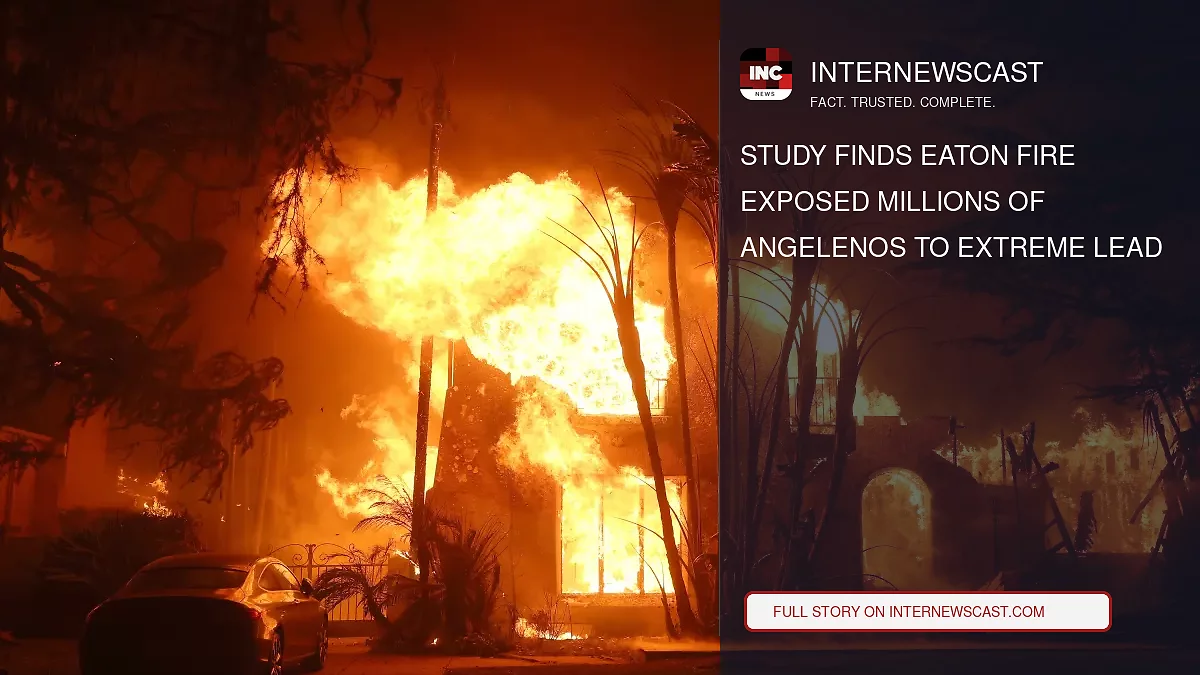

Millions of Los Angeles residents may have been exposed to a highly toxic blend of lead and other hazardous metals during the catastrophic 2025 Eaton Fire, according to a new study. Researchers found that airborne lead levels reached as much as 80 times the normal concentration.
Caltech scientists released the findings Wednesday after comparing the fire’s smoke with emissions from a typical wildfire. Their analysis showed that the urban blaze produced a considerably more dangerous chemical profile.
“Compared to wildfire smoke, the urban plume was enriched more than 50-fold in lead, 7-fold in halogens, and 3-fold in arsenic,” the researchers wrote. The pollutants are associated with burning vehicles, electronics and construction materials — fuels that differ fundamentally from wildland vegetation.
The results underscore the unique risks posed by fires that spread through heavily populated communities. As homes, cars and electronic devices burn, they can release hazardous contaminants into the air inhaled by millions of people.
“Unlike wildfire smoke that has been the focus of decades of air quality research, this plume represents an emerging class of urban fire air pollution that demands revised exposure frameworks and emergency response protocols as fires increasingly burn into cities,” the paper stated.
Lead author Haroula Baliaka, a Caltech PhD student, launched the investigation while examining why Los Angeles continues to experience elevated levels of air pollution.
Baliaka and co-author Ryan Ward relied on a monitoring system that tracked pollution continuously throughout the year. The Atmospheric Science and Chemistry mEasurement NeTwork, known as ASCENT, collected real-time data on the chemical composition of airborne particles.
Download The California Post app, follow us on social media and subscribe to our newsletters
“ASCENT has the unique capability to measure the chemical components and the size of these different particles in real time,” Caltech professor Nga Lee “Sally” Ng said.
The Eaton Fire began on Jan. 7, 2025, the same day the Palisades Fire ignited. Together, the two infernos killed at least 31 people and destroyed more than 16,000 structures.
Residents were ordered to evacuate, while much of Pacific Palisades’ business district was destroyed. Millions of people encountered smoke, and many lost their homes.
The newly identified pollution is raising fresh concerns about health effects that can persist long after the flames are extinguished.
High levels of lead exposure can impair children’s development and may be fatal. The metal can also damage the kidneys and nervous system in people of any age.


