
In a dramatic turn of events, six cruise ships stranded in the Gulf have successfully navigated the perilous Strait of Hormuz, thanks to the assistance of the US Navy. This daring escape marks a significant moment of relief for the cruise lines involved.
The fleet comprised two vessels from TUI Group, docked in Abu Dhabi and Doha, the MSC Cruises’ Euribia that set sail from Dubai, two ships operated by the Greek company Celestyal Cruises, and an Aroya Cruises ship originating from Dammam, Saudi Arabia. While passengers and non-essential staff had already been evacuated weeks earlier, a dedicated crew remained onboard to manage the ships.
Seizing the opportunity presented by a temporary ceasefire between Iran and the US, the captains embarked on the bold decision to traverse the Iranian-controlled waters of the Strait of Hormuz. This risky maneuver was executed over the weekend.
The operation commenced on Friday night as the ships cautiously departed their ports, strategically staying near the Oman-owned Musandam Peninsula to maximize safety. The Celestyal Discovery was the first to clear the strait shortly after midnight, setting a hopeful precedent for the others.
The final vessel, TUI’s Mein Schiff 4, completed the treacherous journey late on Sunday night, marking the end of a tense and challenging ordeal. This coordinated effort underscores the resilience and determination of the crews involved in overcoming the geopolitical challenges faced at sea.
Celestyal Discovery cleared the strait shortly after midnight. TUI’s Mein Schiff 4 vessel was the last to make it through the waterway, reaching safety late on Sunday night.
All six cruises have since continued to sail through the Arabian Sea.
Sailing through the Strait is not a simple task at the best of times, with its rocky terrain making it impossible for large ships to pass without entering Iranian territory and being detected by the IRGC.
Ever since the war between Iran, Israel and the US began on February 28, Tehran officials shut the waterway, making the threat of attack on vessels trying to get through a huge concern. Iran said it had fully reopened the Strait of Hormuz last week following the ceasefire, but has since shut it again after the US refused to lift its naval blockade.

A Celestyal ship was among those cruises that made the perilous journey across the Strait of Hormuz (file photo)

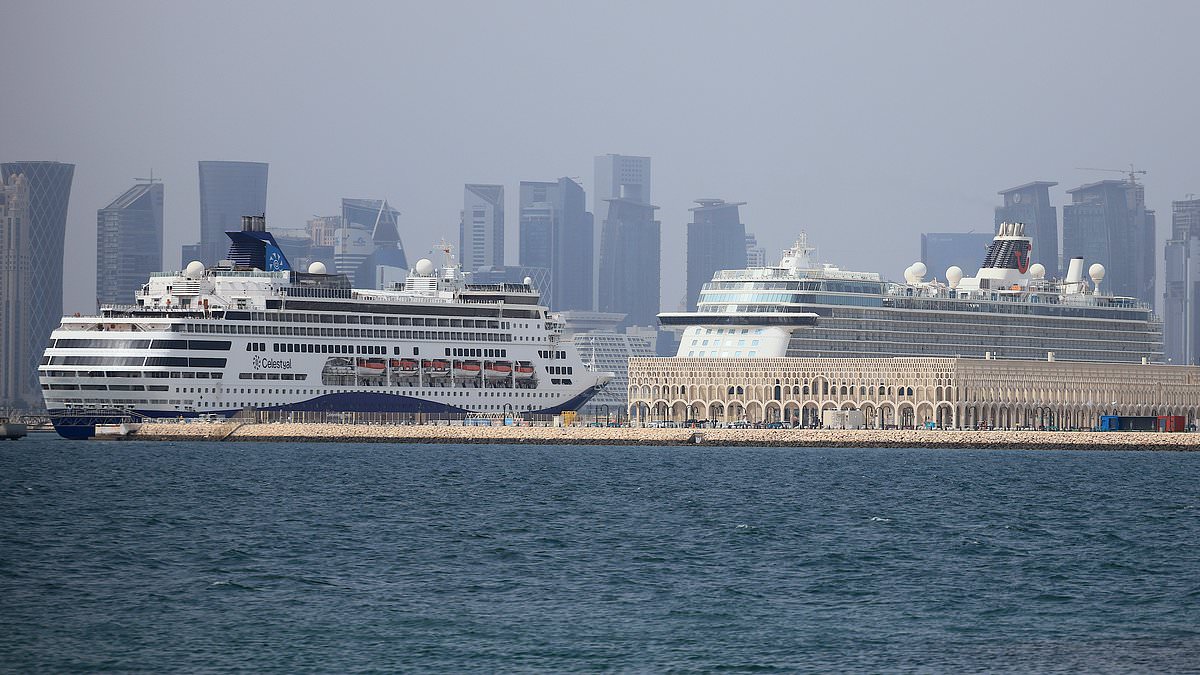
The dangerous escape comes after cruise liners became stranded in ports in the Gulf due to the war in the Middle East. Pictured: Two cruise ships from TUI and Celestyal are docked at the terminal close to the old port, in Doha, Qatar, 02 March 2026

File photo: A handout photo made available by the Royal Thai Navy shows the Thai-flagged cargo ship Mayuree Naree on fire after being hit by Iranian missiles in the Strait of Hormuz, Iran, 11 March 2026 (issued 12 March 2026
The IRGC itself has been known to use drones to strike ships, making the operation to get the six cruise ships across the strait a dangerous one.
But according to sources with insider knowledge on the journey, the cruise ships were able to cross safely by sailing extremely close to the Omani coast, The Telegraph reports – an option that isn’t available to larger oil tankers.
By staying out of Iranian waters, the cruises were able to reduce the threat from Iran.
However, the risk is not removed entirely, given the IRGC’s unpredictability, naval expert Christian Le Miere told The Telegraph.
Earlier this week, Iran attacked three ships near the waterway, with the Islamic Republic saying it fired on three outbound ships and seized two.
The IRGC is also equipped with drones that can be launched from hundreds of miles away, meaning that the threat persists even after a ship has left Iranian waters.
There was also coordination with the US Navy, which even agreed to provide cover for the cruises if needed.
The ships also kept their communication channels open and sailed during daylight, so their identity would be clear.
Cruise-liner Celestyal gave its crew the option to disembark in Dubai, but all of the staff onboard agreed to complete the journey.
In solidarity, the company’s chief operating officer boarded the ship for the daring voyage.
Celestyal’s chief commercial officer Lee Haslett said: ‘It’s been a complex and fast-moving situation, and I couldn’t be prouder of our crew.
‘From our captains to our onboard and support teams, everyone played their part in a safe and well-managed outcome.’

The closing of the strait has plunged the world into an energy crisis as tankers carrying a fifth of the world’s oil have been blocked from using the channel. Pictured: The sun rises behind tankers anchored in the Strait of Hormuz off the coast of Qeshm Island, Iran, Saturday, April 18, 2026

It comes as the Iranian regime shared footage claiming to show naval forces seizing a cargo ship in the Strait of Hormuz
The successful crossing of the ships comes after Iran opened fire on ships trying to cross the Strait of Hormuz, with a cruise liner caught in the line of fire after the key waterway was shut again, according to maritime sources, as tankers turned around and ran for cover.
The UK Maritime Trade Operations (UKMTO) said a cruise ship three nautical miles east of Oman reported seeing a ‘splash in close proximity’, raising fears a passenger vessel may have been caught up in the attack.
The closing of the strait has plunged the world into an energy crisis as tankers carrying a fifth of the world’s oil have been blocked from using the channel.
President Donald Trump has extended the two-week ceasefire with Iran, while Tehran officials said that attacks on ships this week were in retaliation for the American naval blockade of Iranian ports and for the US firing on and seizing an Iranian ship that did not stop when hailed by a vessel enforcing the blockade.
It also comes as the Iranian regime shared footage claiming to show masked naval forces seizing a cargo ship in the Strait of Hormuz.
Attacks on shipping dwindled starting in mid-March as Iran imposed effective control over the strait.
The mere risk of attack has been enough to deter ships from trying to get through.
Iran has demanded details on cargo, ownership and crew and, on at least some occasions, imposed a $1 per barrel tax on oil and oil products, or $2 million for a large tanker.


