
Share this @internewscast.com
In a series of unsettling incidents, the US Air Force’s primary hub for nuclear bombers faced repeated intrusions by elusive drone swarms. These unauthorized aerial vehicles managed to penetrate Barksdale Air Force Base in Louisiana, despite the military’s efforts to neutralize them using jamming technology.
Barksdale officials confirmed to the Daily Mail that from March 9 to March 15, multiple drones were detected breaching the base’s restricted airspace. The initial sighting of a single drone, referred to as an ‘unmanned aerial system,’ prompted a shelter-in-place directive along with heightened security measures, following FBI warnings of potential drone threats on American soil.
An internal military briefing has since disclosed that subsequent incursions involved clusters of 12 to 15 drones, which boldly entered the base’s no-fly zone, presenting a more formidable challenge to the base’s defenses.
The intruding drones were characterized as long-range models employing sophisticated signals, unlike those found in standard consumer drones. Notably, these drones demonstrated an ability to withstand or evade signal jamming attempts, complicating efforts to regain control over the airspace.
As the residence of the Air Force’s formidable B-52 bomber fleet, Barksdale Air Force Base plays a critical role in the country’s nuclear capabilities, making these breaches particularly concerning for national security.
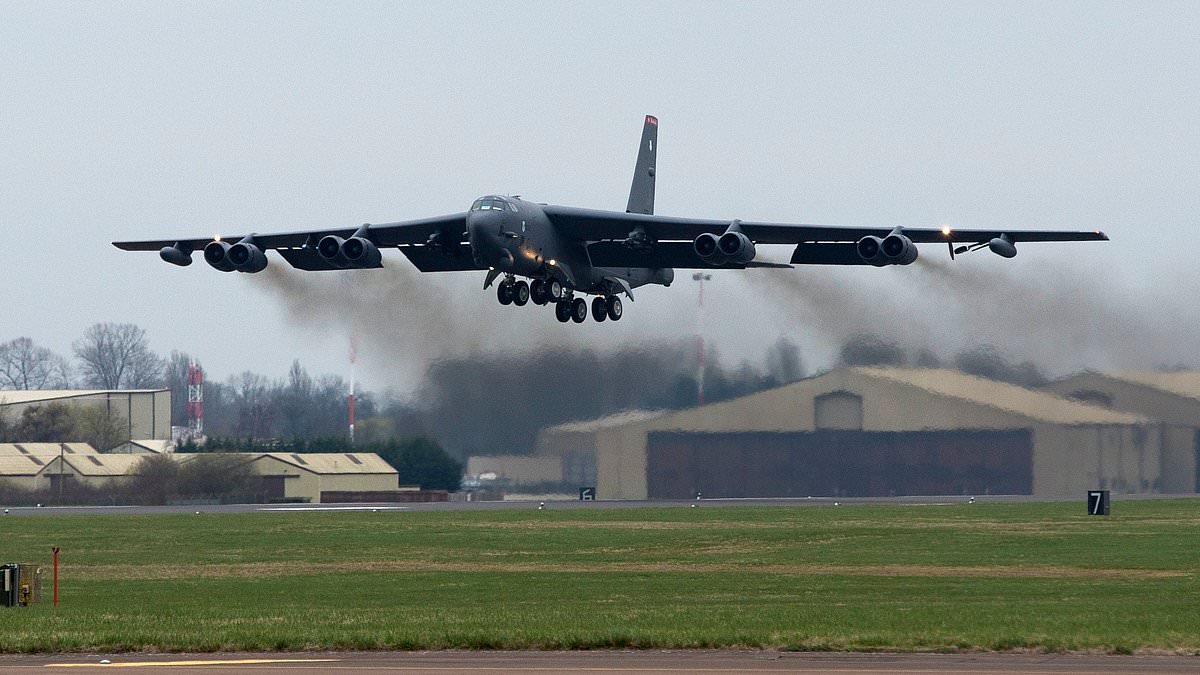
Barksdale Air Force Base is home to the military’s fleet of B-52 bombers, capable of delivering nuclear strikes around the world.
A Barksdale AFB spokesperson said: ‘Flying a drone over a military installation is not only [a] safety issue, it is a criminal offense under federal law.’
‘We are working closely with federal and local law enforcement agencies to investigate these incursions. The security of our installation and the safety of our people are top priorities, and we will continue to vigilantly monitor our airspace.’

Personnel at Barksdale Air Force Base in Louisiana were ordered to shelter in place on March 9 due to a potential hostile drone in the area

Barksdale AFB is home to three squadrons of B-52s (Pictured), a long-range bomber which can carry out global nuclear strikes
Although the Air Force did not elaborate on the number of drone incursions over Barksdale, the confidential report from March 15 revealed that the unidentified drones came in waves and flew over several key facilities at the base.
According to ABC News, who reviewed the document, military officials wrote: ‘BAFB Security Forces observed multiple waves of 12-15 drones operating over sensitive areas of the installation, including the flight line.’
The leaked report added that the drones appeared to be ‘custom built’ and those operating them remotely had a knowledge of advanced radio signals, which prevented the base from disabling the intruders using anti-drone technology.
‘After reaching multiple points across the installation, the drones dispersed across sensitive locations on the base,’ the document stated.
These swarms were spotted on multiple days last week, but the confidential report noted that no drones were spotted on March 13 or March 14.
Officials reportedly revealed that the drone invasions forced Barksdale to close their runway to incoming and outgoing planes, potentially putting aircraft preparing to land at the air base in danger.
US military bases use radio-frequency (RF) and electronic warfare (EW) jamming to bring unauthorized drones down when they stray into restricted airspace or threaten public safety.
This equipment broadcasts interfering signals to break the link between a drone and its operator or scrambles the aircraft’s GPS navigation.

Barksdale AFB officials said the multiple drone incidents during the week of March 9 are still under investigation by the military and the FAA

A leaked military document claims attempts to jam the unauthorized swarms failed, meaning they likely were not commercial drones
The idea is to make the drone lose control, land, crash or fly away harmlessly.
It is unclear what type of signals the drone swarms over Barksdale were using that made them impervious to jamming devices.
A spokesperson from Barksdale did not confirm the details of the internal military briefing document on Friday.
It is also unknown what installations at the strategically vital base were being spied on by the drone swarms.
The B-52H Stratofortress is one of the country’s most terrifying aircraft, especially as tensions in the Middle East spark rhetoric of nuclear escalation.
It is a long-range, heavy bomber capable of flying at high subsonic speeds at altitudes of up to 50,000 feet.
The B-52 also has a range of approximately 8,800 miles without refueling, meaning it can take off from Barksdale and reach Europe, the Middle East or Asia without needing to land.
The bomber has become famous for its ability to carry up to 70,000 pounds of ordnance for both conventional and nuclear strikes and its round-the-clock patrols during times of extreme crisis, like during the Cold War.

The B-52s (Pictured) can fly from Barksdale Air Force Base to targets in Europe, the Middle East or Asia without needing to refuel or land
In July 2025, airmen from Barksdale’s legal office worked with Louisiana state lawmakers to update the state’s drone law, expanding restrictions on unauthorized flights to include Barksdale, US Navy ships, ports and other facilities across the state.
US Air Force Staff Sergeant Ramiro Valero said in a 2025 statement: ‘People who try to fly near a military base might have malicious intent. With the harsher punishments, they might think twice before trying it.’
The updated penalties covering the airspace over Barksdale now call for a fine of up to $250,000 and at least one year in prison for the drone flyer, according to the Air Force.
However, Louisiana state law R.S. 14:337(E)(5) states that a person convicted of flying an unauthorized drone over federal or military installations could also face ‘five years of hard labor imprisonment and court-ordered forfeiture of the drone.’