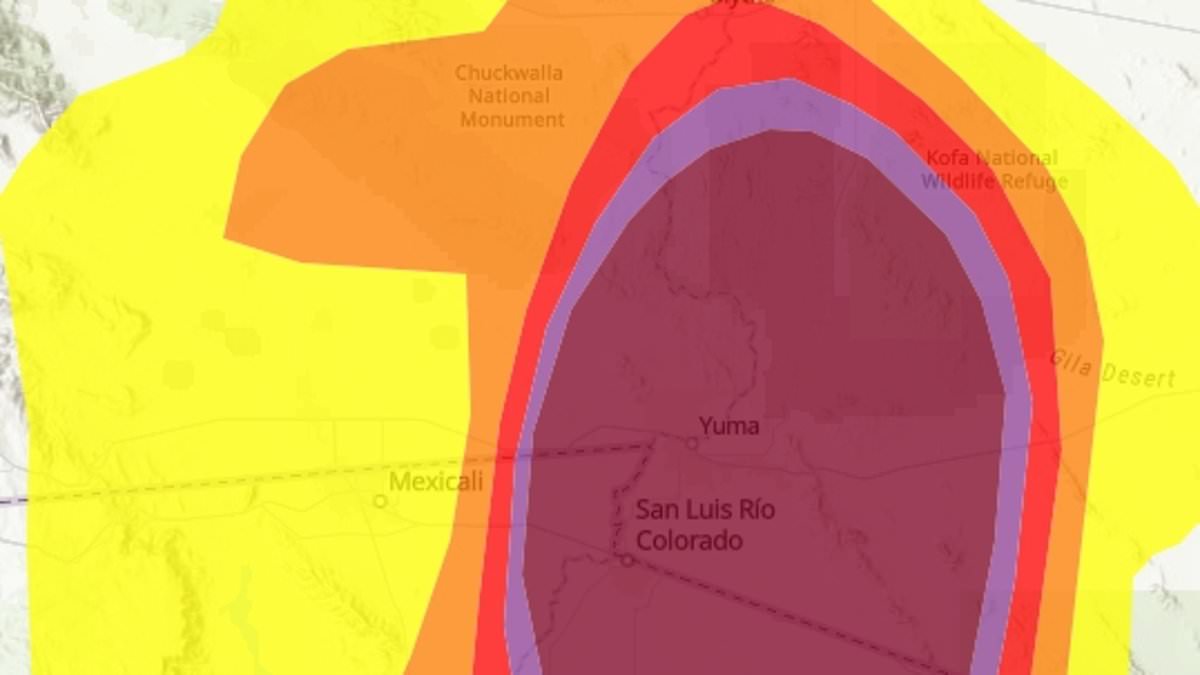

Residents across the Southwest United States are being urged to stay indoors and keep their windows closed as hazardous levels of airborne particles have surged, posing significant health risks. This advisory, impacting nearly a million people, was issued early Monday by the US Environmental Protection Agency (EPA).
A vast cloud of ‘hazardous’ air has descended upon a 100-mile-wide region straddling parts of California and Arizona, the EPA reports. This pollution is primarily composed of fine particulate matter, tiny particles that can include toxic compounds or heavy metals typically emitted from industrial activities and vehicle exhaust. In this region, the desert’s dust also plays a significant role in exacerbating air quality issues.
These microscopic particles are a health concern because they can infiltrate deep into the lungs, potentially causing inflammation and breathing difficulties. Prolonged exposure to such pollution can aggravate respiratory conditions like asthma and increase the risk of cardiovascular events, such as heart attacks and strokes, which can lead to premature death.
The area most affected includes Yuma, Arizona, which has a population of over 220,000, and California’s Imperial County, home to around 180,000 residents. These communities lie within the largest zone of hazardous air quality along the southern border of the United States.
Additionally, the National Weather Service has expanded the air quality alert to encompass California’s Coachella Valley. This region, home to more than 400,000 people, includes cities like Indio, Palm Springs, Cathedral City, Palm Desert, La Quinta, and Coachella, all of which are advised to take precautions against the compromised air quality.
However, the National Weather Service has also issued an air quality alert in California’s Coachella Valley, where more than 400,000 people live in Indio, Palm Springs, Cathedral City, Palm Desert, La Quinta and Coachella.
The hazardous air has been caused by windblown dust throughout the region over the last few days, with some of these gusts reaching 45 to 50mph.
NWS warned in a statement: ‘Everyone can be affected, but sensitive groups such as people with lung or heart disease, older adults, people who are pregnant, children, and those who spend a lot of time outdoors are at greater risk.’
Over 220,000 people live in the areas of California and Arizona the EPA has deemed ‘hazardous’ on May 4, 2026
Dust and polluted air flowing through Yuma County in Arizona (Stock Image)
Melissa Zaremba from NBC News 11 added on Sunday that strong westerly winds would be carrying this unhealthy dust into the region through Monday morning, noting that the heavy dust would affect both health and local travel.
‘Wind Advisories and Air Quality are issued for parts of Imperial County. Yuma County’s highest gusts are looking around 30 MPH,’ Zaremba said on social media.
Dust storms at the US-Mexico border are a common problem, and the EPA warned that air quality levels in the region had deteriorated to ‘hazardous’ levels, the worst rating for air quality measurements the agency gives.
Along with high levels of smaller pieces of particulate matter, known as PM2.5, the dust blowing through California and Arizona has also sent levels of larger particles called PM10 skyrocketing as well.
PM10 is a type of particulate matter made up of tiny solid particles or liquid droplets floating in the air that are less than 10 micrometers in diameter, thinner than a human hair, but still noticeably larger than PM2.5.
While Yuma sits at the center of the air quality alert, the nearby city of Brawley, California, just 70 miles to the west, has reportedly seen air pollution levels jump up into extremely dangerous territory on Monday.
According to the air quality-tracking website IQAir, at least one monitor recorded an air quality index of 1,365, fueled mostly by PM10 filling the air over the city of 28,000 people.
Typically, air quality levels are only measured on a scale from 0 to 500: good (0–50) carries little risk, moderate (51–100) may affect sensitive individuals, unhealthy for sensitive groups (101–150) poses increased risk and unhealthy (151–200) impacts everyone, limiting outdoor activity.
A large zone in the Southwest has been affected by high winds carrying thick clouds of dust

In Brawley, California, air quality monitors recorded airborne pollution levels going off the charts on May 4, 2026
When outdoor air quality reaches the 300 to 500 hazardous zone or surpasses that mark, the EPA warns that everyone should avoid all physical activity outside.
Along with their alert for the Coachella Valley, NWS recommended that anyone in the affected areas keep their windows and doors closed, run an air conditioner or air purifier and avoid using house fans or swamp coolers that pull in outside air.
‘Avoid other sources of pollution such as fireplaces, candles, incense, grilling, and gasoline-powered lawn and garden equipment,’ NWS added in a statement.
The alert in California is expected to last until 11.59pm local time Monday night.
Officials also advised Americans to carpool or telecommute to work if possible, reduce the number of trips they take outdoors, or use public transportation.