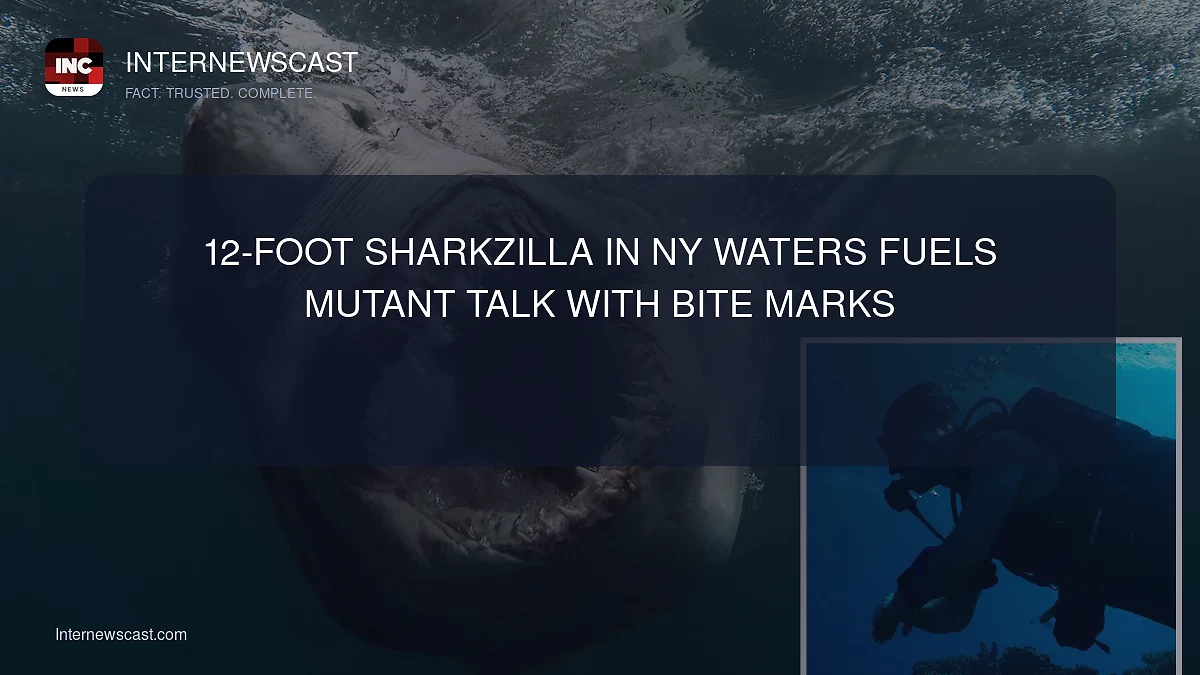

A huge shark is stirring up fears along New York’s coastline — and the story has taken a startling nuclear turn.
The nearly 12-foot predator has reportedly been attacking large marine animals off Long Island, prompting experts to investigate what is lurking in the area and fueling an extraordinary theory that the shark may have been affected by a leak from old nuclear waste.
The giant mako, nicknamed “Sharkzilla” by experts, is said to have bitten a humpback whale near Montauk, leaving behind a massive 2-foot wound.
According to a new Discovery Channel “Shark Week” episode airing Friday night, the shark also attacked a gray seal, tearing a 22-inch gash into the animal, and targeted 400-pound tuna in the same waters.
Marine scientist Craig O’Connell said on the program, “Sharkzilla Takes New York,” that the injuries suggest enormous sharks are moving back into the region, the Daily Mail reported after previewing the episode.
O’Connell also raised a more unsettling possibility: that leaking barrels of decades-old nuclear waste may have triggered genetic changes in the shark — and potentially other wildlife — in a vast underwater canyon, according to the outlet.
“In the late 1960s, they dumped 15,000 barrels of nuclear waste in the Hudson Canyon,” O’Connell said. “Ten years later, they went out to check on these barrels, and they were all leaking.”
“Radioactive leaks could be impacting wildlife, even top predators,” he said.
“If animals are subjected to nuclear waste, this could cause genetic mutations and abnormal growth. If this predator is genetically altered, it could be faster, stronger and deadlier than any predator on Earth. We are calling it Sharkzilla,” he said.
On the show, O’Connell frantically hunted the shark in order to tag and collect its tissue for radioactive testing.
O’Connell also said there are signs that the New York coastline is a hotbed for massive mako sharks, which can grow more than 14 feet long.
“In the past, this is the place you came to catch monster sharks. There are so many records right here off the shores of Montauk,” he said.
“All these monster sharks were completely fished out. They’re gone,” he said. “But all the evidence we are seeing is telling me that all these big sharks might be back. I know those big sharks are out there, and we are going to find them.”
Test results ultimately found no evidence that the “Sharkzilla” was radioactive, and scientists said she was likely a pregnant mako shark with exceptionally fast and deadly hunting skills.
The underwater investigation also revealed the area is now as a breeding ground for makos, and that formidable female sharks were likely hunting to feed their developing pups.


