
Altadena residents, still grappling with the aftermath of the destructive Eaton Fire, saw two significant signs of progress this week: a legislative win in Sacramento and a visible step toward rebuilding in their own community.
On Wednesday, California lawmakers unanimously moved forward with Senate Bill 1090, a proposal supporters say is designed to protect fire survivors from aggressive development pressure as the community works to recover.
The day before, that recovery effort took shape in Altadena when a crane placed a modular accessory dwelling unit on the former site of the Bunny Museum, a beloved local landmark destroyed in the blaze. The demonstration home, built by Team AB Builds, is meant to highlight how modular housing could help accelerate reconstruction in fire-damaged neighborhoods.
Together, the legislation and the new structure mark a meaningful moment for a town still rebuilding after one of the most devastating wildfires in Los Angeles County history.
“This is important community-driven legislation,” state Sen. Sasha Renee Perez, D-Pasadena, who authored the bill, said in Sacramento.
The measure would temporarily exempt Altadena from state zoning rules that permit multi-unit construction on parcels that previously held single-family homes. Supporters say the pause would give displaced residents more time to return and rebuild before outside investors move in.
“It will protect Eaton Fire survivors and allow them the time they need to rebuild their community without the overpowering influence of predatory developers looking to take advantage of the devastation and suffering caused by the Eaton fire,” Perez said.
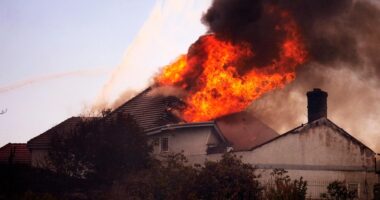
The bill was introduced in response to the Jan. 7, 2025, Eaton Fire, which burned 14,921 acres, destroyed 9,418 structures in Altadena and Pasadena, and leveled about 6,000 single-family homes in Altadena alone.
Perez said survivors are increasingly vulnerable to lowball offers from speculators eager to buy up damaged properties.
“These survivors are asking for time to rebuild our community,” She said. “I want to be crystal clear. These laws were not intended to rebuild a community that has been devastated by fire or a natural disaster.”
MORE STORY: Unmasking the Church: Hugh Jackman's Faith and Emily Watson's Chilling Accusations
Los Angeles County Fifth District Supervisor Kathryn Barger said the legislation would help ensure the community’s future remains in the hands of those who lived there before the disaster.
“As a sponsor of this legislation, I strongly support SB1090 because it provides an important safeguard against opportunistic lot splits while recovery is underway,” Barger told The California Post. “Altadena’s future should be shaped by the people who have long called it home and not by outside interests looking to capitalize on a tragedy.”
For many survivors, the fight is about more than zoning laws.
“I and most displaced Altadenans lost almost every single thing we owned. Some lost loved ones,” resident Laura Berthold Monteros told The Post. “Some, like myself, have seen our families shattered by PTSD and disputes.”
She said residents are determined to return despite the hardships.
“Yet, we want to come back,” she said. “We cannot stand the additional gut punch and shattering emotions of losing our community to robber barons.”
Resident Ania Haigwood said preserving Altadena’s identity is just as important as rebuilding homes.
“The entire neighborhood has always had a wonderful character which has made it very special,” she told The Post.
“We support SB1090 and would like to be treated the same as the Pacific Palisades victims, with the same protections they were given — extended to people who are not as wealthy but have just as much heart, in Altadena,” Haigwood said.
Supporters note that survivors of the January 2025 Palisades Fire received similar rebuilding protections because their neighborhoods were designated high fire severity zones — a classification Altadena did not receive.
SB 1090 has already cleared the state Senate and now heads to the Assembly Local Government Committee. If approved there, the measure will advance to the full Assembly before landing on Gov. Gavin Newsom’s desk for a final decision.