
WASHINGTON — Did Peggy Flanagan leave someone out?
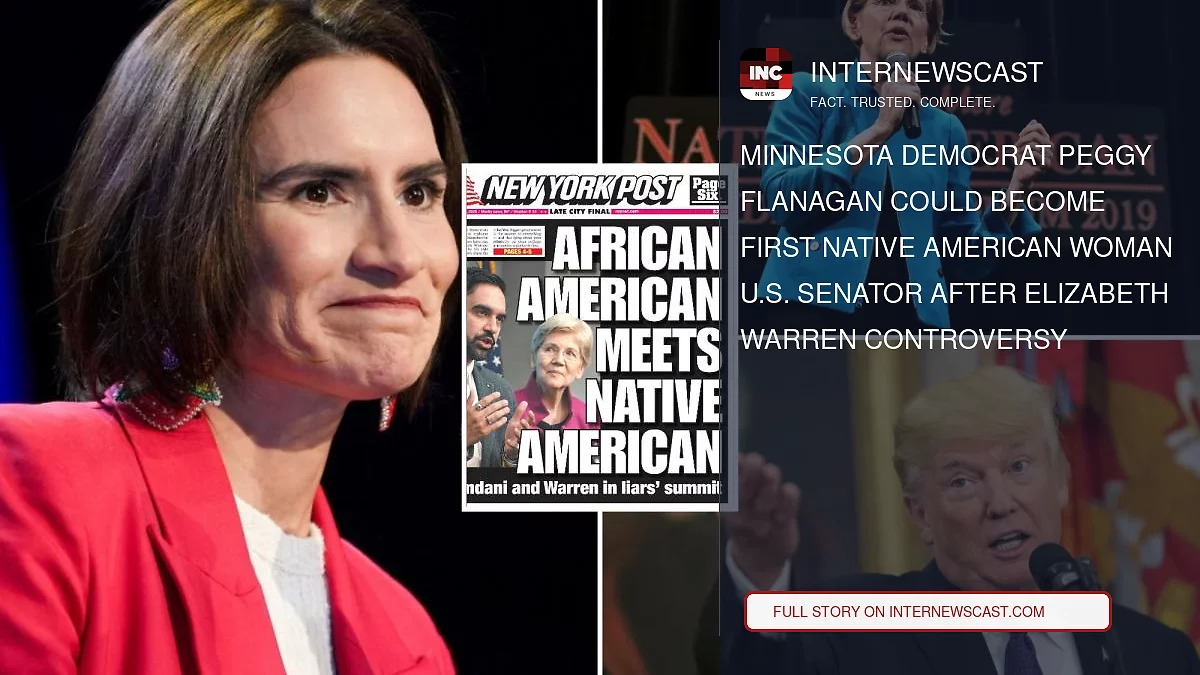
The fundraising arm of Democratic Minnesota Lt. Gov. Peggy Flanagan’s US Senate campaign celebrated her victory in Tuesday’s primary with a pitch noting that she could become the first Native American woman elected to the Senate.
“Friend, in almost 250 years, there’s never been a Native woman serving in the US Senate. It’s time to change that,” the campaign email said. “I’m Peggy Flanagan, the Democratic nominee for U.S. Senate in Minnesota.”
“I am Ojibwe and a proud member of the White Earth Nation,” the message continued.
The claim quickly drew notice from critics with long political memories, who pointed to Sen. Elizabeth Warren (D-Mass.) and her years of controversy over claims of Cherokee ancestry before and after she won election to the Senate in 2012.
Warren, who was born in Oklahoma, identified herself as Cherokee in 1984 when she submitted recipes to a Native American cookbook. In 1986, she listed herself as “American Indian” on a State Bar of Texas survey.
From 1995 to 2004, Harvard Law School, where Warren worked, described her as Native American on federal affirmative action forms. Warren later said she did not know the university had done so.
After Donald Trump won the presidency in 2016, he repeatedly derided Warren with the nickname “Pocahontas,” challenged her to prove her ancestry with the promise of a $1 million charitable donation, and ultimately pushed the Massachusetts Democrat into taking a DNA test.
In 2018, with a presidential run in her sights, Warren rolled out an analysis by Stanford University professor Carlos D. Bustamante that concluded that she had a Native American ancestor “in the range of 6-10 generations ago.”
However, some geneticists argued the analysis was flawed due to the lack of information on Native Americans in genetic databases, and claimed Bustamante should have said Warren “potentially” had indigenous ancestry rather than making a definitive statement.
The Cherokee Nation condemned Warren over the stunt, calling it “inappropriate and wrong,” and she issued an apology in early 2019.
There have been four male Native American senators in US history, the most recent of which was Markwayne Mullin (R-Okla.), now the secretary of Homeland Security.
The others were Robert Owen (D-Okla); Charles Curtis (R-Kan.), who went on to serve as Herbert Hoover’s vice president; and Ben Nighthorse Campbell (R-Colo.).