
AN ANCIENT Mayan city has been discovered by archaeologists in northern Guatemala, offering fresh insights into the historic civilisation.
The nearly 3,000-year-old remains include remarkable pyramids and monuments that appear to be “sculpted with unique iconography”.


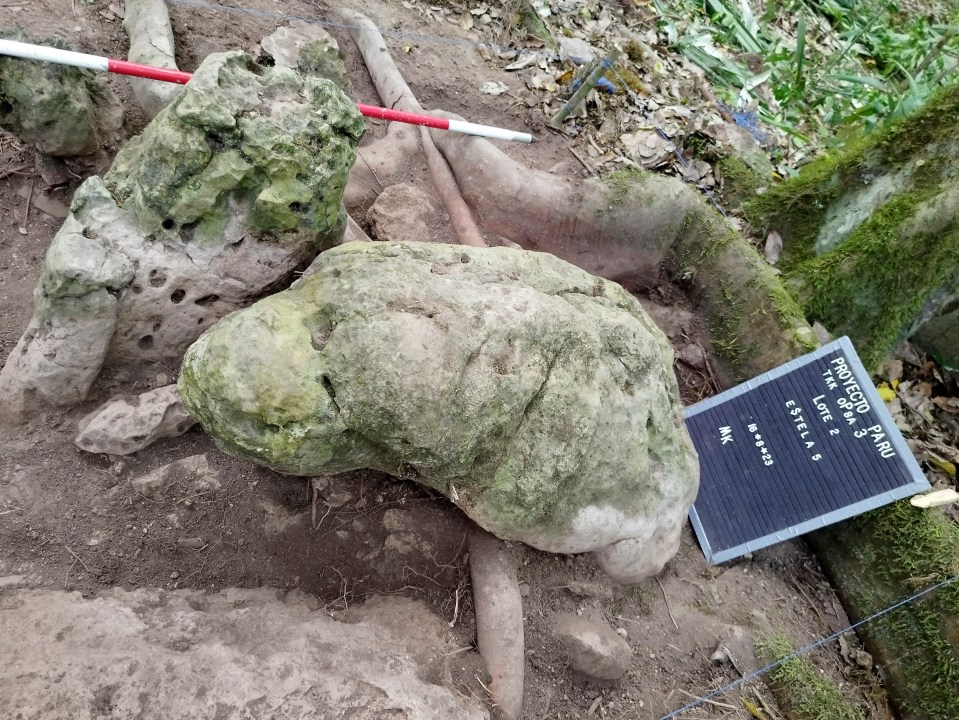
An ancient city, called Los Abuelos—Spanish for “The Grandparents”—was located around 21 kilometers away from the notable archaeological site of Uaxactún, according to Guatemala’s culture ministry on Thursday.
Los Abuelos gets its name from two human-like sculptures of an “ancestral couple” found there.
These figures “could be linked to ancient ritual practices of ancestor worship”, the ministry added.
The city is likely to have been “one of the most ancient and important ceremonial centres” of Mayan civilisation.
The monuments discovered at this location date back to the Middle Preclassic period of 800-500 BC, and the city itself showcases exceptional architectural planning.
The city covers an area of around six square miles and is found in Guatemala’s northern Petén department.
Researchers also found a 108 foot high pyramid nearby that had Preclassic murals and “a unique canal system”.
“Archaeological research has involved the active collaboration of experts from both Guatemala and abroad, supported by Comenius University in Bratislava, Slovakia,” a ministry representative mentioned.
“This joint effort has allowed significant advancements in the exploration, conservation, and dissemination of the Mayan legacy.”
Three sites – Los Abuelos, Petnal and Cambraya – were unearthed through the country’s ongoing Uaxactún Regional Archaeological Project.
“These sites form a previously unknown urban triangle,” a ministry spokesperson added.
“These findings allow us to rethink the understanding of the ceremonial and socio-political organisation of pre-Hispanic Peten.”
Mayan civilisation rose around 2000 BC and reached its peak between 400 and 900 AD.
It spanned across present-day southern Mexico and Guatemala, along with some parts of Belize, El Salvador and Honduras.
The amazing new discovery comes after a 1,000-year-old altar from Mexico’s ancient Teotihuacán culture was unearthed in April.
It was painted with a mural of red, yellow, and blue – which are colours associated with that culture.
This find was seen as suggesting evidence of possible contact between the two cultures.