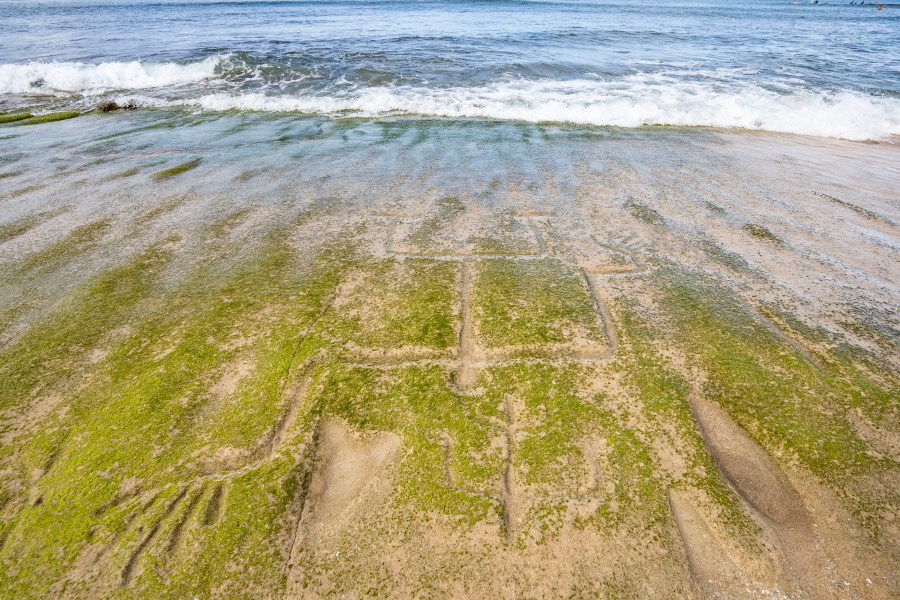


WAIANAE, Hawaii (AP) — In Oahu, Hawaiian petroglyphs dating back at least 500 years have reemerged after being concealed beneath sand for years. Seasonal ocean swells have unveiled a panel featuring over two dozen images resembling stick figures.
These petroglyphs become particularly noticeable during low tide, as gentle waves expose the neon-green algae-covered sandstone. This entire panel has not been fully visible since it was initially discovered nine years ago by two visitors at a U.S. Army recreation center in Waianae, approximately an hour from Honolulu.
Glen Kila, a Native Hawaiian cultural practitioner connected to the aboriginal families of the region, interprets the reappearance as a message from his ancestors through these traditional wonders.
“It’s telling the community that the ocean is rising,” said Kila, a recognized expert on the local culture and history of Waianae who is consulting with the Army on the protection of the petroglyphs.
Army officials are trying to balance protecting the petroglyphs with their accessibility on a public beach.
John and Sandy Stone consulted tide charts and drove about 30 minutes from their home early Tuesday to get a glimpse after a watching a local TV report about the petroglyphs.
“It was so interesting to touch them,” said John Stone, who splits his time between Hawaii and California. “It felt interesting to kind of have a connection with the past like that.”
It is difficult to date petroglyphs, but an archaeological site in the area is from about 600 years ago, said Laura Gilda, an archaeologist with U.S. Army Garrison Hawaii. According to Kila, Hawaiians arrived in Waianae at least 1,000 years ago.
Shift in waves caused petroglyphs to appear
The beach here fluctuates in size and profile each year, with low-pressure weather systems that form in the eastern Pacific between May and November causing waves that cut away loose sand from shorelines and redeposit them further out, according to an Army report on the petroglyphs. That shift is likely what causes their temporary exposure.
Archaeologists identified a total of 26 petroglyphs. Of the 18 anthropomorphic stick figures, eight are depicted with possible male genitalia and the remainder are of undetermined gender, the report said.
The entire panel stretches about 115 feet (35 meters) long, Gilda said.
When the petroglyphs first reemerged in July 2016, it was after late spring and early summer storms, including hurricanes, with a lot of wave action that swept the sand away, Gilda said.
They remained visible for a period and then got covered again.
“So there’s been portions that have … been exposed since then, but this is the first summer that the whole panel has been exposed again,” Gilda said.
Petroglyphs are telling a religious story, expert says
Based on the teachings Kila learned, the lineal petroglyphs appear to be telling a religious, ceremonial story. He interprets the largest figure, which appears to include hands and fingers with one arm raised and the other down, to represent the rising and setting sun.
Kila said that when the military in the 1930s took over the area and evicted Native Hawaiians, including his family who lived there for generations, his great-great grandmother refused to leave so his family exchanged mountain lands with a coffee plantation so she could remain near the bay.
In an interview included in the Army’s report, he recalled growing up in Waianae without television. So “the ocean and mountains were our playground,” he said. The Army recreation center was off-limits to the public, and the seawall was the barrier between Native Hawaiians and the military, Kila said.
Kila, now 72, recalled that if they walked on top of the wall, they were clubbed and pushed off by military police.
“We were proud and knew where we came from, so we never fostered any hatred for the military because one day we believed that the land will eventually return to us,” he said.
Kila, while visiting the petroglyphs earlier this week, told The Associated Press that the Army’s protection of them represents a shift in that community relationship.
Officials have been grappling with how to share the petroglyphs with the community while also protecting them, Gilda said.
“How much attention do you want to bring to this area? You don’t really want people to go digging for them when they’re not exposed,” she said. “But they’re certainly awesome to come and see on the public beachscape.”
Donald Kauliʻa, a Native Hawaiian who was born and raised in Waianae, snapped photos of the petroglyphs Tuesday. Seeing them, he said, feels like “validation that our ancestors were from here.”