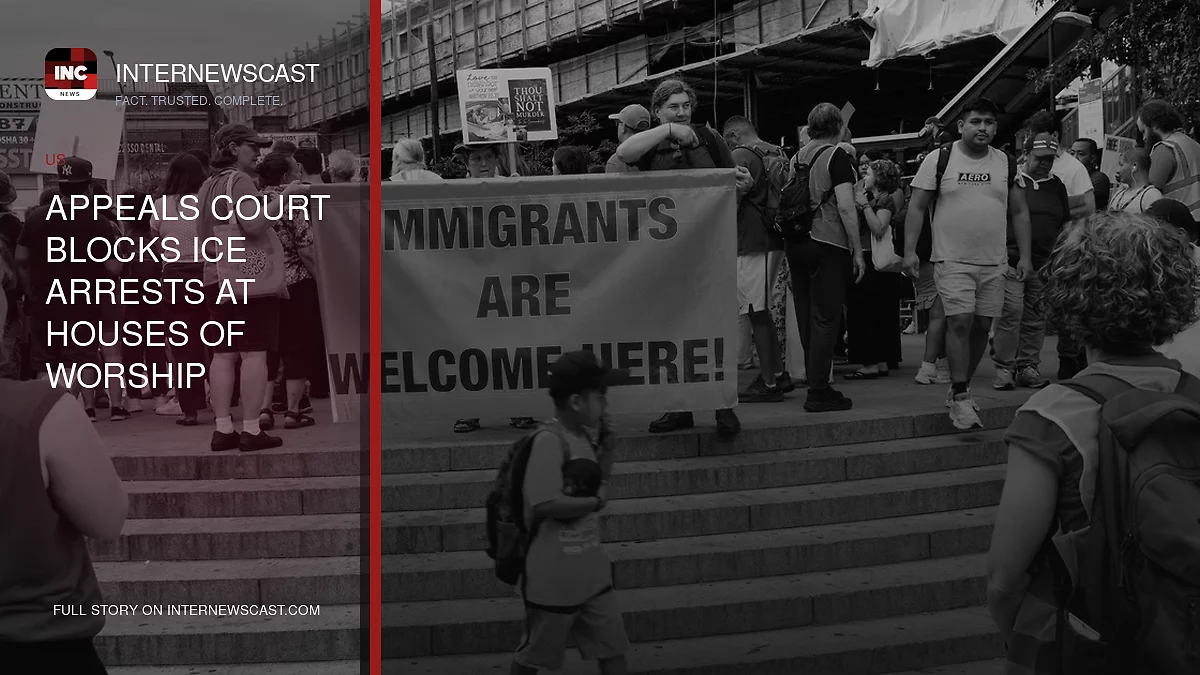

Washington — A federal appeals court on Tuesday kept in place a block on a Department of Homeland Security policy that permits immigration officers to carry out enforcement actions at certain houses of worship, including those affiliated with Quakers, Cooperative Baptists and Sikhs.
A unanimous three-judge panel of the U.S. Court of Appeals for the 4th Circuit allowed a district court’s preliminary injunction to remain in effect as the litigation moves forward. The lower court order barred the Trump administration from enforcing its 2025 policy against the plaintiffs: houses of worship connected to Quaker, Sikh and Cooperative Baptist Fellowship religious communities.
In a decision authored by Judge Barbara Milano Keenan, the 4th Circuit panel concluded that the houses of worship had shown that the Department of Homeland Security policy places a substantial burden on their religious exercise.
Keenan wrote that the guidance “is having a chilling effect on their congregations and already has caused declines in attendance among members of [Cooperative Baptist Fellowship] and the Sikh Plaintiffs.” The reduced attendance, along with the heightened risk of immigration enforcement at the plaintiffs’ places of worship, “already has imposed a substantial burden on the ability of all the plaintiffs to express their religion through communal worship,” she said.
Judges G. Steven Agee and Pamela Harris joined the opinion. Keenan and Harris were appointed to the 4th Circuit by President Barack Obama, while Agee was appointed by President George W. Bush.
The case stems from the opening days of President Trump’s second administration, when DHS rescinded a Biden-era policy that restricted immigration enforcement actions at or near protected areas such as places of worship, schools and hospitals.
The Trump administration’s replacement policy directed immigration officers to rely on their discretion and a “healthy dose of common sense” when determining whether to conduct enforcement operations in those sensitive locations.
The Cooperative Baptist Fellowship, which serves about 750,000 Baptists; Gurdwara Sahib West Sacramento, which serves 30,000 Sikhs; and six Quaker Meetings sued last year to challenge the policy allowing immigration arrests at houses of worship. They argue it violates the Religious Freedom Restoration Act and the First Amendment.
They argued that the new policy chilled immigrants’ attendance at their services and other ministries and led to a decline in attendance.
In its decision in favor of the houses of worship, Keenan cited a DHS statement from January 2025, in which a department spokesperson said that under the new policy, “criminals will no longer be able to hide in America’s schools and churches to avoid arrest.”
“For the plaintiffs, who welcome immigrant worshipers and have locations in or near immigrant communities, DHS’s statement emphasizing the rationale for this policy change shows that the threat of immigration enforcement at their houses of worship is real and substantial,” she wrote. “The evidence showed that this increased threat of immigration enforcement at the plaintiffs’ houses of worship has resulted in substantial pressure on the plaintiffs to violate numerous beliefs.”
The plaintiffs cheered the decision and vowed to continue working to protect religious freedom.
“This decision reaffirms a fundamental promise of religious liberty: every person should be able to gather, worship, pray, and serve their community without fear that immigration enforcement will unlawfully disrupt sacred spaces,” the coalition said in a statement.