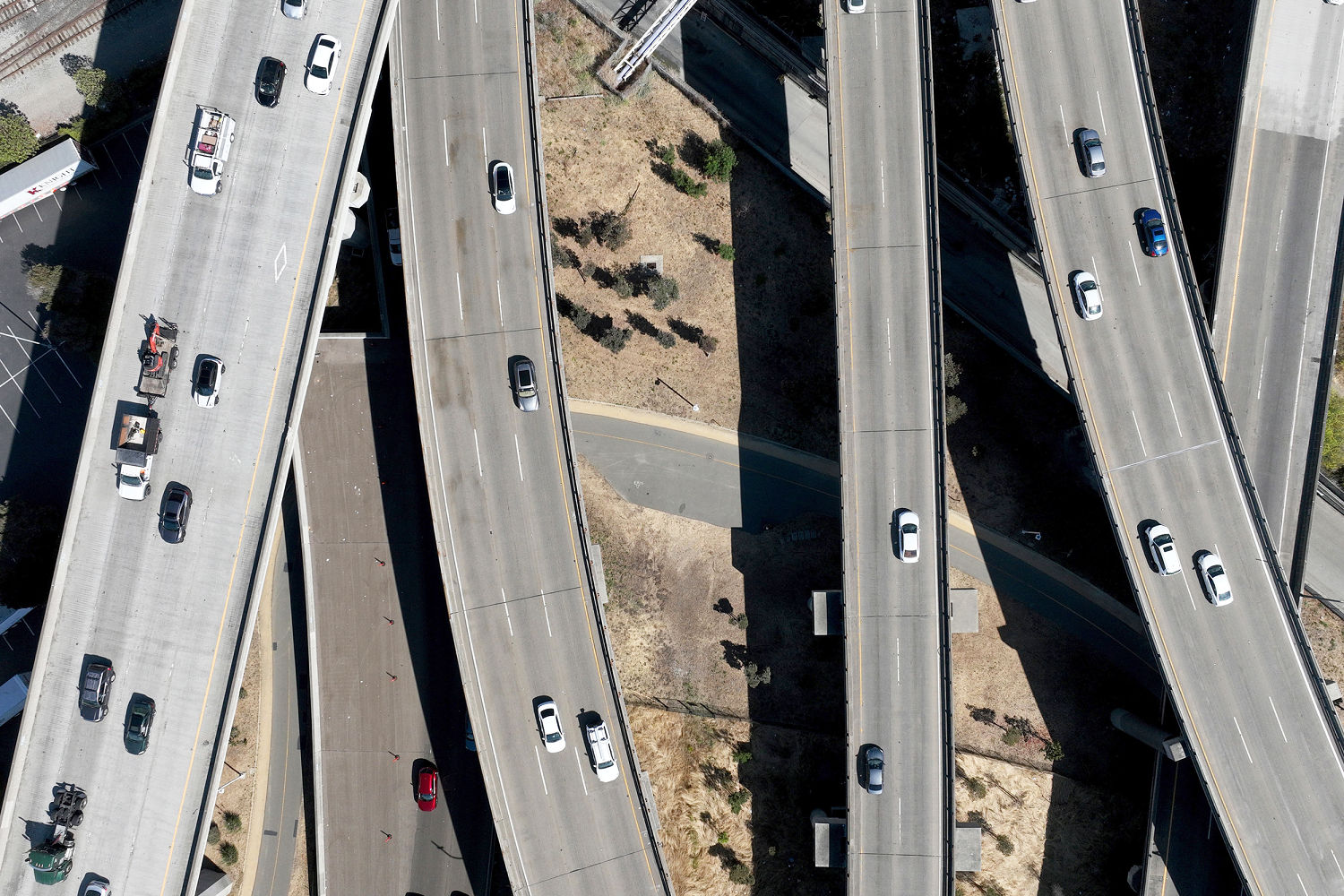
The billions add up: $3.7 billion for an expansion of the I-15 highway in Utah; up to $4 billion for the Brooklyn-Queens Expressway; and $16 billion for the New Jersey Turnpike and Garden State Parkway.
The U.S. continues to fund and expand highways, even as some parts of the world invest in greener infrastructure over concerns about global warming and amid a broader movement away from cars.
As of fiscal year 2023, there were at least seven federally funded highway construction and expansion projects across the country slated to cost nearly $16 billion, according to the U.S. Public Interest Research Group’s “Highway Boondoggle” report published in November.
These projects, which include the Gorham Connector in Maine, the Brooklyn-Queens Expressway, the I-15 expansion in Utah, and the I-10 expansion in Texas, among others, will “harm communities and the environment, while likely failing to achieve goals such as reducing congestion or improving safety,” the report states.
And there’s more. Later this year, Austin plans to spend roughly $4.5 billion expanding I-35 through the heart of the city, potentially displacing more than 140 homes and businesses, according to a Texas Department of Transportation evaluation report.
Some efforts are underway to mitigate the harms highways cause to neighborhoods and the environment.
Earlier this month, the Biden administration announced the winners of more than $3.3 billion in grants to heal neighborhood displacement caused by highway construction. This money, awarded across more than 132 communities, will be used to reconnect communities by “removing, retrofitting, or mitigating highways,” according to the U.S. Department of Transportation.
A spokesperson for the Federal Highway Administration told NBC News in a statement that it is working with states and communities to invest in safer and cleaner modes of transportation, like walking and biking.
“We are dedicating billions of dollars to plan and build locally-driven solutions to redesign roads, addressing inequities to better meet the needs of all community members and building a more equitable transportation system,” the FHWA said.
According to a paper published last month in the Journal of Transport Geography, transportation accounts for 23% of global carbon dioxide emissions, and 70% of those emissions come from road vehicles.
Some members of Congress seek to address the environmental harm caused by highways. Rep. Jared Huffman, D-Calif., introduced a bill in February that aims to mitigate greenhouse gas emissions on the national highway system by creating incentives for reducing vehicle miles traveled.
“It’s urgent because our national highway system is a major contributor to the climate crisis,” Huffman told NBC News. “And the only way we’re going to change that is to reform the priorities we invest in.”
He said the U.S. is “way behind” other countries in terms of these investment priorities.
“Just travel to Europe or other places that have done good planning and you can see just how terribly vehicle-oriented we have been for the past century, and so we’re playing catch-up,” he said.
His Democratic colleague, Sen. Ed Markey of Massachusetts, who originally reintroduced the GREEN Streets Act back in January, put it more bluntly.
“For the last 100 years, we’ve prioritized … gas-guzzling, low-occupancy vehicles on highways. This car-centric approach not only accelerates the climate crisis, but also makes our roads less safe while exacerbating racial and economic inequality,” he said in a statement to NBC News.
“My GREEN Streets Act aims to tackle these issues by requiring states to meet carbon emission reduction goals and invest in cleaner, safer infrastructure,” he said.
Even these proposals, though, assume not only the existence but the necessity of America’s continued reliance on highways.
That’s in stark contrast to Canada, for instance, whose environmental minister announced last month that the country will no longer fund road expansion projects, choosing instead to focus investments on more active modes of transportation like walking and cycling.
“There will be no more envelopes from the federal government to enlarge the road network,” Steven Guilbeault told the Montreal Gazette.
He said that money would be “better invested into projects that will help fight climate change and adapt to its impacts.”
The announcement falls in line with efforts in other countries to move away from car-dependent infrastructure in order to combat climate change.
Last month, Parisians voted to triple parking charges for large SUVs, and the city has added more than 50 miles of bike lanes since 2020.
“We’re proud of having posed an eminently environmental question at a time the environment is presented as the source of all evil,” Mayor Anne Hidalgo said after the referendum.
Later this year, Dublin plans to phase out through traffic in its city center in order to help meet emissions goals and unclog the downtown area.
“By reorienting the City Centre towards sustainable transport modes,” a draft of the City Centre Transport Plan states, Dublin will be able to help “achieve the national objective to reduce emissions from transport by 50% in accordance with the 2023 Climate Action Plan.”
David Zipper, senior fellow at the MIT Mobility Initiative, said similar reforms are difficult and taboo in the U.S. due in part to policy inertia.
“We’ve spent 100 years building roads at the federal level and funding states to do the same, so that’s what state officials and the public expect to keep happening, even if it’s not useful and devastating to the environment,” he said.
There’s also a psychological component, he said. A lot of people and policymakers genuinely believe that expanding highways and roads will ease frustrating congestion issues in their area.
But that’s not necessarily the case, Zipper said, citing the theory of induced demand, which explains why adding more car lanes tends to increase, rather than decrease, traffic by incentivizing more people to drive.
He said the U.S. needs to stop expanding highways and start massively investing in greener alternatives if it wants to be serious about addressing climate change.
“If we’re serious about reducing greenhouse-gas emissions, we have to be serious about reducing transportation emissions, and in order to do that we have to address the main source of those emissions, which come from cars and trucks on highways,” he said.
“And to that extent, we need to rethink how much we want to expand highways.”