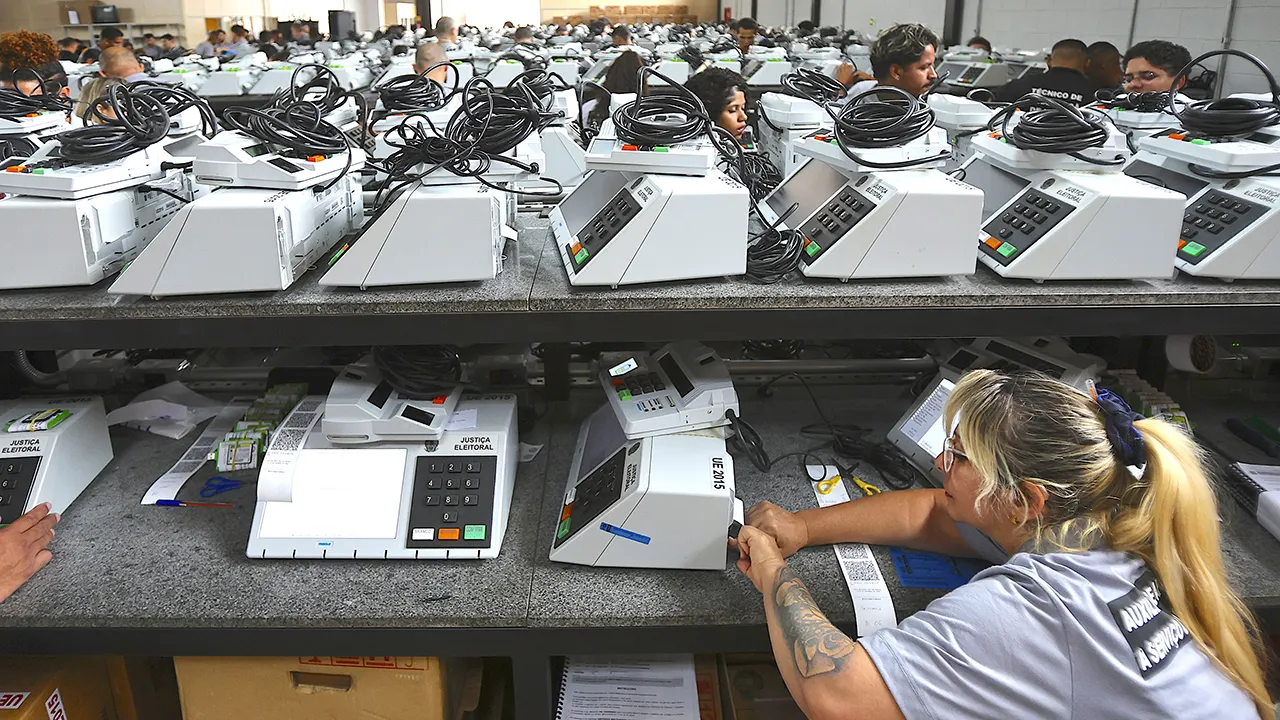

Voting machines at a Rio de Janeiro polling station
Video recorded at a polling station in Rio de Janeiro showed election officials collecting polling-place result reports and shutting down the voting machines after Brazil’s first-round election on Oct. 4, 2026. (Reuters)
Roughly 125 million Brazilians cast ballots on Oct. 4 using voting machines that do not produce paper ballots for voters. Within four hours of polls closing, the nation knew the presidential race would go to a runoff between conservative challenger Flavio Bolsonaro and leftist President Luiz Inacio Lula da Silva.
Brazil has used this model for more than 30 years, making its fast, straightforward and highly routine elections familiar to voters. The system undergoes extensive audits, remains entirely offline and represents the world’s largest digital voting operation.
With the U.S. midterm elections just 11 days away, analysts say Brazil’s approach could point Americans toward a more secure voting process.
Brazil’s election technology has earned broad praise and was cited in President Donald Trump’s 2025 executive order on elections, which highlighted the country’s use of biometric voter identification. At the same time, Brazil relies in part on the very paperless voting machines Trump has promised to eliminate.
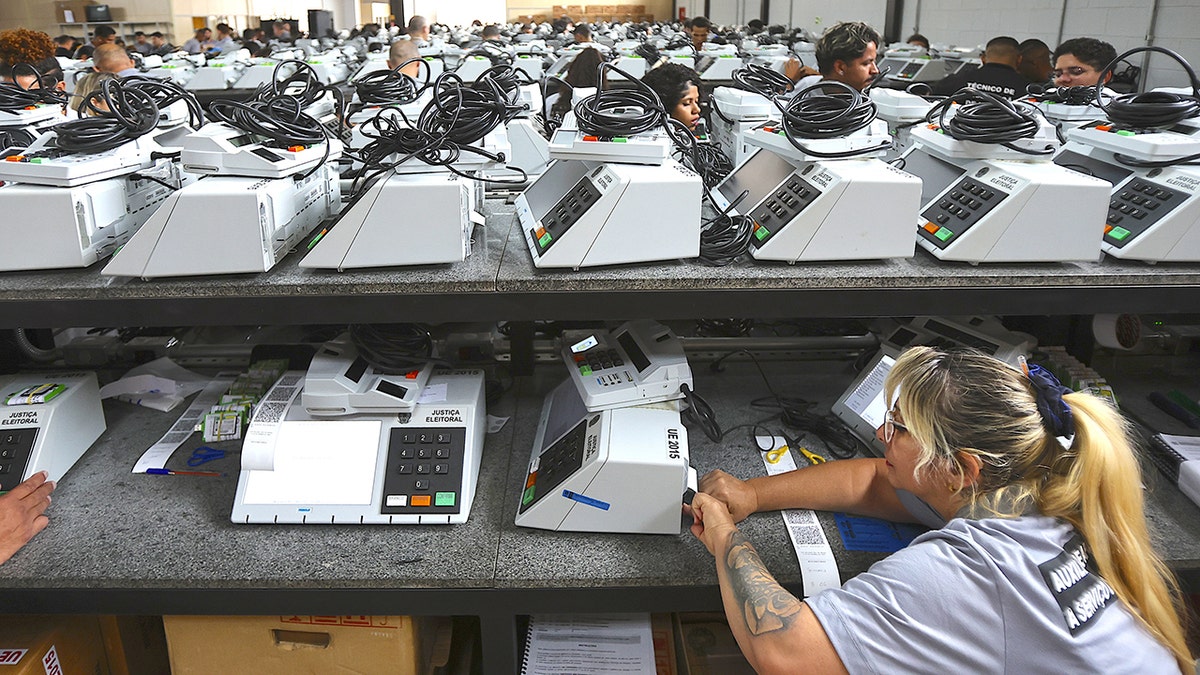
Election workers prepare and seal electronic voting machines ahead of Brazil’s general elections in Brasilia on Sept. 23, 2026. (Mateus Bonomi/Anadolu via Getty Images)
Over time, Brazil connected federal, state and municipal records to create a digital voter registry. Biometric checks can confirm a voter’s identity, eligibility and whether they have already cast a ballot—and in most cases, voters are required to use them. Nearly nine out of every 10 voters open the machine with a fingerprint.
Brazil’s Superior Electoral Court, known as the TSE, develops the machines and supervises national elections. The court says no fraud has been proven since the system was introduced in 1996. None of the 499,248 machines used on Oct. 4 was connected to the internet. Their software was available for review by political parties, universities and election monitors for 11 months before being digitally signed and sealed during a public ceremony. In December, the government invited a record 149 independent participants to test the system’s defenses; they found no vulnerability capable of changing results or exposing an individual’s vote.
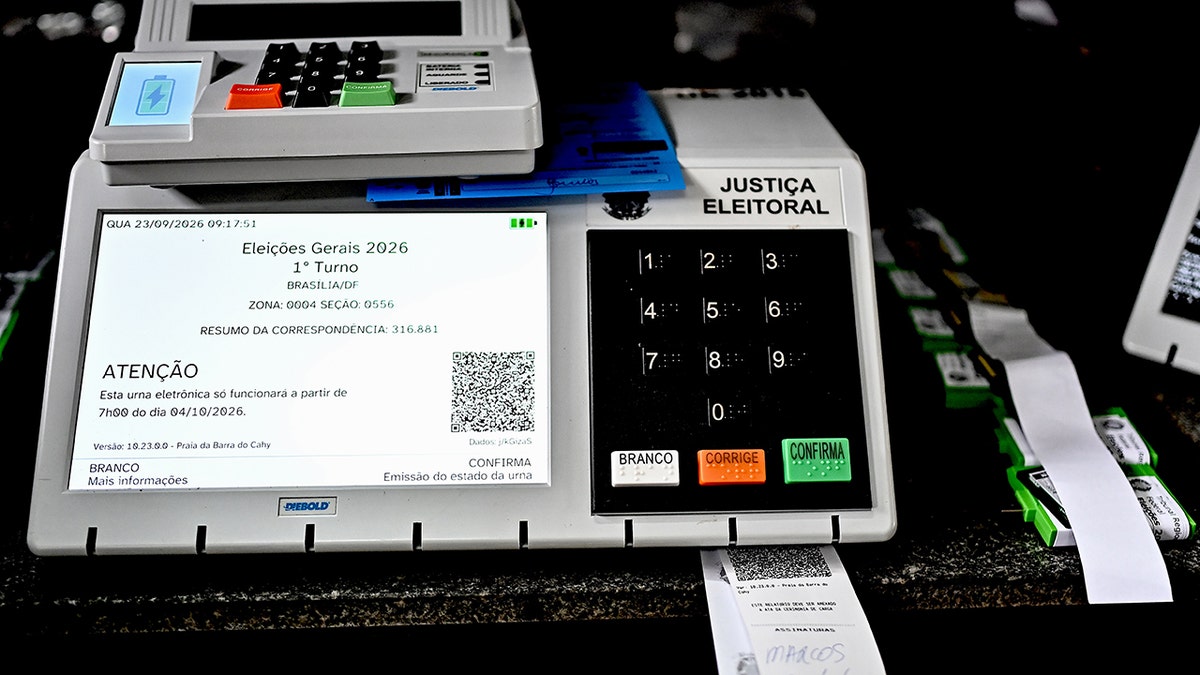
An electronic voting machine sits at a Regional Electoral Court facility in Brasilia on Sept. 23, 2026. (Ton Molina/Bloomberg via Getty Images)
On Election Day, officials randomly select machines and load them with paper ballots in full view of federal auditors and international observers, who monitor and record the results.
When voting ends, each machine prints a local tally that is displayed outside the polling station alongside a QR code. That allows the public to compare the polling-place total with the nationwide count. The TSE told News Outlet by email that every digital signature “confirms that the result was produced by the electronic voting machine registered for that polling station.”
Political scientist Karina Stange Calandrin, a professor at the Instituto Brasileiro de Mercado de Capitais, said Brazil’s system brings together three features that are rarely combined: electronic voting, local storage of votes linked to voter eligibility through a hash and automated tabulation.
DISCOVER MORE: France Deploys 70,000 Police After Suspected Terror Attack Near Paris
“It is an extremely secure and safe system,” she said. The machines never go online, and the central database that receives the totals must correspond with the physical results generated locally by each machine, without human intervention. Any attempt to manipulate the process would require opening every affected machine and installing software that differed from the TSE-approved version, causing those totals to be rejected. The level of coordination required, she said, would be so extensive that it “simply could not pass undetected.”

Brazil’s right-wing senator and presidential candidate Flavio Bolsonaro of the Liberal Party gestures beside federal deputy and Rio de Janeiro gubernatorial candidate Douglas Ruas during a campaign rally in Rio’s Campo Grande neighborhood on Oct. 3, 2026, the eve of the general election. (Douglas SHINEIDR / AFP via Getty Images)
The machines faced their most serious political challenge in 2022, when former President Jair Bolsonaro repeatedly questioned their reliability without presenting evidence. Bolsonaro, who was sentenced to 27 years for plotting to overturn his 2022 defeat, is currently under house arrest.
For the first time this year, the TSE was led by a justice appointed by Bolsonaro: Kassio Nunes Marques. Bolsonaro’s eldest son, Sen. Flavio Bolsonaro, led the first round with 47% of the vote, narrowly ahead of President Luiz Inácio Lula da Silva’s 45%. The technology once targeted by the former president could now help deliver the presidency to his son.
Florencia Ferrer, chief executive of e-stategiapublica and an election auditor in 17 countries, considers Brazil’s system the most advanced and secure in the world. India’s electronic voting machines, she noted, provide voters with a printed record to take away, a design she says can reduce ballot secrecy and increase the risk of coercion. Internet voting in Estonia and paper ballots counted electronically in the Philippines present different security concerns, she added.
An unnamed engineer from the University of São Paulo’s Polytechnic School who audited the machines in 2014 also expressed confidence in the system. Speaking to News Outlet on condition of anonymity because of the sensitivity of the work, the engineer said auditors had found “no traces of tampering, wrong-doing or malicious intent,” while acknowledging that no technology is entirely fail-safe.
Critics nevertheless argue that a spotless track record does not eliminate the need for independent verification. The Carter Center has said voters should at least be able to view a printed version of their ballot before it is deposited in a separate compartment of the machine. Without that safeguard, critics contend, confidence in the outcome depends almost entirely on software. Germany’s highest court reached a similar conclusion in 2009, ruling that voters must be able to verify their ballots without relying on technical experts—a standard that effectively rules out Brazil’s model.
Brazil has supplied its voting technology mainly through loans to countries across Latin America, Africa and Asia. Paraguay became a permanent adopter in 2006, though its machines now print an individual record of every vote.

Brazil’s President and presidential candidate Luiz Inácio Lula da Silva (C) waves next to Vice-President Geraldo Alckmin (L) and to his candidate for São Paulo’s governor, Fernando Haddad during a campaign rally on the eve of the general election, in São Paulo, Brazil on October 3, 2026. Brazilians go to the polls on Oct. 4, 2026, (Luis Robayo/AFP Via Getty Images)
“It’s obvious Washington and the remainder of the U.S. are way behind both technology as well as security when it comes to polling on voting day,” Ferrer said. U.S. elections are run in thousands of local jurisdictions under 50 sets of state rules and about 30% of 2024 ballots came by mail, which is slower to process. Brazil has one national election authority, compulsory voting and no mail-in ballots.
Brazilians will vote this coming Sunday on Oct. 25. The winner is expected to be known and certified in under five hours.
“The question is not whether Brazil has invented a perfect voting machine. No voting system is perfect. It is whether democracies can combine the speed and consistency of digital tabulation with independent verification, public scrutiny and rules that citizens across the political spectrum have reason to trust,” Ferrer said.


