He has earned a promotion — and perhaps a little good karma along the way.
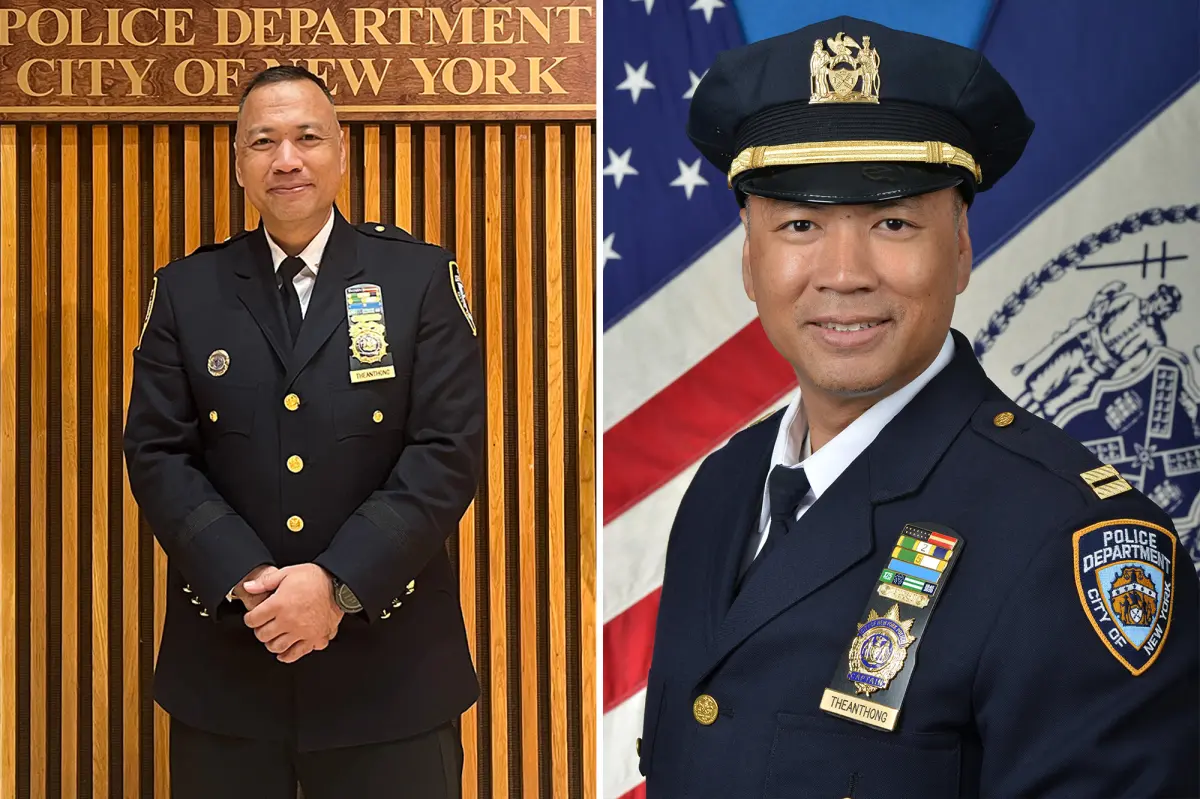
Tawee Theanthong, a former Buddhist monk who joined the NYPD after the Sept. 11, 2001, terrorist attacks, has risen to one of the department’s most senior positions. Along the way, he has championed empathy and compassion as essential tools of police work.
The 53-year-old Queens native was promoted this week to inspector overseeing his Bronx precinct. The ceremony celebrated an unusual journey that led him from a monastery in Thailand to a career in law enforcement.
A father of four, Theanthong said the principles he absorbed as a 22-year-old monk fasting in rural Thailand have continued to shape the way he serves New Yorkers.
“Empathy and compassion are things we really need to focus on more as officers,” Theanthong told The Post following Tuesday’s promotion ceremony at One Police Plaza.
“We’re always looking at crime numbers and statistics, but we don’t always discuss the human side of policing — the people behind those numbers.”
“What are they feeling? What are they afraid of? I believe that is just as important to fighting crime as the statistics,” he added.
Theanthong was born to Thai immigrant parents. His recent police work has included helping apprehend suspects accused of being part of a moped-riding jewelry theft crew, but his path to the NYPD began with a personal search for identity and purpose.
In 1995, he traveled to a remote village near the Mekong River, where he entered a monastery and devoted himself to Buddhist teachings, meditation and moral discipline.
He shaved his head and eyebrows, put on a traditional robe and received only one possession: a bowl, as required by monastic life.
Monks were expected to eat only food donated by villagers, a tradition that taught them to depend on the generosity of others.
“When you enter a monastery and are ordained as a monk, you give up everything. You’re no longer a civilian. It is one of the ultimate sacrifices because you surrender your material possessions, your name, your titles — everything,” Theanthong said.
“Those lessons really humbled me.”
KEEP READING: Tom Hardy Returns to MobLand After His Future on Show Was Unclear
That spiritual experience continues to remind Theanthong that his central responsibility as a police officer is to help people.
“I still draw on many of those philosophies, especially empathy and compassion. As officers, we can sometimes lose sight of them because we’re constantly busy,” he said.
“We go from one call to the next, and for us it may be the 10th job of the day. But for the person involved, it may be the most important thing that happened to them. The way we respond can shape how they remember that entire experience.”
After spending 10 months in Thailand, Theanthong returned to the United States and worked in the technology industry during the 1990s. The devastation of 9/11 ultimately convinced him to serve the city where he was born by joining the NYPD.
“After 9/11, it affected all of us deeply. I was working in New York City at the time, and I thought, ‘If there was ever a moment to choose a career or do something that would help people, this was it,’” he said.
Theanthong entered the Police Academy in 2003 and was initially assigned to patrol New York City Housing Authority buildings in the Bronx.
Over more than two decades with the department, he worked cases in Bronx detective squads covering neighborhoods such as Morris Park and Woodlawn. He later served with the Bronx Robbery Squad before being promoted to deputy inspector in March 2025.
Moving from an orange monk’s robe to the NYPD’s blue uniform also meant entering a very different kind of community, he said.
“Police work is different because it’s such a closed environment. The camaraderie is deeply ingrained, so you find more family-like and fraternal relationships among police officers than you do in monastic life,” he said.
Theanthong, who commands the NYPD’s 43rd Precinct, attended Tuesday’s promotion ceremony with his wife, Lek, and their four sons, Thomas, Timothy, Titus and Tate.
“The funny thing about cops is that you could probably mail us our shields and we’d be perfectly happy,” he said. “But what makes a ceremony like this meaningful is having your family there.”
“When your family recognizes what you’ve accomplished, it makes the moment that much more special,” he said.