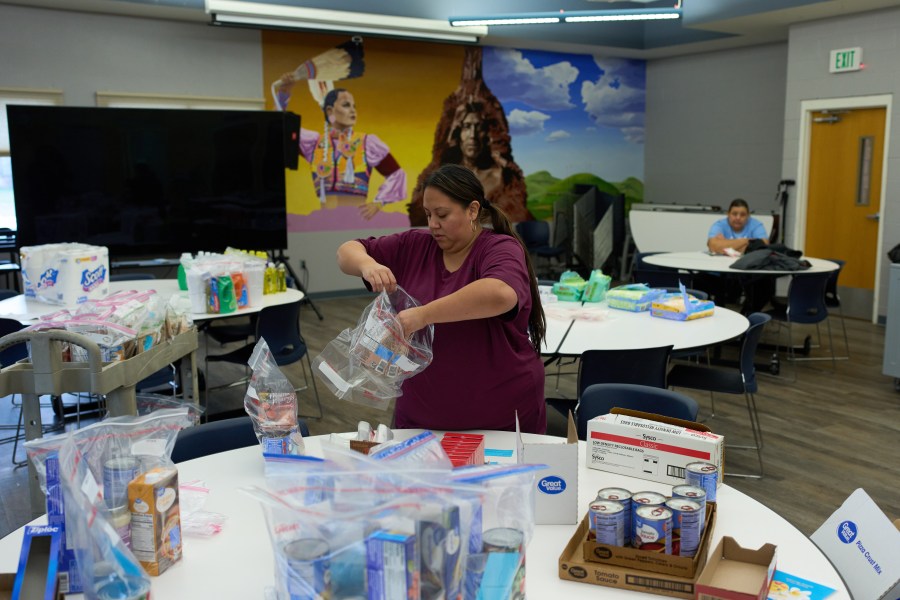


Shelves at a college food pantry in Sacramento, California recently displayed an array of items including acorn squash, Spam, and baby food. This pantry has become a crucial support for students dependent on federal grocery aid, which has been disrupted by the ongoing government shutdown.
At California State University, Sacramento, commonly known as Sac State, numerous students frequent the Basic Needs Resource Center weekly. Here, they can choose up to 12 items per visit, ranging from fresh produce and meat to essential toiletries and gently used clothing.
“It’s a tremendous help,” remarked Antonette Duff, a psychology junior at the university who benefits from the Supplemental Nutrition Assistance Program (SNAP), previously known as food stamps.
Emily Tupper, who leads Crisis Assistance and Resource Education Support at the college, noted that over 3,600 students at the 31,000-strong campus receive SNAP benefits. Statewide, over 200,000 college students in California participate in SNAP, with the U.S. Government Accountability Office reporting 1.1 million recipients nationwide.
Facing the pressures of tuition, housing costs, and part-time jobs that often pay modestly, many students find it challenging to manage grocery expenses, especially as prices climb.
SNAP assistance, vital for around 42 million Americans, was halted in early November due to the shutdown. Although a federal judge recently ordered the Trump administration to restore full funding, the U.S. Supreme Court’s emergency appeal decision temporarily blocked this order. This has left students reliant on SNAP in a state of uncertainty, prompting colleges to combat campus hunger by promoting food pantry services and distributing free meals.
“It just puts students in a really horrible position,” said Mike Hannigan, a student at Greenfield Community College in Massachusetts and an advocate against food insecurity on college campuses.
Hannigan receives just under $300 a month from SNAP, but the benefits didn’t come through at the beginning of November due to government delays.
If SNAP benefits keep getting delayed, he doesn’t know what he would do to afford groceries, he said. Some students, including those at community colleges who don’t have meal plans, may “have to decide whether or not they are going to attend a class or they’re going to pick up an extra shift to try to make money to be able to feed themselves or their families,” Hannigan said.
Campus food pantries and farmers markets offer some relief
Hannigan and other students recently hosted a free farmers market on campus and gave out thousands of pounds of vegetables from local farms. Nothing was left over.
Nueta Hidatsa Sahnish College, a tribal college of about 250 students in North Dakota, hosts ‘Soup Tuesdays’ to feed students on campus for free. Students can also access a food pantry and kits with easy-to-prep meals such as chicken Alfredo or chili, and they’ll soon be able to pick up gift cards from the school to use at local grocery stores.
Many people living on tribal land or in rural areas are in so-called food deserts with limited access to grocery stores, college President Twyla Baker said. The uncertainty over SNAP caused by the political stalemate in Washington adds another layer of difficulty.
“To essentially use the most vulnerable as political pawns is just untenable,” Baker said. “It’s unsustainable, and it’s detrimental to the country as a whole.”
Food insecurity on college campuses has been on the rise in the past decade, and students have had to make tough choices about how to stretch their wallets to cover the necessities, said AJ Scheitler, director of the Data Equity Center at the University of California, Los Angeles, Center for Health Policy Research.
“Students will first make sure that they pay for tuition and books and all that stuff so that they can stay enrolled at school,” she said. “After that, they concern themselves with transportation so that they can get to school, then housing, and then food almost becomes this category that you can go without if you have to if after all of those other categories you don’t have any money.”
Sac State’s food pantries host grocery pop ups on campus twice a month where students can pick up fresh produce for free, said Tupper, the school official. The college may hold the events more often if federal food aid keeps getting delayed.
At the University of New Mexico in Albuquerque, which estimates at least 4.5% of students receive SNAP benefits, officials have encouraged people to donate food, funds or their time to the campus food pantry.
Between 100 and 150 students pop into the campus pantry every day, said Lisa Lindquist, director of the LoboRESPECT Advocacy Center. The pantry is free and open to all students. Some fill up baskets with as many as 10 pounds (4.5 kilograms) of food per visit, while others are looking for a snack to hold them over between classes.
The pantry is fueled by donations, but there have been times when staffers have had to run out to the grocery to buy more items to keep the shelves stocked.
“It’s not necessarily for a lack of people donating, it’s just that the food, it just goes in and out so quickly,” she said. “That tells me anecdotally, there’s great need.”
Students stressed about food aid uncertainty
On a recent trip to the grocery store, July Star Medina, a senior studying biology at Sac State, was shocked she had to spend about $30 just to buy chicken and a few spices. She’s had to make more frequent trips to the Basic Needs Resource Center in recent months because her SNAP benefits decreased from $290 to $120 a month this year. The assistance was lowered after she started working more hours during the summer, but it hasn’t gone back up now that she’s working less during the fall semester.
“I don’t think it’s enough at all,” Medina said. “After one week of groceries that’ll last me maybe two weeks.”
The prospect of that $120 going away has been stressful, she said.
“And that’s why I’ve been trying to come here to see what I can get,” Medina said outside the center. “Now I need to see where I can pull money aside to just get basic things.”
Scheitler, the UCLA researcher, said the uncertainty “is just so rough” for students.
“And the number of students who may have to drop out of school because they need to eat, their grades are going to fall,” she said. “Their mental health is going to be hurt by the stress of not being able to eat. This is going to have a significant impact if they can’t figure out how to fix this and fix this quickly.”
__
Associated Press Southwest chief correspondent Susan Montoya Bryan in Albuquerque, New Mexico, contributed to this report.