

Share this @internewscast.com
Unveiled construction plans for China’s upcoming super embassy in London have sparked significant national security concerns throughout the United Kingdom. These plans disclose a concealed underground chamber situated perilously near some of Britain’s critical communication cables.
Opponents of the planned site, which will be just three feet from the internet infrastructure, have voiced fears that the secret chamber could function as a base for Chinese espionage activities. Although the British government has reassured allies that these lines do not carry sensitive government data, they are vital for financial transactions and millions of users’ internet communications.
The Telegraph made the blueprints publicly available on Monday, precisely one week before Prime Minister Keir Starmer is expected to endorse the plans ahead of his visit to President Xi Jinping in China.
A government spokesperson remarked to The Telegraph that, despite the highlighted security issues, “national security is our first duty and government security experts have been involved throughout the process so far.”

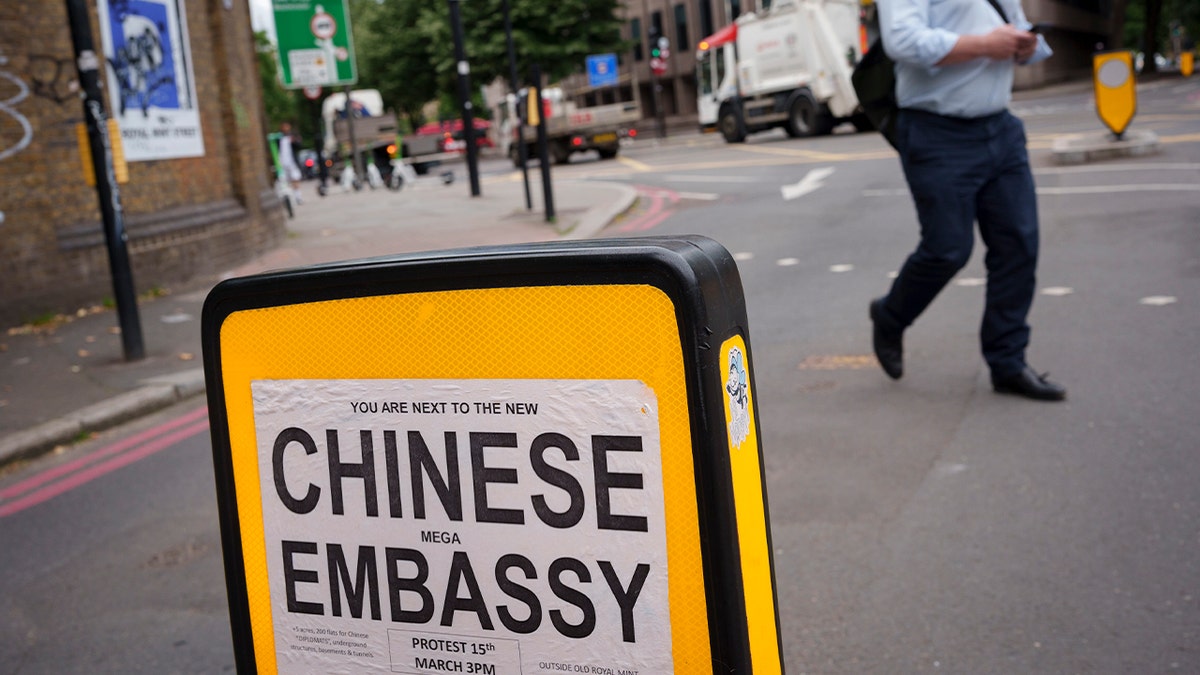
Protest against the proposed China Embassy at the Royal Mint Court, London (Matthew Chattle/Future Publishing via Getty Images)
The proposed embassy will be constructed at the site of the former Royal Mint and is set to become the largest Chinese embassy in Europe.
Construction plans indicate that China intends to demolish and rebuild a basement wall, placing officials and equipment just over three feet from critical fiber-optic cables. Security experts have warned that such proximity could create opportunities for “cable-tapping,” which involves inserting wiretaps or reading light signals leaking from the lines.
Professor Alan Woodward, a security expert at the University of Surrey, highlighted the technical feasibility of espionage given the physical layout, The Telegraph reported. He described the demolition as a “red flag” and noted, “If I were in their shoes, having those cables on my doorstep would be an enormous temptation.”
Royal Mint Street at the rear of the possible future Chinese embassy which has been locked in a planning battle for years and whose decision is still due for review, on 10th June 2025, in London, England (Richard Baker/In Pictures via Getty Images)
Additionally, the concealed chamber appears to be equipped with at least two hot-air extraction systems designed to ventilate heat-generating equipment. Experts reportedly inferred that this infrastructure suggests that the room is designed to accommodate high-powered technology such as advanced computers typically used for espionage and data processing.
Beyond the single chamber near the cables, the unredacted plans also revealed a network of 208 secret rooms beneath the diplomatic site. The basement appears to allow for emergency backup generators, sprinkler systems, communications cabling and showers, suggesting that officials could remain underground for extended periods, potentially to operate or monitor equipment.
The construction plans have generally raised fears that the London complex could serve as a Beijing intelligence hub. According to U.K. outlet The Times, Britain has been pressured to reassure the United States and other intelligence partners that the cables do not transmit any sensitive government data.

Protesters hold a huge banner saying “No To China’s New Mega Embassy Spy Base In London’ during the demonstration outside the Royal Mint on March 15, 2025. (Martin Pope/SOPA Images/LightRocket via Getty Images)
Alicia Kearns, the shadow national security minister and prominent critic of the project, described the approval of the embassy as handing Beijing a strategic advantage against British interests.
“Giving China the go-ahead for its embassy site would be to gift them a launchpad for economic warfare at the very heart of the central nervous system of our critical financial national infrastructure,” she said in a post on X.