
Fresh off the heels of a triumphant Artemis II mission, NASA is already setting its sights on the next big leap: the Artemis III launch. Engineers are in full swing, gearing up for this next chapter in lunar exploration.
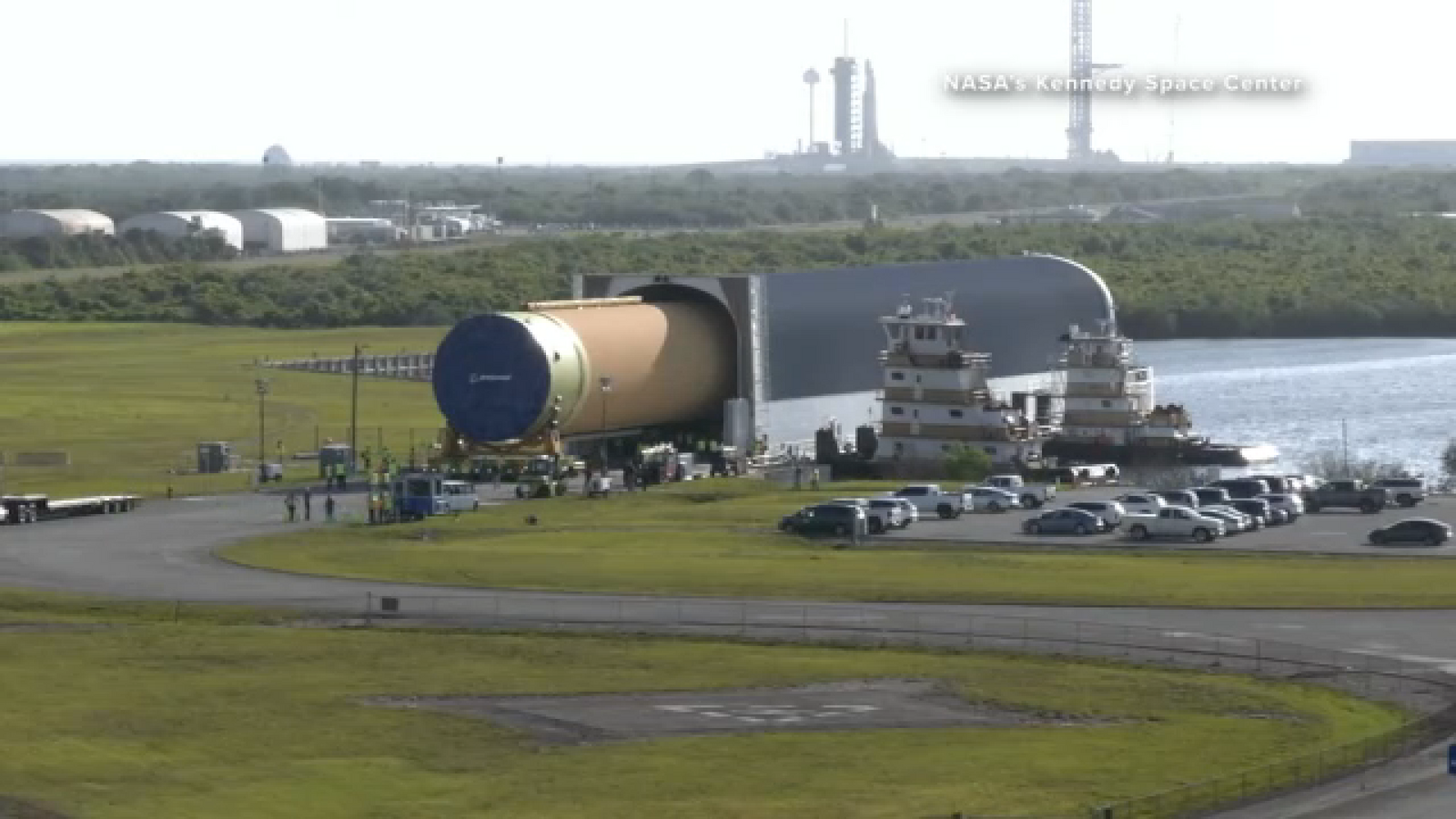
This week, a pivotal component for Artemis III made its way to the Kennedy Space Center in Merritt Island, Florida. NASA confirmed the arrival of the rocket’s largest section on Monday, marking a significant milestone in the mission’s preparation.
The colossal 212-foot-long core stage of the Space Launch System (SLS) was crafted at NASA’s Michoud Assembly Facility in New Orleans. It embarked on a 900-mile journey by barge to reach its destination at the space center, where it will undergo final assembly.
This core stage is a critical part of the rocket, featuring essential components such as the liquid hydrogen tank, liquid oxygen tank, intertank, and forward skirt, as detailed by NASA.
On Tuesday, the majority of the core stage was carefully moved to NASA’s Vehicle Assembly Building. Here, it will be united with the boat-tail and engine section, completing the assembly of the full stage.
For those eager to witness this historic moment, NASA provided a live stream of the core stage’s unloading and its transportation to the Vehicle Assembly Building, sharing the excitement with space enthusiasts worldwide.
The historic 10-day Artemis II mission, which launched on April 1 and splashed down on April 10, took the four-person crew on a 694,481-mile journey around the moon.
The lunar fly-by allowed the astronauts to observe unprecedented views of the moon’s Orientale basin with the human eye for the first time.
The next mission, Artemis III, will test rendezvous and docking capabilities between the Orion spacecraft and commercial spacecraft that will be used to land astronauts on the moon.
The demonstration mission in low Earth orbit will test one or both commercial landers from SpaceX and Blue Origin, respectively.
The Artemis III crew is expected to launch Orion on the SLS rocket from the Kennedy Space Center in late 2027, according to NASA Administrator Jared Isaacman.
Humanity will return to the moon’s surface during the Artemis IV mission, expected to launch in 2028, according to NASA.
The current plan for Artemis IV calls for the astronauts to travel to lunar orbit, where crew members will descend to the surface near the South Pole of the moon to conduct tests. They will then rejoin the rest of the crew in lunar orbit and journey back to Earth.
Artemis IV will mark the first lunar landing with humans since Apollo 17 in 1972.
Copyright © 2026 ABC News Internet Ventures.