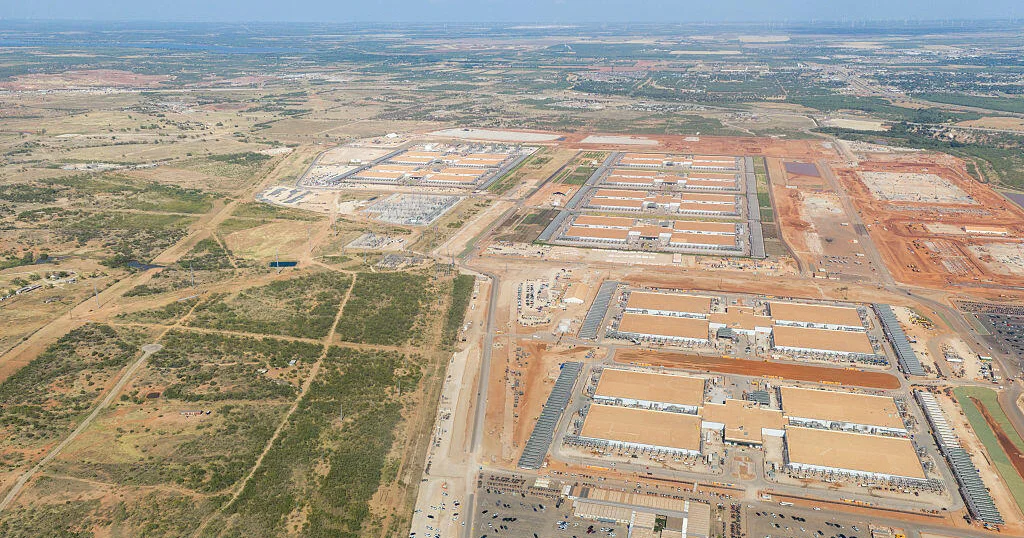

Just a year ago, data centers rarely figured in voters’ conversations. Now, the enormous facilities being built to power the AI boom have emerged as one of the most volatile issues of the 2026 midterms, creating a rift between the Trump administration and Republicans campaigning in state and federal races this fall.
When ChatGPT launched in late 2022, most data centers were located in blue states. By 2025, however, 68% of operating data centers were in red states. Republican-leaning states now account for 75% of facilities under construction and 80% of those in the planning phase, according to new data from Cleanview Research, an independent energy market intelligence firm tracking the industry’s expansion.
“Red states have more of a history of accepting large, energy-intensive infrastructure projects — even those that might have detrimental effects on communities,” said Chris Millay, a data center analyst at macroeconomic consultancy Greenmantle. He also cited fewer environmental regulations and the availability of open land as reasons rural states are attracting a growing share of the investment.
President Trump views the AI competition as vital to both the economy and national security, making him one of the industry’s strongest supporters. At a recent rally in Ohio, he said of data centers, “We want them … look, there’s so much money to be made for Ohio — you can’t just turn them off. They’ll go to China.”
Trump has repeatedly brushed aside local opposition, writing on Truth Social that “the only reason that communities throughout the U.S.A. should not want Data Centers is if they want to end up being backwards and poor.” Although he has resisted regulation, he has urged developers to benefit surrounding communities through education, lower taxes, job creation and protections against rising energy costs.
Although red states are hosting most of the expansion, residents living near new facilities are increasingly objecting. They have reported concerns about declining property values, noise, higher utility bills and depleted resources. Calls for construction moratoriums are also spreading among communities across the country.
Overall, opposition to data centers exceeds support by 30 percentage points. Polls show that a majority of Republicans oppose building the facilities near their homes.
“It’s such a consensus issue it’s really impossible to take the other side,” Millay said. “When voters see a politician who supports data centers, they think, ‘Well, how am I going to trust him with my job?’”
Some of Trump’s closest allies are beginning to distance themselves from him on the issue. In Texas, which has more data centers under construction than any other state, Republican Gov. Greg Abbott has paused environmental permits and grid connections for new facilities. Abbott, who is pursuing a fourth term, is in a surprisingly close race against Democrat Gina Hinojosa.
In Texas’ tight Senate race, Republican nominee and state Attorney General Ken Paxton has called for ending the state’s sales-tax break for data centers. He has also said developers should face criminal liability if they power AI chatbots that put children at risk.
Data centers may be the one issue on which Democratic and Republican candidates sound remarkably similar.
CONTINUE READING: Iranian Protester’s Final Call With Sobbing Father Before Execution
In Ohio, Democratic gubernatorial nominee Amy Acton said in a press release, “I am calling on our Statehouse to pass a conditional moratorium on data centers.”
Her Republican opponent, Vivek Ramaswamy, has taken an even harder line. He has pledged to “issue an executive order on my first day in office to immediately halt the approval of any new data center project announcements in Ohio” and maintain the pause until lawmakers approve his “Ohioans-First” law. The proposal would require data centers to provide free electricity to nearby residents.
A recent New York Times/Siena poll found that data centers are a vulnerability for Ohio Republican Sen. Jon Husted. On the issue, voters preferred his opponent by an 11-point margin.
Campaigns have spent $45 million this year on advertising that mentions data centers, with most of those ads opposing new projects, according to AdImpact.
Georgia has seen nearly $13 million in spending on data-center-related ads, more than any other state. Republican gubernatorial candidate Rick Jackson continues to support Trump’s position, while Democratic candidate Keisha Lance Bottoms is calling for a temporary construction moratorium. Jackson says decisions should instead be left to local officials.
At a recent news conference, Jackson argued that data centers can bring major financial benefits, saying he wanted “to educate people on the benefit if they want [a data center].” Some counties, he said, expect “will have zero property taxes after the data center goes in.” Effingham County, where OpenAI plans to build a $20 billion data center, has promised to use part of the resulting revenue to reduce homeowners’ property taxes.
Because most of the next generation of data centers is planned for states Trump carried in 2024, Republican candidates’ decisions — whether to side with local voters or the president — could determine whether projects are delayed, become more expensive or are canceled altogether.