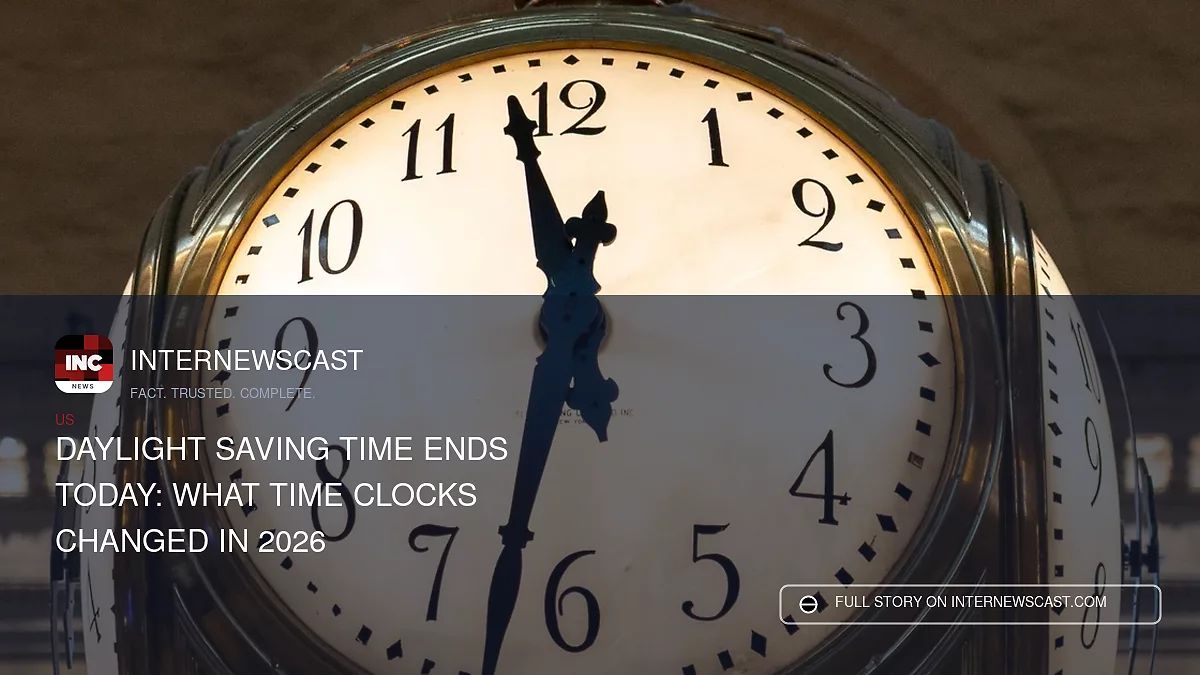

Millions of Americans got an extra hour of sleep this weekend as the twice-yearly clock change came to an end for 2026. Across most of the country, clocks moved back one hour at 2 a.m. Sunday.
Here’s a closer look at daylight saving time, why the nation observes it and what happens next:
What is daylight saving time, and why do we have it?
Daylight saving time is the stretch of the year—typically from March through early November—when most of the United States sets its clocks one hour ahead of standard time.
By shifting an hour of daylight from the morning to the evening, the practice creates later sunsets during the longer spring and summer days. When autumn and winter bring shorter daylight hours, the country returns to standard time, allowing the sun to rise earlier in the morning.
In Boston, for instance, the sun rose at 7:16 a.m. and set at 5:39 p.m. on Saturday before the clocks changed, according to the National Weather Service. After the return to standard time, Sunday’s sunrise was expected at 6:17 a.m., with sunset at 4:37 p.m.
The U.S. first adopted daylight saving time in 1918 during World War I, following similar efforts in Europe and with the aim of conserving fuel, according to the Congressional Research Service. Once the war ended, Congress repealed the national requirement but allowed individual states to continue observing the clock change.
Year-round daylight saving time returned during World War II and again during the energy crisis of the 1970s, both times as an attempt to reduce energy use. Neither experiment remained in place for long.
Following World War I, states and local governments largely decided whether to keep daylight saving time and how to schedule it. Congress did not establish a consistent nationwide start and end date until 1966. During the 1970s, the country’s trial of year-round daylight saving time was abandoned before it reached 10 months.
Will the U.S. move to year-round daylight saving time?
Earlier this year, legislation aimed at keeping daylight saving time in place year-round cleared an important step in Congress. Known as the Sunshine Protection Act, the bill passed the House in July and went to the Senate. It would also give states the option of rejecting daylight saving time entirely before the measure took effect.
President Trump, who backs the proposal, blamed fellow Republican Sen. Tom Cotton of Arkansas for holding up the legislation. Trump also shared what he identified as Cotton’s cellphone number on social media and encouraged supporters to contact the senator about the bill.
Cotton responded that Congress has previously tried permanent daylight saving time, only to restore the twice-yearly clock change after Americans faced “absurdly late sunrises in the winter.”
The Senate faces a deadline to act. The bill, along with other legislation still awaiting congressional approval, is scheduled to expire in early January when lawmakers elected in Tuesday’s midterm elections begin their terms.
If the proposal expires, supporters would have to restart the process, winning approval from both the House and Senate before sending it to the president.
IN CASE YOU MISSED IT: Gov. Hochul’s Cameo in Cornell Sex Assault Documentary Raises ‘Impropriety’ Concerns: Attorney
Did the time change today?
Yes. Clocks moved back at 2 a.m. local time Sunday.
In 2026, the shift came overnight after Halloween, giving people an extra hour for costume parties, late-night celebrations or much-needed sleep after the festivities.
For families with young children, however, the change can be less welcome. Parents may see their children’s sleep routines disrupted until their bodies adjust to the new schedule.
What day and time did daylight saving time end in November 2026?
Daylight saving time officially ended at 2 a.m. local time on Sunday, Nov. 1.
Since 2007, Americans have returned to standard time on the first Sunday in November, when the latest federal changes to the schedule took effect. A 2005 law shifted the end of daylight saving time from the final Sunday in October.
Do we lose or gain an hour when daylight saving time ended?
Most Americans gained one hour when daylight saving time ended, restoring the hour lost when clocks moved forward in March.
When will daylight saving time start again in 2027?
Daylight saving time will resume in 2027 at 2 a.m. local time on Sunday, March 14. The annual change takes place on the second Sunday in March, which falls relatively late next year because March begins on a Monday. In 2026, daylight saving time started on March 8.
The start date was moved to March in 2007 as part of an effort to lengthen the daylight saving period. Before then, it began on the first Sunday in April.
Which states don’t do daylight saving time?
Every state observes daylight saving time except Hawaii and most of Arizona. The Navajo Nation, which extends into parts of Arizona, does observe the change so its communities remain aligned with those in neighboring New Mexico and Utah, according to the tribe.
Daylight saving time is also not observed in the U.S. territories of American Samoa, Guam, the Northern Mariana Islands, Puerto Rico and the U.S. Virgin Islands.
Will my phone change for daylight saving time automatically?
Most phones will update overnight and display the correct time automatically, provided their automatic date and time settings are enabled.
Apple, Google and Samsung offer instructions for adjusting time settings on their devices. Wireless carriers, including Simple Mobile and Straight Talk, also provide online guidance for checking clock settings on other phones.