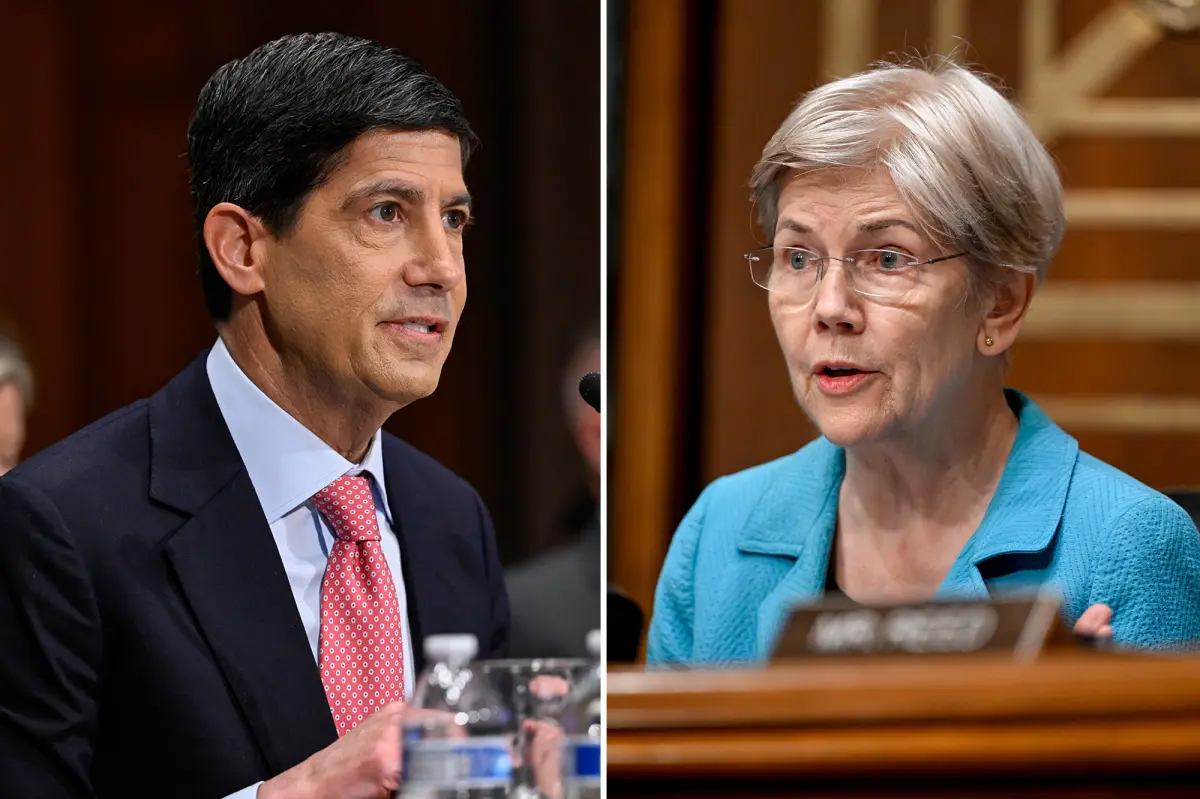
Sen. Elizabeth Warren sharply confronted Federal Reserve Chairman Kevin Warsh during a congressional hearing Wednesday, accusing the central bank leader of failing to address what she described as a pattern of corruption and ethical lapses inside the Fed.
Warsh was appearing before the Senate Banking Committee for a second consecutive day of testimony when the Massachusetts Democrat used her questioning to spotlight past ethics controversies involving senior Federal Reserve officials.
“Instead of trying to repair this broken culture, I’m concerned that you seem to be embracing it,” Warren said, pointing to Warsh’s divestment of more than $100 million in assets. Warsh has said he either fully sold those holdings or was in the process of doing so before assuming the Fed’s top job.
Warren pressed him directly on the timing of the transactions. “You say now that you’ve sold those shares. In other words, somebody wrote you a check for more than $100 million days before you entered office. Chair Warsh, who wrote that check?” she asked.
As Warsh began to answer by saying he had complied with requirements set by the Office of Government Ethics, Warren cut him off.
“I asked you a very specific question. Who gave you $100 million right before you were sworn in? Was it a billionaire who has businesses with the Fed? Was it Stanley Druckenmiller, who’s made billions of dollars betting on what the Fed does?” Warren said.
When Warsh again sought to emphasize that he had met all legal and ethics obligations, Warren rejected the response, declaring: “That’s not an answer!”
“Well, it is an answer, actually, senator,” Warsh responded.
Warren also grilled Warsh about a Wall Street Journal report that Michelle Bowman, the Fed’s vice chair of supervision, spoke at an invite-only Bank of America dinner last month during a blackout period, which bars central bankers from speaking about monetary policy publicly.
Warsh said he plans to leave the matter to the Fed’s Office of Inspector General. Warren has called on the office to investigate Bowman.
“I wasn’t at the meeting, I don’t know the facts,” Warsh said Wednesday.
Warren replied: “Did you ask her? Did you care enough to ask? How can you be chair and not ask your vice chair whether or not she violated the blackout period, violated the law?”
Warsh replied that he thought it would be inappropriate to “pre-judge facts.”
The questioning quickly devolved into a heated back-and-forth, with Warren asking three times in a row whether Warsh asked Bowman about the alleged meeting.
“Yeah, I think that’s one more question you don’t want to answer! I got to say, the tone that you are setting is one that seems to invite corruption and that’s gonna be a real problem.”
Warren also accused Warsh of being in President Trump’s “pocket,” since the president repeatedly said he would only nominate a chairman who promised to lower interest rates – though Warsh held rates flat at the central bank’s meeting last month.
Later in the hearing, Republican Sen. Mike Rounds of South Dakota gave Warsh time to respond to some of the accusations.
“I think you’ve been basically harassed a little bit in terms of making accusations to you. Let me give you just a minute to perhaps respond in just a straightforward manner. Did anybody give you $100 million?” Rounds asked.
“No,” Warsh replied.
During his testimony, Warsh emphasized the huge impact of artificial intelligence, calling it the most “consequential change to the US and global economy in my adult lifetime.”
Warsh said AI is “not without challenges,” but that he believes the US is in the best position worldwide to benefit from the new tech.
“In the long-term, my best guess is that this will improve American productivity and will improve the real wages and will help us on full employment,” Warsh said. “But between the short-term and the long-term, it can have a disruptive effect.”
He specifically warned that AI will likely raise prices over the next 12 months, but that he does not view this as “inflationary” since it is just a one-time change that will balance once supply catches up.
During his testimony Monday in front of the House Financial Services Committee, Warsh also emphasized the Fed’s commitment to bringing down inflation and prices.
Though he declined to share forward guidance on the path of interest rates, his hawkish, anti-inflation stance typically indicates a bias toward raising rates, not cutting them.


