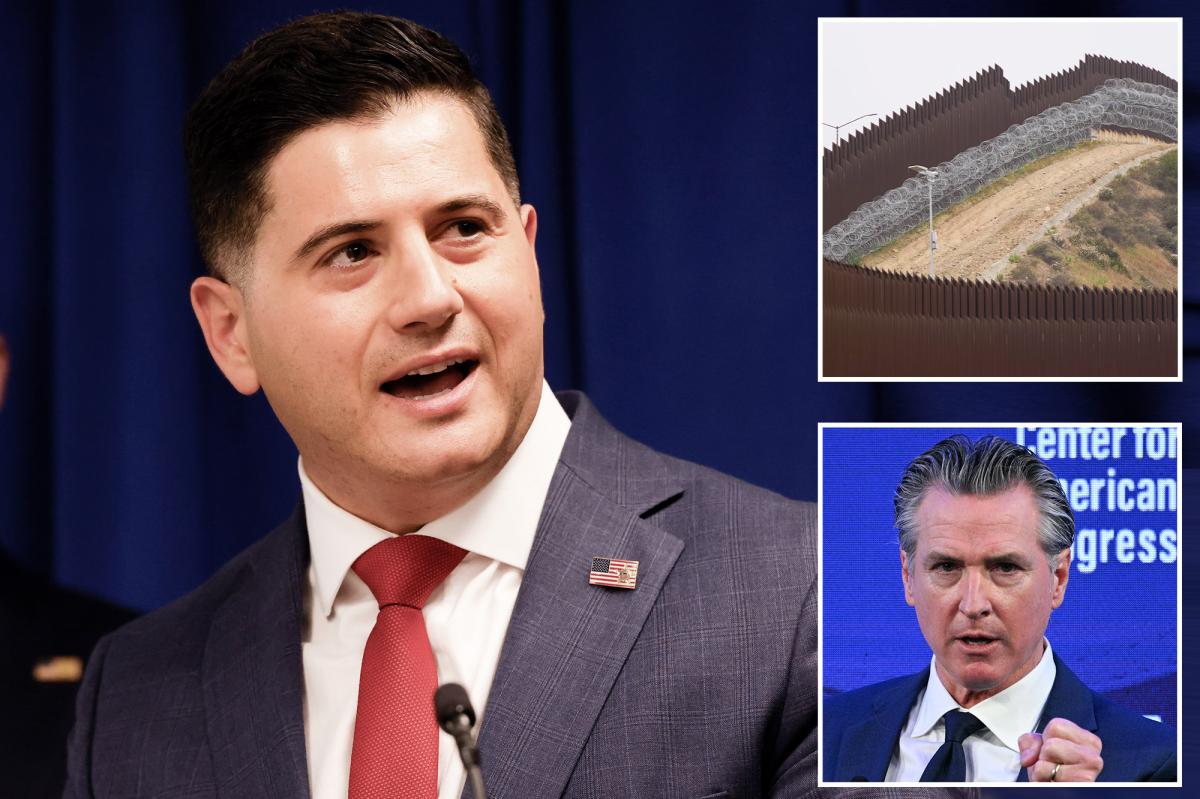


California’s sanctuary-state policies are drawing sharp criticism for allegedly compromising public safety. A prominent law enforcement official argues these policies necessitate costly and complex street operations to apprehend undocumented immigrants with criminal records, rather than allowing immigration agents to take them directly from jails.
According to Bill Essayli, the US Attorney for the Central District of California, the state’s sanctuary measures have dismantled a previously cooperative system. This system, he claims, was effective in preventing high-risk individuals from returning to the streets and posing potential threats to public safety.
“By state law, California has transformed into a sanctuary state,” Essayli remarked in an interview with The California Post.
In response to these growing concerns, federal authorities have launched Operation Guardian Angel. This initiative aims to target deportable individuals held in county jails before they are released back into the community.
Announced last year by the US Attorney’s Office for the Central District of California, the operation is a coordinated effort involving several agencies, including ICE, the FBI, the DEA, and the US Marshals Service. The primary objective is to identify undocumented immigrants with criminal backgrounds, secure federal arrest warrants prior to their release, and thus avoid the need for potentially disruptive street-level arrests.
Officials say the goal is to identify criminal undocumented immigrants in local jails, secure federal arrest warrants ahead of release, and prevent what they describe as avoidable street-level apprehensions once individuals re-enter public life.
At the center of the effort is a reliance on fingerprinting and jail booking records to flag individuals with prior deportation history.
Task forces typically begin reviewing county jail bookings across the state in the early morning hours, often around 3 a.m., cross-checking fingerprints against federal databases in near real time.
Those who show prior removals can face federal felony charges for illegal reentry, allowing prosecutors to obtain warrants quickly and take custody before release from local detention.
“This program only works, if we know who they are,” Essayli said.
First-time offenders in non-state prisons can easily slip back into the community under current state laws.
Essayli added that the financial burden of bypassing sanctuary policies could ultimately reach “hundreds of million, if not, billions,” when accounting for enforcement costs and broader impacts.
He said that under previous practices, immigration detainers allowed jail inmates to be transferred directly into federal custody after their local cases concluded, avoiding the need for post-release enforcement operations.
“Prior to these laws, we would work cooperatively with local police and jails and so when an illegal immigrant was arrested or charged or convicted they would work with immigration officials to place detainers on them and then once they’re done with their local or state proceedings they would be handed over to immigration for deportation,” Essayli said.
Download The California Post App, follow us on social, and subscribe to our newsletters
Now, he said, many county jails refuse to honor detainers, forcing federal authorities into more resource-intensive efforts to locate individuals only after they have been released into communities.
“Blue states think they’re protecting illegal immigrants, but they’re just making things worse on them,” he said. “Instead of just being deported, they’re going to have a felony.”
Essayli also pointed to what he described as a structural split between state prisons and county jails.
“There is a loophole in that prisoners in the state prison, which is run by the governor, (Newsom) has the discretion on whether to hand someone over to ICE or not.”
He said Gov. Gavin Newsom retains discretion over transfers from state prisons, while sheriffs and police chiefs are restricted at the county level.
“You’ll hear Newsom often say ‘we’re not a sanctuary state, we handed over 3,000 felons,’ that is for political cover so he can hand over literally the worst of the worst. He has the discretion to hand (all of) them over, but the sheriffs, the police chiefs have zero discretion, they’re not allowed to, the governor can do it if he wants to, that’s the state of the law in California.”
Essayli noted that most offenders never reach state prison custody.
“Basically, you don’t go to state prison unless you murder someone,” he said.
He added that offenses such as theft, DUI, and domestic violence are typically handled at the county level, where federal transfer options are more limited.
“We don’t want to wait until an illegal immigrant commits a murder, we want to deport them before that.”
In a recent and tragic instance, a deportable individual released due to non-cooperation state policies went on to murder two women and an infant.