
Tensions rippled across the Middle East on Saturday as Iran set out sweeping new conditions for reopening the Strait of Hormuz, while the United Arab Emirates said one of its vessels had been struck by an Iranian missile. In Yemen, government forces launched attacks on the country’s Iran-aligned Houthi rebels, and Turkey’s parliament approved a Kurdish peace measure.
Here is a roundup of the latest Middle East developments on Saturday. Full coverage is available here.
Iran says the strait won’t open until the US ‘corrects’ its behavior
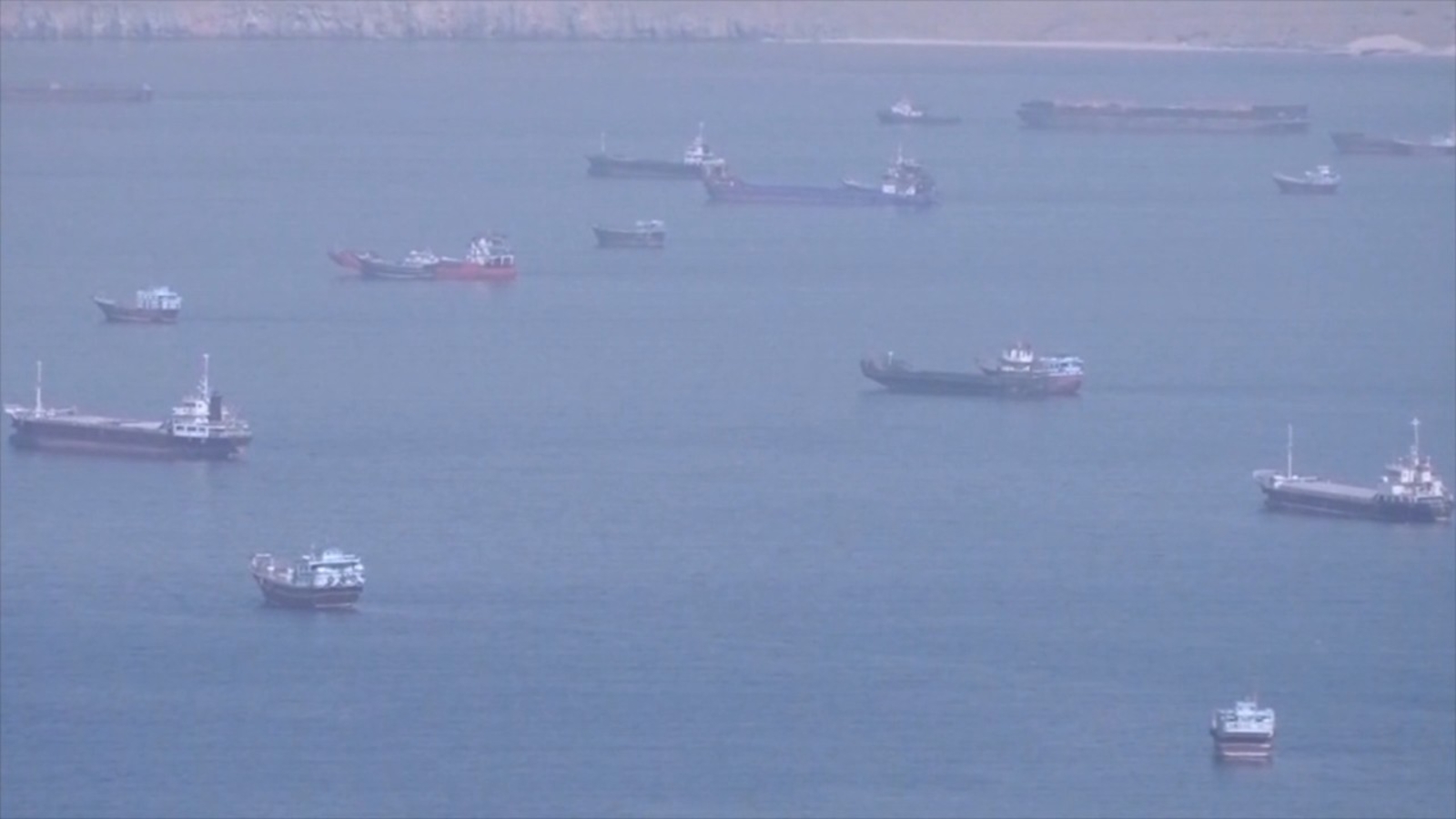
Iran’s Supreme National Security Council, a powerful body often compared to a politburo, declared that the Strait of Hormuz would remain closed until the United States “corrects its behavior.” The demand adds fresh uncertainty to negotiations aimed at reaching an agreement over management of the critical waterway.
The statement was carried by Iranian state television and attributed to the council’s secretary, Mohammad Bagher Zolghadr, who also serves as a commander in Iran’s influential Revolutionary Guard.
According to the statement, Washington must pledge never to threaten Iran again, permanently end its war with Iran and Tehran-backed armed groups across the region, lift the naval blockade on Iranian ports and pull U.S. forces out of the area. Iran also demanded full compensation for wartime damage, the removal of sanctions and the “unconditional” release of frozen Iranian assets.
There was no immediate response from the United States, which has sought an acceptable framework for the Strait of Hormuz before ending the blockade. Under an interim agreement signed in June, a timeline for sanctions relief and a process for compensation were expected to be addressed in a final deal, with frozen assets also slated for negotiation.
Iran has separately indicated that it was nearing an arrangement with Oman over management of the strait, the narrow but strategically vital passage that runs between the two countries.
Earlier Saturday, Iranian Foreign Minister Abbas Araghchi said an agreement on navigation through the Strait of Hormuz was close. But in comments shared on social media, he stressed that reopening the waterway depends on additional conditions, blaming the standoff on what he described as a U.S. breach of the interim deal.
Oman, a mediator Gulf Arab country which has said relatively little on the talks, said in a statement discussions were ongoing “in a positive and constructive atmosphere,” and condemned attacks on ships on the strait.
Details emerge about potential Iran-Oman deal
The strait, crucial to global supplies of oil and natural gas, was considered an international waterway before the war.
The deal Iran and Oman are working to finalize would be temporary, but it would reopen the strait with ships entering the strait through a route close to Iran and exiting through a route close to Oman, according to two people familiar with the talks who spoke on condition of anonymity because they were not authorized to speak publicly.
Ships would cross the strait without paying fees or tolls during the interim period.
The agreement is designed to restore an earlier, separate agreement between the U.S. and Iran and restart a 60-day clock for the two countries to negotiate over Iran’s nuclear program.
During that time, Iran is expected to be able to sell oil. The current 60-day deadline to negotiate a final deal is due to end in just over a week.
According to the two people who spoke about the talks, the deal is endorsed by members of the Gulf Cooperation Council and expected when finalized to be jointly announced by Iran, Oman, the U.S., and the International Maritime Organization of the United Nations. But the people stressed the terms could still change before the deal is final.
– by Michelle Price in Washington and Aamer Madhani in New York.
Iran attacks a vessel in the Strait of Hormuz, the UAE says
A vessel owned by Abu Dhabi’s state-owned ADNOC oil and gas company was attacked while transiting the strait, Emirati authorities said. The Foreign Ministry said Iran fired the missile as part of attacks on commercial shipping.
ADNOC in a statement said there were no casualties following the early Saturday attack. The company said over a dozen of its vessels have been attacked by missiles and drones while transiting the strait since the U.S. and Israel launched the war on Iran in February. One crew member has been killed and 20 others wounded, it said.
ADNOC didn’t elaborate on the attack’s location or any damage.
Later, the United Kingdom Maritime Trade Operations Center said a vessel east of the town of Khasab, Oman, had been struck by a projectile that caused a fire that was put out, with the vessel and crew safe. It was not clear whether this was the ADNOC incident.
A defense deal is not aimed at any third country, Turkey says
A defense agreement that Saudi Arabia, Pakistan and Turkey signed Friday is not aimed against any third country, Turkish Foreign Minister Hakan Fidan said. It says an attack on one would be considered an attack on all three.
Fidan told Turkey’s state-run Anadolu Agency on Saturday the countries do not view any state as an adversary unless it takes hostile action against them: “We don’t have anything written down – nothing we’ve signed – that defines a common threat.”
Asked how the mutual defense mechanism would work, Fidan said a member would formally request help and the two countries’ assistance could range from intelligence-sharing to logistics support or the deployment of military units. The mechanism would establish a secretariat to be based in Saudi Arabia, Fidan said.
He said other nations, which he did not identify, have expressed interest in joining the agreement, adding that he expects Egypt, which he described as a “natural partner,” to participate “at the next stage.”
Yemen’s military attacks Iran-backed Houthis
The attacks were in response to the Houthis’ recent strikes in central and eastern Yemen. Col. Majed al-Nazili, spokesperson for Yemen’s military, said the attacks targeted the rebels’ “sites and capabilities” on multiple front lines, without elaborating.
The escalation between the Houthis and Yemen’s internationally recognized government and its backer, a Saudi-supported coalition, threatens to reignite Yemen’s civil war following a 2022 truce.
Turkey’s Kurdish peace bill wins approval in parliament
A Turkish draft law aimed at advancing a peace effort with the country’s Kurdish insurgents passed its first hurdle in parliament on Saturday. A committee approved the measure. It is expected to be approved in the general assembly next week.
Last year, the Kurdistan Workers’ Party, or PKK, declared its decision to disarm and disband as part of the peace initiative aimed at ending the decades-long conflict with the Turkish state.
The draft legislation defines the procedures for the group’s disarmament and rehabilitation of some PKK members. The measures would come into effect once Turkey’s National Security Council confirms that the group has disbanded and surrendered all weapons.
The conflict has killed tens of thousands of people since it began in the 1980s. Turkey and its Western allies consider the group a terrorist organization.
Copyright © 2026 by The Associated Press. All Rights Reserved.