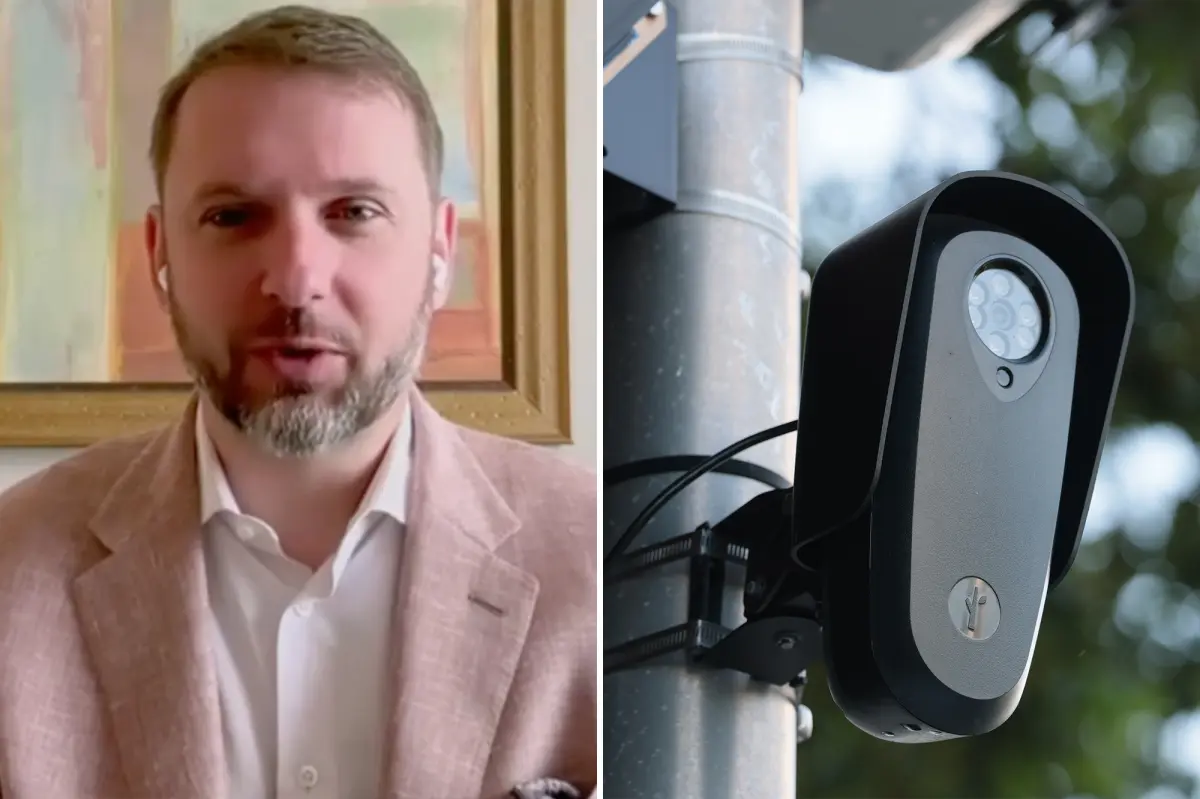

Former Pentagon AI policy director Mark Beall is sounding the alarm over the rapid spread of artificial intelligence-powered surveillance systems, warning that tools such as Flock cameras could push U.S. neighborhoods toward a “China-like surveillance state” if firm safeguards are not put in place.
Appearing on “Saturday in America,” Beall said the technology can be a valuable asset for police departments investigating crimes, but he stressed that its use must be governed by clear limits, strong policies and judicial oversight to ensure Americans’ constitutional rights are protected.
“We have to be careful that we don’t go too far to the other direction and create a China-like surveillance state, which is literally what AI capabilities will ultimately enable and are enabling right now,” Beall told Fox News.
The debate has already spilled into neighborhoods across the country, where backlash has ranged from damaged camera poles to viral signs placed in front of surveillance lenses. Flock cameras, which function as automated license plate readers, collect vehicle data that law enforcement agencies say can help solve crimes. Critics, however, argue the systems raise serious privacy questions and could be misused by police.
Beall said those competing concerns should not be dismissed. While acknowledging that the cameras can help officers do their jobs, he called for a middle ground that includes strict usage rules and court supervision, particularly to prevent law enforcement personnel from accessing the technology for personal or improper reasons.
“It’s tough to bring the message of compromise to the American people, especially when it comes to our constitutional protections,” Beall said.
“I think what we’re seeing across the board when it comes to artificial intelligence is that the innovation upside is so tremendous, but across all of these different use cases, including the Flock cameras, what we really need are strong guardrails, a strong policy that allows us to maintain those special values, the American founding principles that make this country so great,” he added.
Concern over AI surveillance and automated license plate readers has also reached Capitol Hill, where lawmakers in both parties have urged tighter controls. Sen. Bernie Sanders, I-Vt., has proposed banning the technology entirely, while Rep. Tim Burchett, R-Tenn., has sought to block federal funding for local deployments.
In Florida, transportation officials have ordered law enforcement agencies to take down the license plate readers from state highways. They cited privacy concerns and reports of misuse of the technology.

Florida Gov. Ron DeSantis criticized the cameras at a news conference Monday, saying, “If you want to get in your car, and you want to go down to Buc-ee’s in St. Augustine, it’s really none of the government’s damn business if you’re doing that, right? What we don’t want in the state of Florida is to have a digital AI surveillance state where everything we’re doing is being tracked at all times.”
He added that the technology has sometimes been useful but questioned where the data is going and how it is being stored.
“They claim that the companies aren’t going to misuse it, but no one’s watching that, and I know you can make some money selling cameras, but you really can make a lot of money if you can sell people’s data,” DeSantis said.
He said the company is focused on ensuring the technology is used for good, including by recommending seven-day data retention limits and holding those who misuse the system accountable.
In a statement to Fox News Digital, Flock Safety said they announced new safeguards, including cutting default data retention to seven days, making misuse detection mandatory for every customer and calling on the broader surveillance industry to meet those same standards.
In August, Flock Safety CEO Garrett Langley addressed privacy and safety concerns in an interview with Fox News host Kayleigh McEnany.
“Today, it is too often that in Flock and in other technologies, there’s no regulation. There’s no accountability, and we think that’s wrong,” Langley said.
“We announced changes that required auditing, that required using our audit assistance tool, which detects abnormal behavior, and we’re calling on state regulators to focus less on banning this type of technology and more [on] holding our law enforcement community accountable,” he added.