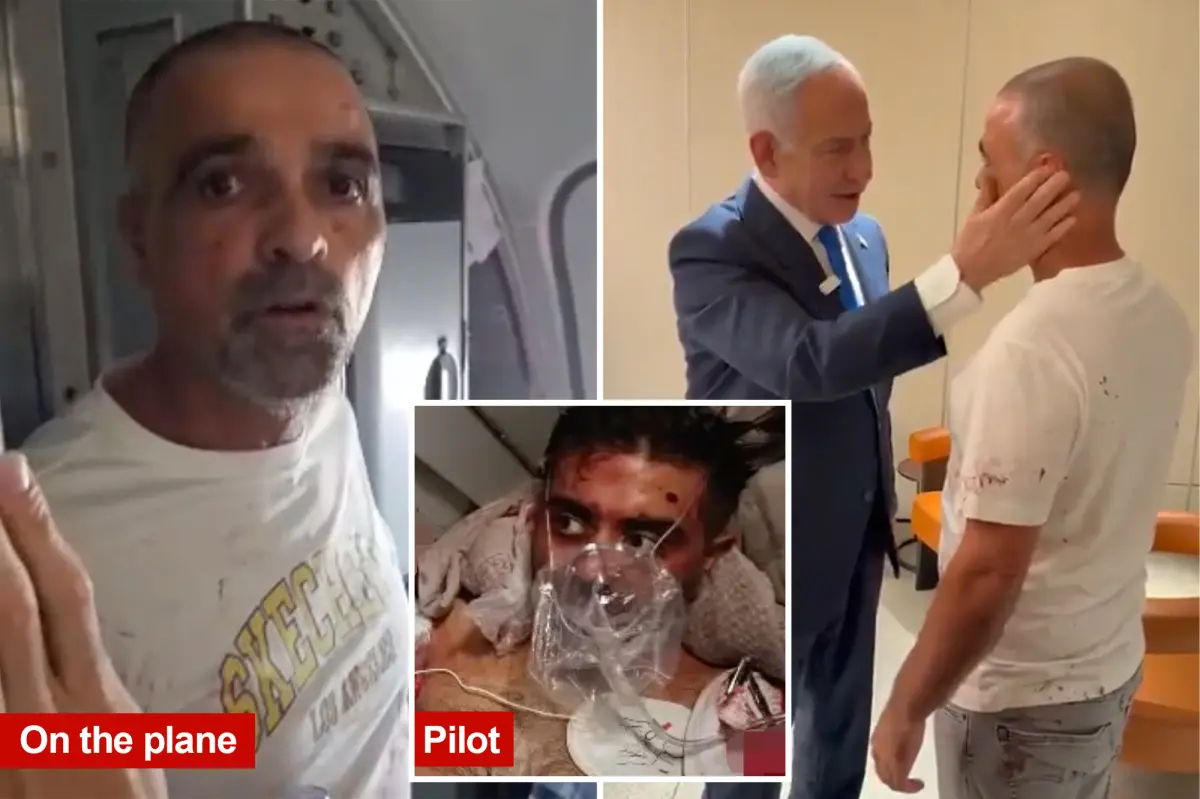

Passengers on a hijacked flydubai flight said they were stunned when crew members confronted the Israeli civilians who had subdued an ax-wielding co-pilot after he attacked the pilot, demanding that the suspected terrorist be released. Two of the men who helped restrain him described the dramatic confrontation in exclusive interviews with The Post.
“They were asking us to untie the terrorist — we had no idea why,” said banking executive Tzvika Manes, one of three civilians who overpowered the would-be hijacker.
“They were saying to free the terrorist — we got instantly suspicious of them,” said real estate professional Daniel Schlichter, who was seated in the second row near the cockpit.
Manes, 40, was flying home with his wife and their three daughters, ages 11, 7 and 6, after a family vacation in Japan. During the flight, the co-pilot — identified by The Wall Street Journal as Omani national Hamam al-Hammami — allegedly began attacking Indian pilot Capt. Smit Machchhar with a crash ax.
Machchhar, who was seriously injured, managed to open the cockpit door. Manes, plumber Yaniv Hayoun and Asaf Rajuan rushed toward the attacker and succeeded in overpowering him.
Hayoun then helped stabilize the plunging aircraft, relying on techniques he had learned from the television program “Air Disasters.”
After the three Israelis subdued the attacker and restrained him face-down, with his hands tied behind his back first by zip ties and later with headphone wires collected by Schlichter from other passengers, several crew members began insisting that he be released.
A heated argument followed. The three Israelis responded that the suspected terrorist would not be freed under any circumstances.
“They said, ‘You are not God, you are not going to kill him,’” Manes recalled. “We didn’t want to kill him, we just wanted him not to kill us.”
Schlichter, 59, who was also returning from a vacation in Japan with his wife, said the Israelis and Manes provided the wounded attacker with an oxygen mask.
“We wanted him to live so he could be investigated,” Schlichter said.
The standoff escalated as crew members insisted that they were responsible for the aircraft and needed to remain in the space directly outside the cockpit.
Fearing that the crew might have been involved in the pilot’s alleged plot, the Israelis ordered the flight attendants to leave the cockpit area and move to seats in the middle of the plane.
“We told them, ‘Now the policy is we’re in charge and you do what we say,’” Manes said.
“We didn’t know what to think, we were in a suspicious mode for every steward.”
A group of passengers, including Schlichter, escorted the crew members to seats in the fifth or sixth row, away from the cockpit.
“We shouted at them and told them to sit down,” said Schlichter, who has two children and two granddaughters.
The three men then recruited a “big guy” to guard the cockpit and stop anyone from entering, Manes said.
By that point, reserve pilots seated toward the rear of the aircraft had entered the cockpit and taken control of the plane.
Once the crew members were seated, they began to “understand that this was a special case,” Schlichter said. They then turned their attention to the traumatized passengers, distributing blankets and water.
The crew has not been accused of conspiring with the bloodthirsty co-pilot.
When asked by The Post about the crew’s behavior, flydubai said it could not comment on a matter under investigation. “We remain fully committed to supporting the ongoing investigation and are in close coordination with the relevant government authorities and regulators,” it said in a statement.
“I stayed with the terrorist until we landed safely in Tabuk, Saudi Arabia. After that I hugged my daughters and told them they were going to be OK, and that they are heroes,” Manes said.
Once the plane landed, the adrenaline began to wear off and passengers started processing what they had just survived.
Some had panic attacks while others broke down crying, Manes said.
“They didn’t want to fly back to Israel on another flydubai flight. Many wouldn’t step foot on the plane until they were personally told by the Mossad that the pilots had been cleared,” he said.
The self-described “regular finance guy” never dreamed he would one day be the center of a movie-like life-or-death midair battle.
His only thought was saving his family.
“When I heard my daughters crying ‘Father I don’t want to die’ — that was the trigger for me to run and fight, I wasn’t thinking of anything, it was just fight or flight,” Manes said.
The pilot fought the three men viciously.
“Punches were flying, we were kicking him, we didn’t know if he still had his knife, we couldn’t see it,” Manes said. “None of us were fighters or heroes, we were just normal guys who wanted to save our families.”
“It was sounds you only hear in a movie,” Schlichter said.
Manes, the CEO of Barak Capital Underwriting, Israel’s largest investment bank, said he has bruises all over his body.
“The G-Force was like something I never felt like in my life, it felt like everything was soaking, it was a crazy feeling,” he said.
Schlichter said that he was fully prepared to die as the plane nosedived 17,000 feet in moments.
“It was the longest minute I’ll ever have in my life, I remember everything, I remember clearly thinking about 9/11, then I thought about my children, my family, how awful it would be for them to hear what happened,” he said.
Both men said they were overwhelmed by the number of things that had to go right for everyone aboard to survive.
“Statistically this kind of miracle can not be happening, the chance that each one of us, especially would be on the same second where they had to be, I can’t even fathom how unlikely it is,” Schlichter said.
“I believe that definitely we had divine protection,” Manes said. “Someone up there is watching over us.”