
Journalist and former Carter White House speechwriter James Fallows reflects on the enduring legacy of 9/11, a quarter-century after the attacks:
People often recognize that they are living through a historic rupture. What they cannot know in the moment is where that rupture will lead.
December 7, 1941, the day Pearl Harbor was attacked and later remembered as a date that would live in infamy, pushed the United States out of isolationism and into a lasting global role.
But what about September 11, 2001? In its immediate aftermath, the attacks appeared to alter nearly every assumption about American life, security and the country’s place in the world. Now, on the 25th anniversary of 9/11, the legacy looks more complicated: some changes that once seemed likely to endure did not, while others that became permanent may one day be reconsidered by future generations.
Moments of national trauma can reveal extraordinary reserves of decency and solidarity. After the attacks, Le Monde captured the mood abroad with the words, “We are all Americans.” NATO, for the first and only time in its history, invoked its collective defense principle, with member nations rallying behind an ally under attack.
Inside the United States, the country paused to honor firefighters, police officers, emergency workers and ordinary citizens whose courage became part of the day’s story. President George W. Bush, whose administration had been blindsided by the attacks, visited the Islamic Center of Washington just days later. His message was direct: although the hijackers were Muslim, Islam was not the enemy. “In our anger and emotion, our fellow Americans must treat each other with respect,” Bush told the nation.
That spirit of unity, however, proved more fragile than many hoped. At the same time, some of the most consequential changes that followed 9/11 became embedded in American government and daily life without receiving the sustained public examination they deserved.
Before the attacks, there was no Department of Homeland Security, no Transportation Security Administration and no Immigration and Customs Enforcement. The responsibilities now associated with those agencies existed, but they were carried out on a smaller scale and with far less institutional reach.
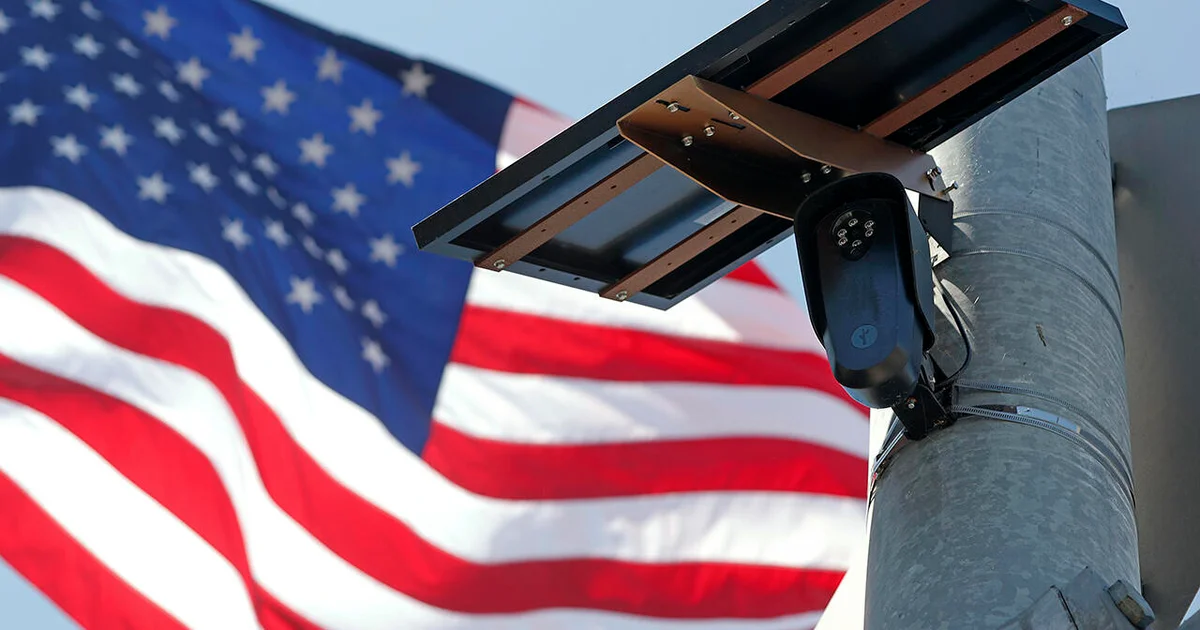
Before 9/11, there was no Patriot Act, and barely any of the modern structure of the surveillance state.
Justin Sullivan/Getty Images
Before 9/11, local police in the U.S. were not kitted out in combat gear as if fighting in Fallujah. That is because before 9/11, there was no war in Iraq (for which 9/11 was the excuse, though no Iraqis were involved), and nothing like the “forever wars” that have followed.
Much of it was bipartisan. Most of it was step-by-step. And as we look back, we see a country that survived an attack and avoided a repetition. But it is also a country whose daily life and civic culture those attackers managed to change.
The U.S. has had other hinges of history that turned in the wrong direction: In the late 1800s, with the turn against Reconstruction and equal rights after the Civil War; in the 1920s and ’30s, when the U.S. closed its doors to the world, even as Nazis and fascists rose to power elsewhere.
Let us hope that 25 years from now, the U.S. has reckoned more seriously with who we are, and who we want to become, than we have done so far.
Remembering 9/11: Where tragedy left its marks
Remembering 9/11: Andrew Card on the moment everything changed
Remembering 9/11: Robert De Niro on helping revive Lower Manhattan after September 11
Remembering 9/11: When Gander provided safe haven in a time of crisis
Remembering 9/11: “Come From Away”: Transforming tragedy into art, darkness into light
For more info:
Story produced by Annie Iezzi. Editor: Emanuele Secci.


