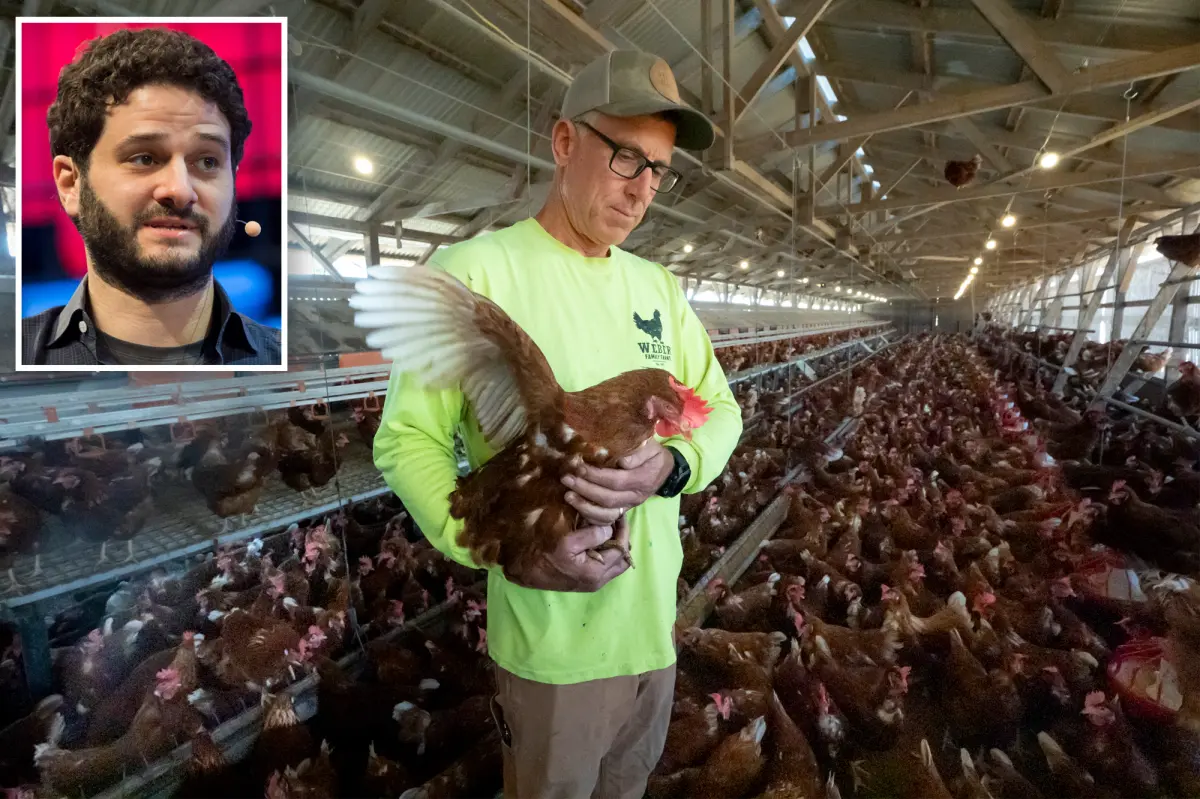

Dustin Moskovitz, the billionaire who helped launch Facebook and later co-founded workplace software firm Asana, has publicly acknowledged that he enjoys eating meat.
Yet in an unusual contrast, the left-leaning Democratic megadonor has directed close to $500 million into advocacy efforts aimed at reshaping animal agriculture — campaigns critics say have made livestock farming more difficult and helped push up egg and meat prices for millions of U.S. shoppers. At the same time, one of Moskovitz’s foundations owns an almost $89 million stake in Impossible Foods, the plant-based food company, creating the possibility that it could gain if higher meat prices steer more consumers toward alternatives, The California Post has learned.
The funding trail leads to two tightly connected parts of Moskovitz’s charitable network: Coefficient Giving, the nonprofit previously called Open Philanthropy, and Good Ventures, the private foundation overseen by Moskovitz and his wife, former journalist Cari Tuna.
Coefficient Giving describes its goal in straightforward terms: limiting suffering on factory farms. Since 2016, the organization has distributed more than $480 million in grants tied to that mission.
Farmers and agriculture-industry sources told The Post, however, that the effort functions as a heavily financed campaign of pressure — supporting activist organizations, ballot initiatives, corporate lobbying, litigation and media ventures that they contend have contributed to higher prices for meat, eggs and pork paid by ordinary Americans.
Hannah Thompson-Weeman, president and CEO of the Animal Agriculture Alliance, told The Post that many consumers imagine animal-rights activism as a loosely organized collection of sign-carrying volunteers.
That perception, she argued, misses the level of coordination, strategy and financial backing behind the movement — forces she said, combined with inflation, have helped leave grocery shoppers stunned by rising prices.
Download The California Post App, follow us on social, and subscribe to our newsletters
“These groups are all connected, it’s the same people, it’s the same money flowing back and forth,” Thompson-Weeman said. “Those different public personas are a very intentional strategy to work differently towards the same goal.”
The Post’s review of donations listed on Coefficient Giving’s website found that money has been spread across nearly every part of the animal rights activist ecosystem.
The biggest recipients include The Humane League with $94.5 million, Mercy For Animals ($38.7 million), Anima International ($21.1 million), Compassion in World Farming ($27 million), and The Good Food Institute ($32.5 million), a nonprofit that promotes plant- and cell-based alternatives to animal products.
Moskovitz’s money — he’s estimated by Forbes to be worth $10.5 billion and has contributed almost $135 million to Democratic campaigns, according to Federal Election Commission records — also went to media outlets and communications groups, including The Guardian. The outlet’s nonprofit arm received three grants totaling $2.24 million from Open Philanthropy (Coefficient Giving’s name until late last year) for a sprawling, multi-year series on factory farming and animal cruelty.
Stories on pig slaughterhouses and “dairy cruelty” cited officials from groups like Compassion in World Farming and the Conservative Animal Welfare Foundation, respectively, both of which have received millions from Coefficient Giving.
The stories did not disclose the circular nature of funding sources, and any mention of Open Philanthropy can only be found on a separate webpage on the Guardian’s website.
“Make no mistake,” Thompson-Weeman said, “this is a very well funded and strategic movement that’s targeting animal agriculture.”
The Chicken and the Egg Fight
The activist war on animal farms is not some abstract policy debate for Mike Weber, whose family owns Sunrise Farms in Sonoma County, just north of San Francisco.
In 2018, activists raided his farm in what they thought would be a viral sting operation.
“They showed up with buses, hundreds of people,” Weber said of the activists who targeted his family’s 114-year-old poultry farm.
“They coordinated this whole event to storm onto our farm illegally, pry open the doors and run through the chicken houses, trying to steal the chickens.”
Forty activists involved in the incident were reportedly arrested for trespassing, according to Politico. Activists claimed the barns were filled with bloody, injured and dead birds, Weber said, but his own footage showed a different story in court.
The same year, California voters passed Proposition 12, which required farm animals to receive more space and egg-producing chickens to go cage-free. Weber said the new requirements forced him to overhaul the design of his farm, leading to extra costs being passed on to consumers while also making it more likely that his chickens could contract disease, leading to additional measures to vaccinate the birds.
“The small guys like us, at some point we have to tap out, because we just can’t afford to keep borrowing money to swim like crazy to stand still,” Weber said.
A spokesperson for Coefficient Giving denied any financial motive in its philanthropic efforts around animal farms, saying the group’s work is driven solely by animal welfare.
“Coefficient Giving is proud to support advocacy, scientific research, and movement-building efforts to improve the awful conditions on factory farms in which billions of animals live,” Officials said. “Reducing their suffering is the sole motivation of our work in this area.”
The nonprofit said that its giving to organizations focused on non-animal products represents only a small fraction of its grantmaking, and any profits on Good Ventures’ Impossible Foods investment are legally required to go to charity.
Weber’s farm was not targeted by a group funded by Moskovitz, but he told The Post that he considers Coefficient Giving’s network to be in league with the same bad actors. Coefficient Giving also lists more than $5 million in grants to fund litigation.
Coefficient Giving noted that it does not fund anyone to enter agricultural facilities without authorization.
The activists funded by Moskovitz’s operations, Weber said, often present themselves as experts on farming while lacking any formal education or experience in agriculture, animal husbandry or biosecurity.
“It’s as if you’ve got a chiropractor who’s impersonating a brain surgeon,” Weber said. “When you scratch below the surface, you realize you’re just talking to somebody who’s a fanatic.”
A Steak in the Future
Will Coggin, research director at the Center for the Environment and Welfare, said the real fight is not over whether animals should be treated humanely, but whether billionaire-backed activists can make animal farming so expensive and legally risky that producers eventually give up.
“It was billed as one of these humane farming laws,” Coggin said of Prop. 12. “But what it really does, in effect, is that you can’t buy regular eggs anymore in California like you could anywhere else — or regular pork products.”
The California ballot measure did not just regulate farms inside the Golden State. It also imposed California’s standards on pork, eggs and veal sold in the state, forcing out-of-state producers to comply if they wanted access to one of the country’s largest consumer markets.
The Post’s review found Coefficient Giving gave $4 million to Prevent Cruelty California for the “Yes on Prop 12” campaign. Its grant database also shows millions more flowing to groups pushing cage-free egg campaigns, broiler chicken campaigns, corporate pledges, shareholder pressure efforts and litigation targeting animal agriculture.
Coggin said the campaigns continuously move the goalposts for farmers until compliance costs become too steep for smaller producers, leading to the cost of meat and eggs becoming more expensive for consumers. Meanwhile, the same groups vilify large-scale farms.
Download The California Post App, follow us on social, and subscribe to our newsletters
“It raises the cost of animal protein and it reduces consumer choice,” Coggin said. “It’s part of a long-term strategy that we’ve identified by the animal rights movement to drive up costs for consumers, reduce demand for animal products and put farmers out of business.”
He added, “If Moskovitz-funded groups can come in and raise the price of eggs and pork or other animal protein at the supermarket, then all of a sudden Impossible Foods products become more cost-competitive, and that helps the bottom line for the investment.”
Thompson-Weeman said the group’s paid activists often target brands and farms that have already adopted higher welfare practices. The point is not to improve animal agriculture, she said, but to make the public believe the entire system is inherently cruel and should be replaced.
“They believe there’s no way to ethically and responsibly raise animals for food,” Thompson-Weeman said.
Coggin suggested the endgame in this Moskovitz-funded operation targeting animal farms will eventually benefit the source.
“They want to ban and get rid of standard animal farming,” Coggin said. “And in the long run, they want to replace it with things like Impossible Foods products or lab-grown meat.”