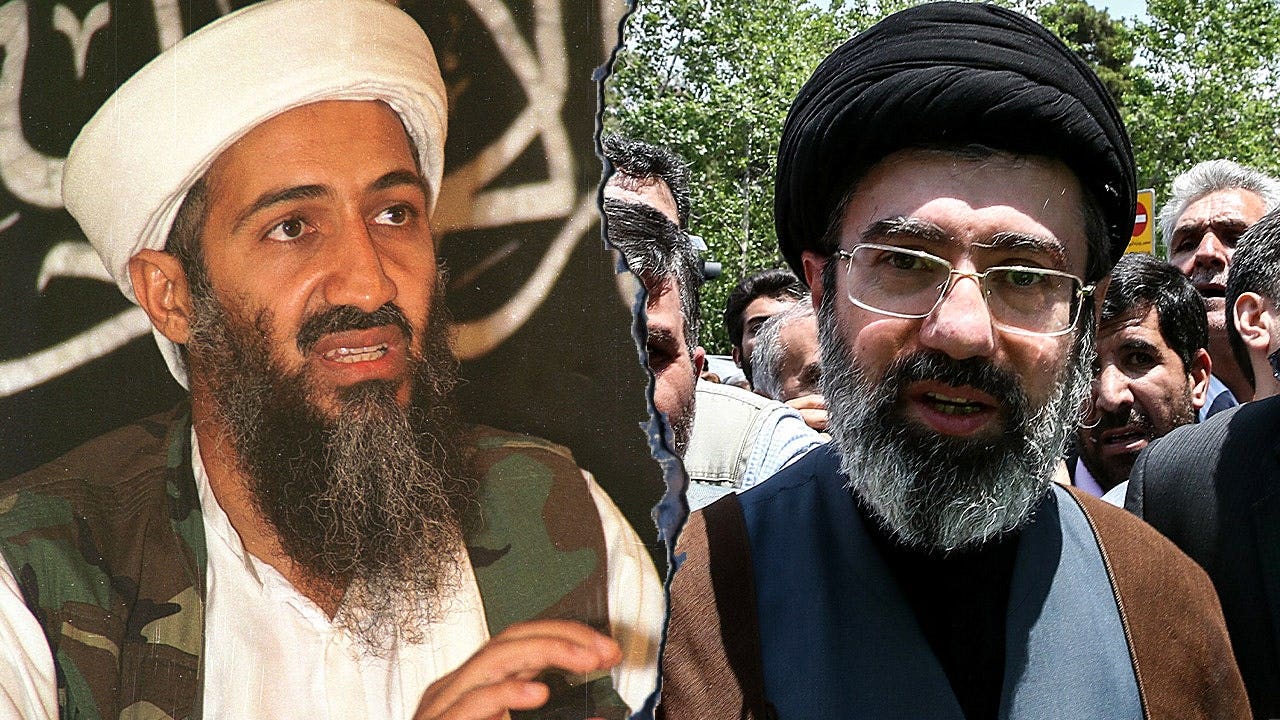

Iran’s Supreme Leader Mojtaba Khamenei has remained out of the public eye for nearly three months as tensions with the United States continue to rise. This extended absence has drawn comparisons from counterterrorism experts to al Qaeda leader Osama bin Laden’s final years in hiding.
This parallel arises amid a high-stakes standoff between Washington and Tehran. The situation recently led President Donald Trump to halt a planned military strike on May 19. Speaking to reporters on Wednesday, Trump indicated that he is “in no hurry” to escalate actions further.
Although Khamenei’s official X account shared three posts on May 18, the Supreme Leader himself has not made any public appearances since then.
“For the first time in the history of the Islamic Republic, the United States is exerting pressure on Tehran similar to what it directed at al-Qaeda and ISIS over the past two decades,” Dr. Omar Mohammed, a counterterrorism expert, remarked to Fox News Digital.
MISSING IN ACTION: IRAN’S SUPREME LEADER AVOIDS PUBLIC EYE AMID U.S. TENSIONS AND NUCLEAR SITE PRESSURE
A portrait of Iran’s Supreme Leader Mojtaba Khamenei has been circulated by news outlets, including Fox News, in the absence of recent appearances.
“The U.S. has driven its leader into the same kind of operational invisibility that bin Laden lived in for 10 years in Abbottabad,” he added.
“Both Mojtaba Khamenei and bin Laden inherited their status on the back of an American operation, and both responded the same way: by ceasing to exist publicly,” Mohammed said before adding that bin Laden “stopped releasing dated videos around 2007 and confined himself to audio messages carried by hand.”
Bin Laden founded al-Qaeda in the late 1980s and masterminded the Sept. 11, 2001, terrorist attacks against the United States.
After the U.S. invasion of Afghanistan, bin Laden evaded capture for a decade by hiding inside a fortified compound in Abbottabad, Pakistan.
To avoid Western electronic surveillance, he severed his digital footprint and relied exclusively on a network of physical couriers, said Mohammed, an expert with the Antisemitism Research Initiative at George Washington University’s Program on Extremism.
U.S. intelligence eventually tracked one of those couriers to the compound, culminating in the 2011 Navy SEAL raid that killed the al Qaeda leader.
OPERATION EPIC FURY: HOW AMERICA’S AIR POWER IS CRUSHING IRAN’S TERROR REGIME
Portrait of former al-Qaeda leader Osama bin Laden. Bin Laden was killed in 2011 in a daring SEAL Team 6 raid in Pakistan. (Photo by Stephane Ruet/Sygma via Getty Images)
“Bin Laden survived with no cables out of the Abbottabad compound. Communications were carried by hand by two trusted couriers, the Kuwaiti brothers,” Mohammed said.
“Bin Laden stayed hidden for the rest of his life because the moment he surfaced was the moment he died. Mojtaba’s incentives point the same way. Mojtaba Khamenei won’t emerge,” he said.
“The Abbottabad lesson, which Tehran will have studied closely, is that the safest hiding place is not a cave in Tora Bora but a walled compound in a garrison town,” Mohammed added, recalling how U.S. forces targeted bin Laden in the cave complex before he escaped.
Bin Laden also lived roughly a mile from Pakistan’s top military academy, hiding in plain sight behind high concrete walls and barbed wire, Mohammed noted.
“The logical Iranian equivalents are hardened sites under or alongside IRGC facilities,” Mohammed added, referring to the Islamic Revolutionary Guard Corps and possible locations where Khamenei could be.
As previously reported by Fox News Digital, one of Khamenei’s few recent communications was an X post declaring a “holy war,” framing the geopolitical clash as a mandatory religious obligation.
INSIDE IRAN’S RULING IDEOLOGY: HOW A ‘HOLY MISSION’ AND MESSIANIC DOCTRINE FUEL REGIME EXTREMISM

President Donald Trump said, “I got him before he got me” after Iran’s Supreme Leader Ayatollah Ali Khamenei and several top leaders were killed in an Israeli strike in Tehran during the U.S.-Israeli military offensive called Operation Epic Fury. (Majid Saeedi/Getty Images; Yuri Gripas/Abaca/Bloomberg via Getty Images)
“This is a religious leader calling for sacred war against America and the Jews from an undisclosed location because his enemies have publicly vowed to kill him on sight,” Mohammed said, describing the narrative as “the bin Laden template, almost line for line.”
Mohammed also suggested Khamenei’s retreat into the shadows marks a watershed moment for Washington and the future of the Iranian regime.
His predecessor and father, Supreme Leader, Ayatollah Ali Khamenei, was killed Feb. 28 in a targeted U.S.-Israeli airstrike in Tehran during Operation Epic Fury.
“This regime that for 47 years projected its power through a single visible Supreme Leader at the Friday prayer pulpit can no longer produce that figure on demand,” he said, calling it a “strategic milestone.”
“Predecessors killed by U.S. strikes and successors who cannot show their faces. Real power exercised by a security apparatus rather than by the nominal figurehead.”
“Now one side is announcing operations on three continents through its president; the other is governed on paper by a man whose own population is uncertain where he is or what state he is in,” Mohammed said.
“The contrast is also about the optics of leadership during this war,” he added.
<!–>
–>