
“That may be the bleakest thing I have ever looked at,” I remember saying.
It was January 2004, just over two years after the September 11 attacks, and New York City was still living with grief that felt painfully close to the surface.
A jury had announced the winner of the international design contest for the National September 11 Memorial, planned for the site everyone still knew simply as Ground Zero.
The selected proposal was “Reflecting Absence,” created by then little-known architect Michael Arad: two enormous, spare black-stone voids, with water cascading down their sides into quiet pools, as if channeling the city’s mourning into a dark center below.
I loathed it — and plenty of others felt the same way.
Lee Ielpi, whose firefighter son Jonathan was killed during the rescue effort, put the anguish bluntly: “We failed every one of them.”
The Post’s Steve Cuozzo called the design “funereal” and “grim,” arguing that it turned “victimization … a defining theme of American life.”
At the time, I didn’t know Steve. I was a stay-at-home mother on Staten Island, pregnant with another child. But to me, his reaction sounded exactly right.
And while I “wasn’t directly affected” (as we’d say in those early months, our shorthand phrase for “No, I didn’t lose a spouse or sibling or friend or colleague that day, did you?”), 9/11 had shaken me hard.
By that time we’d learned the stories of so many heroes: Rick Rescorla, the Morgan Stanley security chief who ushered 2,687 colleagues to safety but perished himself; Betty Ong, the coolheaded flight attendant who identified the terrorists for the FBI in the earliest moments of the crisis; Orio Palmer, the FDNY battalion chief who climbed to the South Tower’s impact zone, 78 floors up; the passengers of United Flight 93, who turned the tables on their hijackers and prevented untold carnage.
American troops, including a dear friend of mine, were at that moment fighting courageously for us in Afghanistan and Iraq.
But a pair of dank holes in a barren plaza was the best we could do? It was an outrage.
So I refused to go see the memorial once it opened in 2011, and I made it a point to avoid the site for years after. Until, at last, I caved — and found how wrong I’d been.
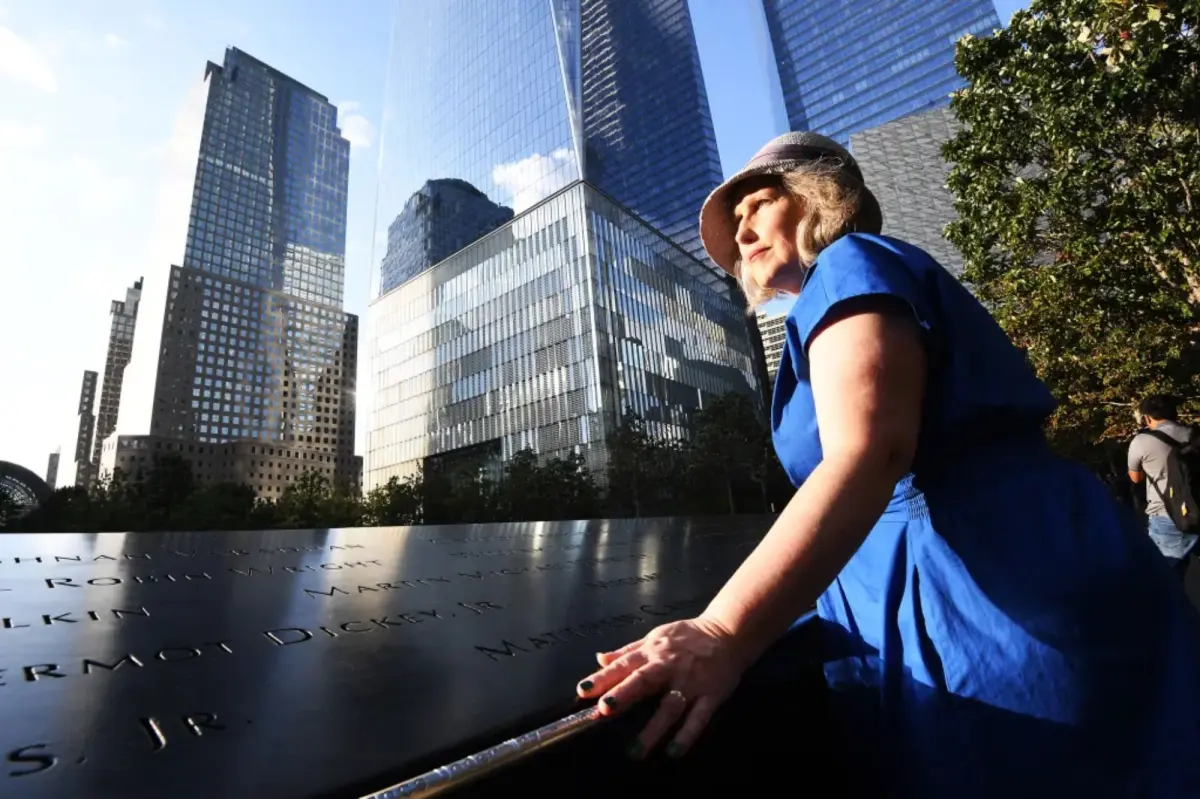
The water, falling in a rush rather than a teardrop trickle, created an enveloping white noise that shut out the surrounding city clamor. The dark parapets recalled the enormity of the buildings themselves.
And the names — oh, the names: 2,983 of them. Not chiseled into unforgiving stone as I’d imagined, but delicately traced through bronze panels in open lettering, ready to receive loving tributes and flowers and flags; glowing from beneath with golden light when evening gathers.
And for every name, endless stories, endless associations.
Of course I know only a few. But each familiar name I encounter provides a moment to stop and reflect, to think of who they were and the families left behind.
Here’s Thomas Hobbs, the fierce Mets fan whose daughter took up the Amazins’ cause in his honor. She saved a quilt made from her dad’s T-shirts so that she could wrap the grandbaby he’d never meet in his embrace.
And Deanna Galante, a first-time mom just weeks away from maternity leave. She and her husband had already given their baby Matthew his name; she was building up a library of Disney picture books for him. They kept arriving after the two were lost.
Alongside Deanna’s name appears the heartbreaking phrase, “and her unborn child” — words that recur 11 times on the parapet panels.
I spot the FDNY’s Kevin Dowdell, a lieutenant with Rescue 4 in Queens. His body was never found in the wreckage, but somehow his Halligan tool — a pry bar he’d personalized with his soldered-on initials — survived intact. His sons, one of them now a firefighter himself, have cherished it ever since.
There’s Mary Lenz Wieman, a dynamo marketing exec who doted on her three kids and nursed a hidden passion for carousels. A steed at a ride near her Long Island home was dedicated in her honor.
Gary Herold, a co-worker of Mary’s at Aon Corp., guided people out of the South Tower, then turned back to check for more. “Pop-Pop was a hero,” his grandchildren — who never got the chance to know him — now say.
And there are the men of Rescue 5, the pride of Staten Island. Twelve members of the elite squad — half of them off-duty at the time — raced to the towers. Eleven never came home. Today a friend serves on that storied crew, and I know he’d do exactly the same.
So a visit for me is a reverent experience — or would be, were it possible to navigate the two huge footprints in peace.
But you can’t avoid the selfie brigades, grinning and posing here of all places. I breathe deep and grasp for grace.
“They weren’t here,” I tell myself of the tourists. “They didn’t smell that unmistakable acrid stench, or see the smoke billowing for days, or hear the scream of United 175 over their neighborhood.”
But I think the real problem is simply this: They need to know a name. I would encourage visitors to please don’t make this just another box to tick on the Big Apple to-do list.
Learn one name, just one, and do a little homework. Seek out that name (an online directory makes it easy), touch it, trace it. Reflect on that person’s story.
Because the National September 11 Memorial isn’t about the evil of terrorism, or foreign conflicts, or even about mourning and misery.
It’s about life — and about lives. It enshrines a core American principle: that in this country every individual, from the famous hero to the child not yet born, is precious.
That every innocent life lost that day deserves to be known and remembered. That each name matters.
Mary Kay Linge is The Post’s Op-Ed Editor.