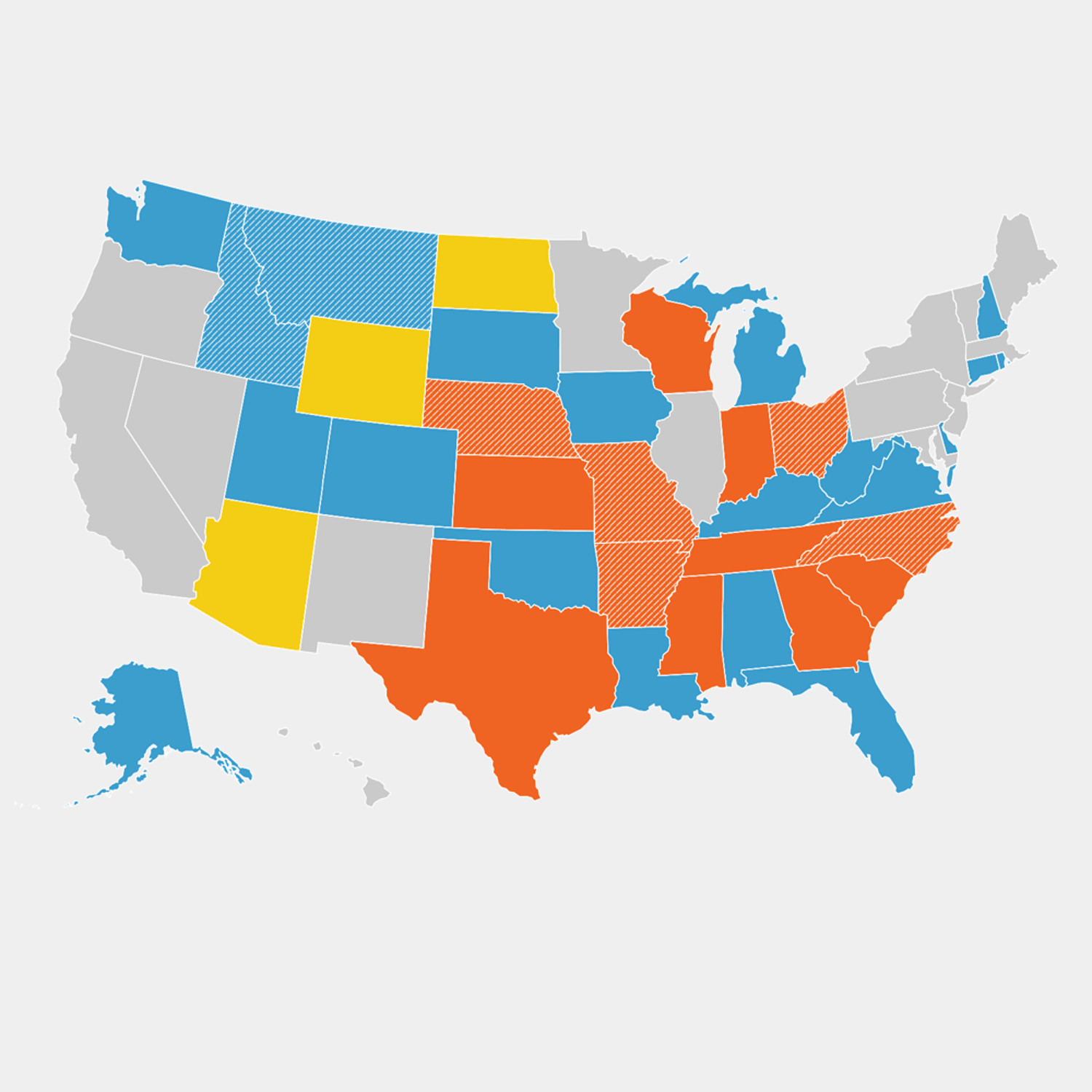
Policies vary widely from state to state. In Ohio, acceptable forms of identification are limited to those issued by state or federal governments, such as driver’s licenses or passports, while North Carolina accepts student IDs, as well as military, public assistance and tribal cards. Certain states allow voters to request a free ID card or sign an affidavit verifying their identity if they do not have an ID.
The stricter requirements ahead of Tuesday’s primary elections were years in the making. North Carolina’s law, passed in 2018, was blocked by the state Supreme Court three years later, with the court ruling the law was “motivated at least in part by an unconstitutional intent to target African American voters.”
The court reversed that decision in 2023, after the election of two GOP justices, allowing the law to go into effect. A federal lawsuit against it is set to go to trial this spring, The Associated Press reported.
Arkansas’ new law no longer allows voters to sign an affidavit verifying their identity in place of showing an ID — something many states still offer. Instead, voters are now required to return to the polling place with a photo ID within a set time frame in order for their provisional ballot to count.
Requesting some form of identification from voters dates to the 1950s, but two Supreme Court decisions in the past two decades have paved the way for states to enact ID requirements. In 2008, the court ruled that an Indiana law requiring voters to present photo ID did not violate the Constitution.
In 2013, another decision stripped a section of the Voting Rights Act of 1965 that required states with a history of voter discrimination to get federal approval to make changes that affect voting.
Since removing that requirement, at least 25 voter ID laws have been implemented — some of which have been struck down in court, according to the Brennan Center for Justice, a law and public policy group that tracks election laws.
Voter ID requirements are not inherently unpopular, and a recent Pew Research Center poll found more than 8 in 10 Americans supported requiring government-issued photo identification for voting.
Many of the recent ID laws gained momentum after former President Donald Trump and his allies made repeated, unfounded claims that voter fraud affected the outcome of the 2020 election. Trump’s challenges to the election have consistently lost in court, and state officials across the country have debunked fraud claims.
Studies have found voter fraud rates to be exceptionally low, something that Ohio state Rep. Thomas Hall, a Republican who sponsored a law requiring state-issued photo IDs, acknowledges. Still, Hall believes the law gives voters “peace of mind” that elections are secure.
“I think voter ID just took that ‘exceedingly rare’ and made it almost impossible here in Ohio,” said Hall.
Missouri state Rep. John Simmons, a Republican who sponsored legislation requiring a state-issued photo ID, said election fraud cases are low priority for prosecutors, and this requirement is a “commonsense” way to prevent such cases.
“Just because I don’t get broken into my home, doesn’t mean I’m not going to lock my doors at night,” Simmons said. “We’ve got to get back to making sure we have confidence in the government.”
Voting rights advocates say strict ID laws have had a direct effect on voter turnout and disproportionately deter low-income people and people of color from voting.
“The policy of voter ID is responding to a problem that is not there, and so we have to be skeptical as to why states would put these policies in place if the justification for them is lacking,” said Eliza Sweren-Becker, senior counsel at the Brennan Center.
Sweren-Becker added that the barriers to voting created by ID laws are “part and parcel of an overall effort to make it harder for Americans to participate” in elections. States such as North Carolina, Georgia, Arkansas and Missouri implemented ID requirements alongside other election changes regarding absentee voting, early voting, signature matching and more.
Nearly 29 million Americans did not have a current driver’s license and 7.6 million did not have any nonexpired government-issued photo ID in 2020, according to a University of Maryland report that used a representative sample from an American National Election Studies survey. Survey participants who identified as Black or Hispanic were twice as likely as other groups to lack a photo ID, and 18- to 29-year-olds in these demographics were the least likely to have a driver’s license or any photo ID out of all other groups.
“The unfortunate reality is that lawmakers tailor these laws to exclude certain types of voters,” said American Civil Liberties Union voting rights attorney Molly McGrath. “And it works.”
Identification requirements can bring about disparities in other ways. Texas’ 2021 voting law required mail voters to list their ID number or partial Social Security number on both a mail ballot application and the ballot envelope itself, which must match the information on their voter registration. In the state’s 2022 primary election, the Brennan Center found that Latino, Asian and Black voters were at least 30% more likely to have an application or mail ballot rejected due to the new requirement compared to white voters. Some voters did not have matching information, and others left it blank because they didn’t see it or thought it was optional, NPR reported.
Transgender people can also be caught up by voter ID laws. The Williams Institute, a think tank at UCLA Law, estimated that 260,000 transgender people living in states with voter ID laws did not have a form of ID that accurately reflected their name or gender identity for the 2020 general election. In the 2015 U.S. Transgender Survey, 25% of respondents reported being verbally harassed by poll workers after showing an ID that did not match their current name or gender identity.
Updating ID gender markers can be an arduous process for transgender people. Eight states require proof of gender-affirming surgery and two states do not allow ID changes. All of these states also have voter ID requirements.
A Pew Research poll found that 1 in 5 registered voters did not know they’d be asked to show IDs to vote going into the 2016 election.
“Most people think about what they need to vote, meeting deadlines and everything else, just within the months or weeks before the election,” said McGrath, who expects the new requirements will surprise voters during the primaries. “Voters are busy, they have lives.”
More voting laws are coming. Hall, the Ohio state representative who is running for re-election, said he and his colleagues hope to pass more legislation in the near future in the name of election integrity.
Those against ID requirements like Ohio’s say the push for stricter election laws will continue to inhibit voters.
“We are seeing a sort of death-by-a-thousand-cuts approach to voting rights,” Sweren-Becker said.