
Share this @internewscast.com
On Thursday, Israel’s Defense Minister Israel Katz revealed that their military forces had successfully targeted and eliminated Admiral Alireza Tangsiri of Iran’s Islamic Revolutionary Guard Corps (IRGC). Katz identified Tangsiri as the pivotal figure obstructing the Strait of Hormuz, a key maritime route.
Following this announcement, Prime Minister Benjamin Netanyahu released a statement corroborating Katz’s assertion. He noted that the operation against the IRGC official was a collaborative effort with the United States, highlighting the strategic partnership between the two nations.
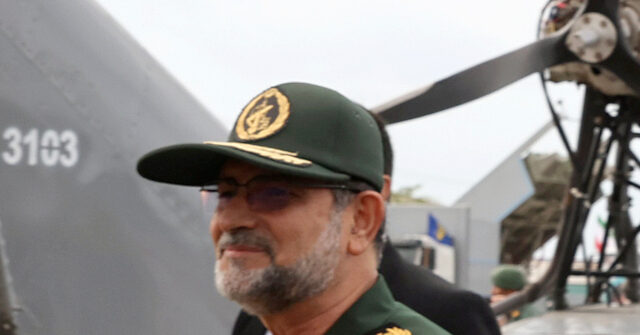
Admiral Tangsiri led the IRGC’s naval branches and was known for his threats to fully blockade the Strait of Hormuz, a vital channel for global commerce. Such threats have contributed to a spike in global petroleum prices, posing significant risks to regions like East Asia. Countries such as South Korea and China have been vocal in their opposition to any disruptions in this critical trade artery, emphasizing the need for uninterrupted commercial flow to sustain their economies.
This event marks another instance in a series of targeted actions against high-ranking Iranian officials under the banner of “Operation Epic Fury,” spearheaded by President Donald Trump. This initiative aims to dismantle Iran’s capacity to conduct global terrorist activities. The operation’s commencement on February 28 included the notable elimination of Iran’s longtime leader, Ali Khamenei, creating a leadership vacuum. While Mojtaba Khamenei has been named as his successor, his absence from public engagements has sparked rumors about his potential incapacitation.
In his statement, Defense Minister Katz described the operation that led to Tangsiri’s demise as “precise,” mentioning that it also impacted other senior IRGC figures. The IRGC, deemed the most formidable faction of Iran’s military and labeled a terrorist organization by the U.S., remains a significant focus of these military efforts.
Katz issued a stark warning to Iran’s leadership, stating, “The IDF will hunt you down and eliminate you one by one. We will continue to operate in Iran with full force to achieve the objectives of the war.”
Prime Minister Netanyahu separately repeated on Friday that Israeli forces had eliminated Tangsiri, explaining, “this individual has a great deal of blood on his hands, and he was also responsible for leading the closure of the Strait of Hormuz.” He described the strike as “yet another example of the cooperation between us and our ally, the United States, in pursuit of our shared war objectives.”
The Iranian government has not, at press time, confirmed Tangsiri’s elimination. The admiral was a regular official cited in state media for much of the past year, however, particularly on the issue of the Strait of Hormuz. As recently as Wednesday, shortly before Katz announced his purported death, Tangsiri issued belligerent comments announcing that the IRGC had blocked the passage of a container ship and that it would continue to prevent the normal transit of commerce through the maritime byway.
“Any vessel’s passage through this waterway requires full coordination with Iran’s maritime sovereignty,” Tangsiri said on Wednesday, according to Iran’s state-run Mehr News Agency. Tangsiri similarly announced on March 11 that any ship attempting to travel through the Strait of Hormuz must have Iranian permission to do so.
Tangsiri was also the official chosen to announce on March 18 that Iran would be targeting civilian oil facilities “linked to the U.S.” in the Middle East, demanding that “citizens and workers” avoid these locations. The announcement arrived weeks after Iran launched a massive missile and drone campaign in response to “Operation Epic Fury” primarily targeting neighboring Arab Muslim states. Iran has bombed more than a dozen countries since February 28, including Saudi Arabia, the United Arab Emirates (UAE), Qatar, Jordan, Iraq, Azerbaijan, and Turkey. Several strikes have targeted fossil fuel facilities, including Qatar’s most valuable liquefied natural gas (LNG) facility, raising global alarm regarding production of these fuels.
The Iranian naval chief had begun threatening ships in the Strait of Hormuz before “Operation Epic Fury” began. On February 17, Tangsiri told state media that the IRGC had imposed “full 24-hour intelligence dominance” in the strait – meaning that Iran was spying on every vessel transiting the body of water.
The Israeli announcement of Tangsiri’s elimination follows a flurry of anonymous reports claiming that Iran has begun attempting to negotiate an end to the war with the United States. Officials from the government of Pakistan claimed this week that they were mediating negotiations between Iran and America and that the United States had prepared a 15-point proposal for ending the conflict. On Wednesday, Iranian state media shared comments from a purported “official with knowledge of the details” who claimed that Tehran was not interested in the peace plan and had, instead, offered its own provisions for peace. Among Iran’s alleged demands were “reparations” from America to Iran and full control over the Strait of Hormuz.
Follow Frances Martel on Facebook and Twitter.