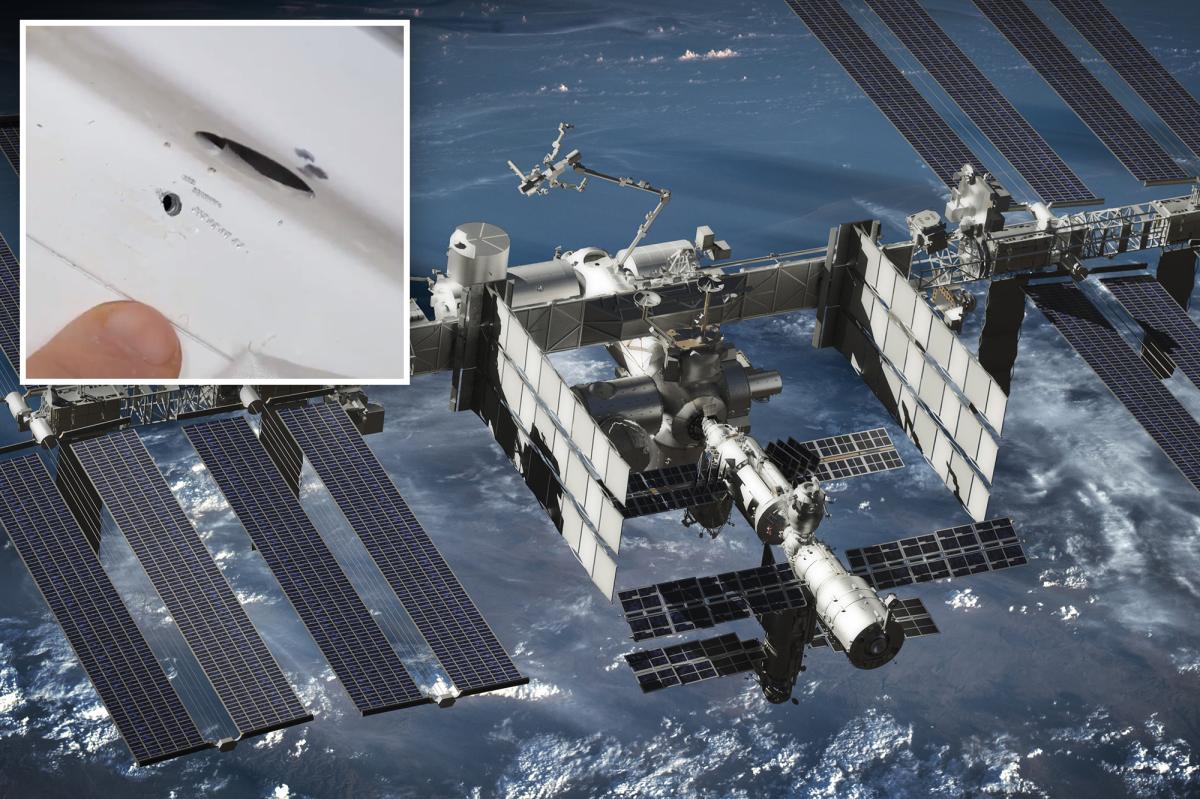


The International Space Station is once again experiencing air leaks.
NASA confirmed the latest air leak last week, marking a reoccurrence of an issue the agency believed had been addressed earlier this year, according to a report from Ars Technica.
Since 2019, the 27-year-old space station has faced ongoing air leaks in the PrK module, a narrow transfer tunnel located in the Russian segment of the station.
Back in January, NASA had declared that the PrK module had achieved a “stable condition” following several inspections and the application of sealants.
However, on May 1, the problem resurfaced.
NASA informed the publication that a “slow pressure drop” was observed in the PrK module as Russian astronauts were unloading cargo.
The leak — which is a microscopic structural crack within the floating space station — indicated a loss of roughly one pound per day and is “being maintained at a lower pressure, with small repressurizations as needed,” NASA spokesperson Josh Finch told Ars.
While the leak is not impacting operations onboard the space station or the safety of the seven astronauts who currently call the ISS home, the possibility of “catastrophic failure” is reportedly discussed during internal meetings.
NASA uses a 5×5 “risk matrix” to classify the likelihood of and consequences of risks to spaceflight operations — and the Russian module leaks have been classified as a “5” on both high likelihood and high consequence, Ars reported.
The agency, however, says that emergency evacuation procedures are maintained that would allow the astronauts to abandon the ISS if the situation were to deteriorate — including isolating impacted portions of the station and in the most dire of circumstances, evacuating the astronauts back to Earth, the Daily Mail reported.
Engineers from NASA and Roscosmos, Russia’s government space agency, have been tracking the leak rate from a small Russian module attached to the space station for over half a decade.
Trouble first began in 2019, when a small but persistent air leak in the PrK module was detected.
By 2024, the leak rate had doubled, prompting NASA to elevate the issue to one of the most serious safety concerns on board and the highest risk currently facing the ISS, according to the Daily Mail.
This latest leak is raising concerns for the already-aging space station, which is due to retire in 2030 — but is being considered by NASA and Congress to extend operations to 2032 or beyond until commercial replacements are available.
“This further confirms the wisdom of returning the ISS in 2030 and replacing it with more modern, more cost-effective, and safer commercial platforms,” Phil McAlister, former director of commercial space flight at NASA told Ars.
The Post has sought comment from NASA.