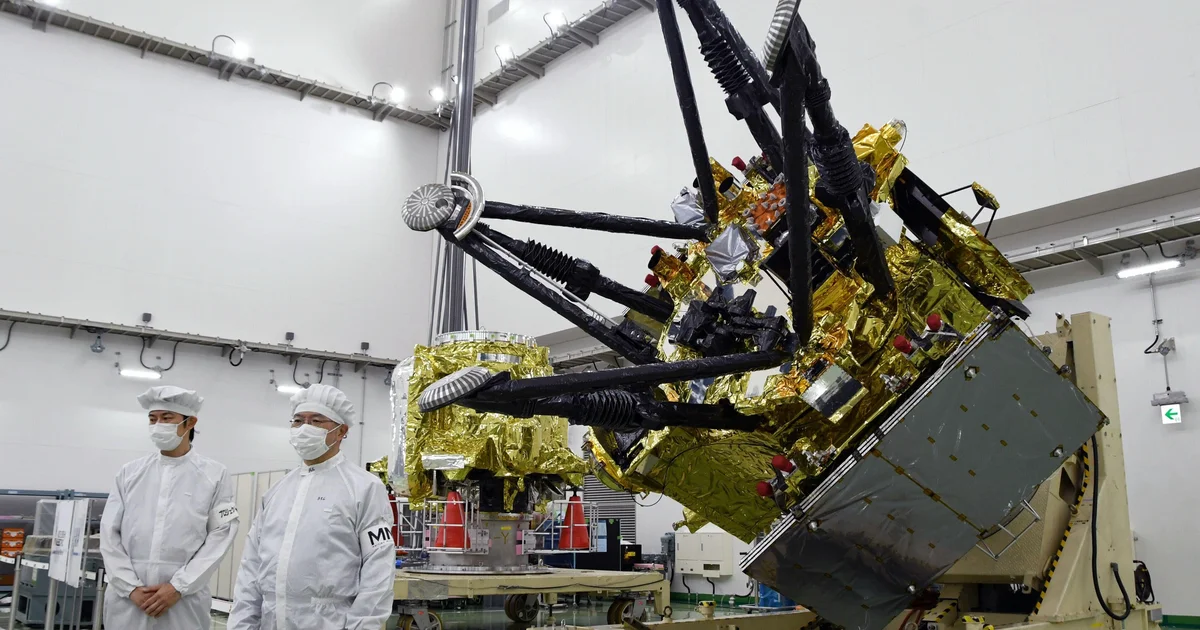

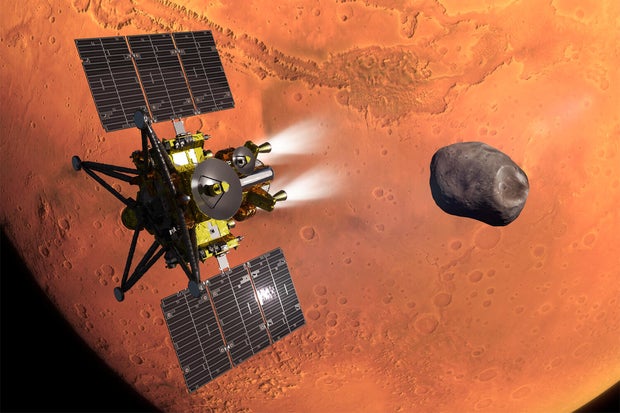
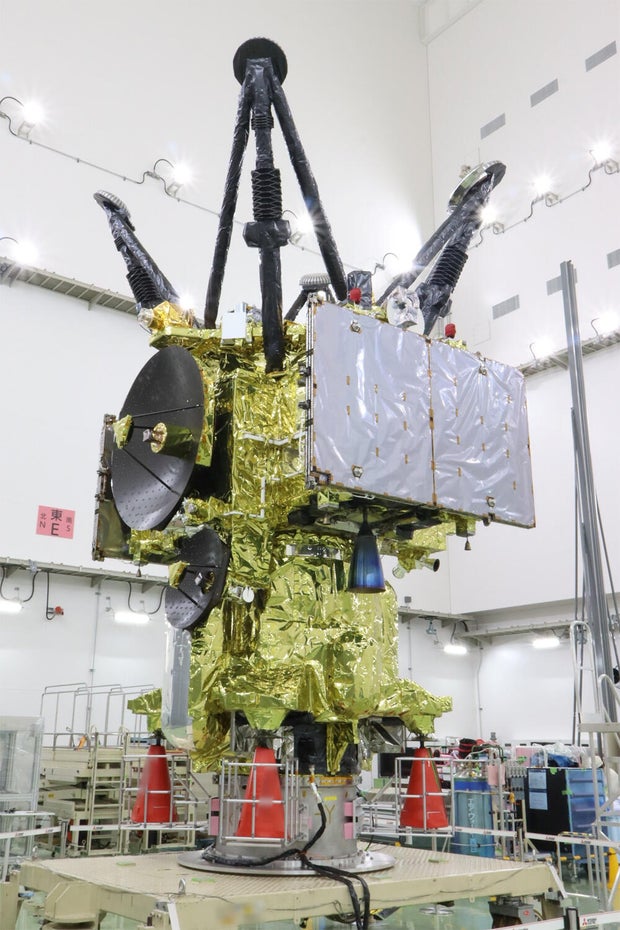
Japan has launched an ambitious $350 million mission to Mars aimed at studying the Red Planet’s two moons in unprecedented detail. The spacecraft will deploy a small rover onto Phobos, the larger moon, before landing itself to collect soil samples for eventual return to Earth.
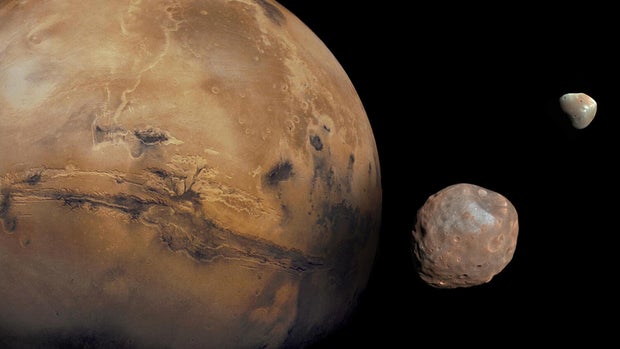
The central objective of the Martian Moons Exploration mission, known as MMX, is to solve a longstanding mystery: were Phobos and the smaller Deimos formed from debris blasted into space by a massive impact early in the solar system’s history, or are they asteroids that Mars captured with its gravity?
JAXA
Both moons are far smaller than Earth’s moon. Phobos is only about 17 miles wide at its broadest point, while Deimos measures less than half that. Their irregular shapes and asteroid-like appearance offer clues, but scientists say those features alone cannot reveal where the moons came from.
“One of the most intriguing questions about Phobos and Deimos is simply why these two little moons are there in the first place,” said Thomas Statler, who helped oversee the development of two NASA instruments carried aboard the MMX spacecraft.
“In some ways, they resemble asteroids from the outer part of the asteroid belt … but there (are) other lines of evidence pointing to these moons being remnants of a giant impact early in Mars’ history.”
Jaxa
Samples expected to reach Earth in 2031 could provide the decisive evidence needed to settle the debate.
“By going to the Martian moons, studying them up close and bringing samples back to Earth, we’ll be able to determine whether Phobos material is more consistent with an asteroid composition or with debris created by a collision involving Mars,” Statler said.
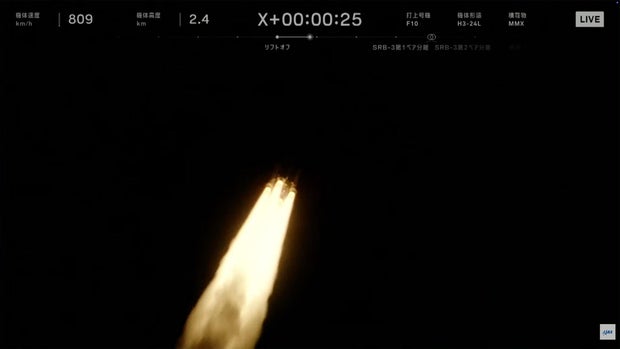
The mission began at 3:41 p.m. EDT, or 4:41 a.m. Japan time, with the dramatic launch of a Japanese H3 rocket from Tanegashima Space Center. The facility is operated by the Japan Aerospace Exploration Agency, or JAXA.
Four solid-fuel strap-on boosters and two hydrogen-powered engines on the rocket’s first stage lifted the vehicle through the dense lower atmosphere. The H3’s second stage then took over, carrying the mission onward toward space.
One hour and 11 minutes after liftoff, following two burns by the upper-stage engine, the 9,900-pound MMX spacecraft separated from the rocket and began its journey independently.
If the mission proceeds as planned, MMX will enter orbit around Mars in September 2027. Its flight path will allow it to travel around the planet in step with Phobos.
The spacecraft is expected to remain in the Martian system for three years, using a suite of instruments to study Phobos and the space around it. Researchers will examine the moon’s chemical and mineral makeup, evaluate whether it could serve as a staging point for future astronauts and deploy a small rover built by Germany and France onto the surface in early 2029.
The 55-pound rover has no braking rockets or other equipment to control its landing. Because Phobos’ gravity is only one-thousandth as strong as Earth’s, the rover is expected to bounce across the surface before gently tumbling to a stop.
The rover is built to right itself no matter how it lands and then begin exploring. Its equipment includes navigation cameras, imaging tools to examine the soil as it moves, a laser instrument that can identify minerals beneath the surface and a sensor designed to track soil temperatures.
JAXA
Around a year after the rover lands, in approximately 2030, the MMX spacecraft will descend to Phobos once—and possibly twice—to gather soil. The collection systems include one device developed by JAXA and another provided by NASA.
The mission’s formal requirement is to retrieve at least 10 grams of material, an amount weighing less than half an ounce. The total could be greater, depending on the condition and composition of Phobos’ surface soil.
After collecting the samples, MMX will lift off, complete remote observations of Deimos and begin the journey home. The Phobos material will be sealed inside an aerodynamic, heat-resistant capsule designed to re-enter Earth’s atmosphere over Australia, where recovery teams will be waiting.
An international group of scientists will analyze the returned samples.
“There’s a lot of adrenaline, a lot of excitement, and a lot of wow,” Statler said. “MMX will be the first spacecraft ever to return to Earth from the Mars system. That says a lot.”
Still, Statler said the mission’s greatest moment will come when the sample-return capsule plunges through Earth’s atmosphere, is opened and reveals the material for the first time. “There is absolutely no lack of excitement and adrenaline on this mission,” he said.