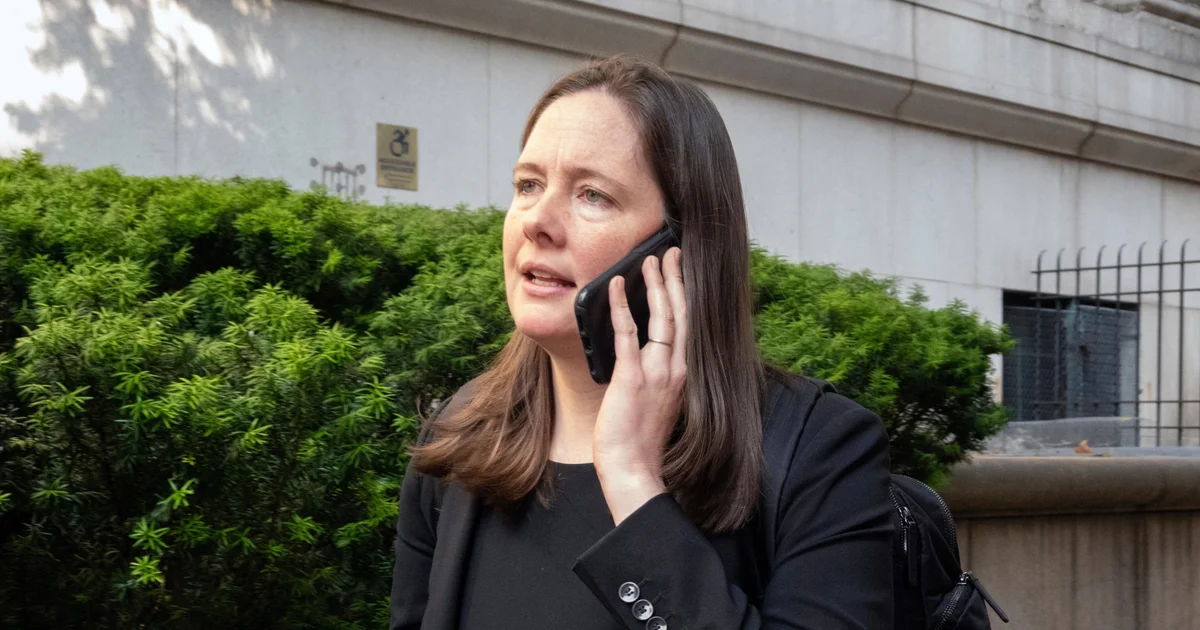

Washington — A federal judge ruled Monday that the Justice Department acted unlawfully when it dismissed Maurene Comey, the daughter of former FBI Director James Comey, from her position as a federal prosecutor in New York.
In a 55-page opinion, U.S. District Judge Jesse Furman concluded that Comey’s termination violated both federal law and the Constitution’s separation of powers. He ordered her reinstated retroactively and directed the Trump administration to pay her lost wages from the July 2025 date of her dismissal through Dec. 20, the day before she took another job.
The case was among a series of lawsuits brought by former federal employees who said they were removed without cause, creating a broader test of how far the president’s authority extends when firing government officials.
The Trump administration maintained that Article II grants the president broad, unrestricted power to remove executive-branch officials. It also argued that Congress had no authority to impose limits on the dismissal of federal prosecutors.
Furman rejected that position, finding that Comey’s firing violated the Civil Service Reform Act, the landmark 1978 statute that shields federal employees from certain forms of arbitrary termination. The administration, he wrote, was seeking to “upend” established precedent permitting Congress to regulate the removal of so-called inferior officers.
“Indeed, to accept Defendants’ argument would be to unsettle the very equilibrium established by this Nation’s constitutional system,” Furman wrote.
Comey’s attorneys described the ruling as a “hard-earned victory” not only for their client but also for federal workers across the government.
“As the Court correctly held, to accept the government’s argument about unlimited executive power ‘would be to unsettle the very equilibrium established by this Nation’s constitutional system.’ This decision reaffirms our bedrock system of checks and balances: the President is not above the law,” lawyers Ellen Blain, Nicole Gueron, Deepa Vanamali and Margaret Donovan said in a statement.
A Justice Department spokesperson said the agency “disagrees with this decision and will appeal in due course.”
Comey joined the Manhattan U.S. Attorney’s Office in 2015 and worked on several prominent criminal prosecutions, including cases involving Sean “Diddy” Combs, Jeffrey Epstein, Ghislaine Maxwell and former Democratic Sen. Robert Menendez.
In a message to former colleagues after her removal, Comey said Justice Department headquarters had “summarily fired” her in a memo without explaining why she was being terminated.
The dismissal notice stated, “Pursuant to Article II of the United States Constitution and the laws of the United States, your employment with the Department of Justice is hereby terminated, and you are removed from federal service effective immediately.”
The identity of the official who ordered Comey’s dismissal was initially uncertain. The Trump administration later said that then-Attorney General Pam Bondi had “directed” the firing, while her successor, Todd Blanche, had “ratified” it.
Comey filed a lawsuit against the Justice Department last year, claiming she may have been targeted because President Trump holds animosity toward her father. James Comey has been indicted twice during the second Trump administration; one case was dismissed, while he has denied wrongdoing in the other.
“Ms. Comey’s termination — without cause, without advance notice, and without any opportunity to contest it — was unlawful and unconstitutional,” her lawyers wrote in the lawsuit.
The administration sought to have the case dismissed, arguing that Comey first needed to take her claims to the Merit Systems Protection Board. That agency handles federal workers’ appeals involving adverse employment actions. Furman, however, rejected the government’s request and allowed the lawsuit to proceed.
The judge determined that the federal court had authority to hear the dispute because the government based Comey’s dismissal on Article II of the Constitution rather than on a civil-service statute.
In court documents, the Justice Department acknowledged that Comey had received “outstanding” performance evaluations every year from 2019 through 2024. The department nevertheless argued that her termination was authorized under powers Congress granted to the attorney general to remove assistant U.S. attorneys.
The administration also cited a June Supreme Court ruling that cleared the way for the president to remove members of certain independent agencies without cause. In that decision, the justices overturned a precedent more than nine decades old that had allowed Congress to restrict presidential control over officials serving on multimember agencies.
Furman said the Justice Department was attempting to advance a “sweeping and unprecedented theory of executive authority.”


