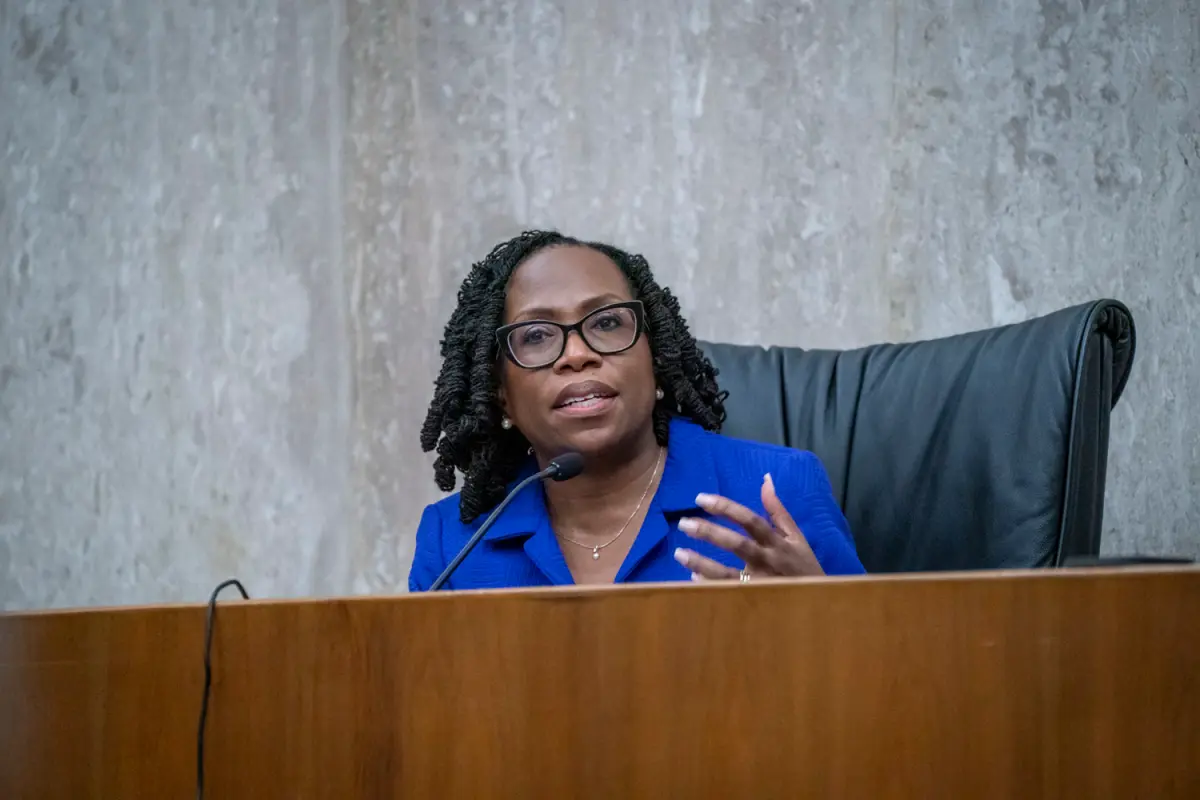

Supreme Court Justice Ketanji Brown Jackson on Thursday condemned the high court’s growing reliance on its so-called “shadow docket,” arguing that her colleagues have too readily cleared the way for controversial Trump administration policies and, in the process, weakened public confidence in the judiciary.
“We cannot expect the public to have faith in our judicial system if, without clear explanation, we are consistently green-lighting harmful acts that do real damage to litigating plaintiffs,” Jackson, who was appointed by former President Joe Biden, said during an appearance at the University of the District of Columbia. Her remarks amounted to a rare public rebuke of how fellow justices handle the court’s business.
Since President Trump began his second term, the Justice Department has repeatedly turned to the Supreme Court’s emergency docket to seek stays of lower-court decisions that have blocked contentious administration policies. The justices generally decide those requests without oral arguments, and the court often provides little detail about how individual members voted.
That lack of transparency has fueled criticism of the process and prompted opponents to label it the “shadow docket.” Jackson has previously described the court’s use of the procedure as “problematic.”
In comments first reported by The Washington Post, Jackson urged the justices to return to “first principles” and exercise greater restraint when intervening in politically charged disputes.
MORE STORY: NASA Offers Clues as SR-71 Spy Plane Vanishes From California Base
“Very little good comes from taking an institution that is supposed to be operating outside of the political realm and routinely steering it into the fray,” she said. Jackson argued that earlier Supreme Court benches adhered more closely to that principle, while the current court “has been noticeably less restrained, especially with respect to pending cases that involve controversial matters.”
Among the Trump administration’s actions permitted through the shadow docket were the dismissal of more than 1,300 Department of Education employees in July 2025, the termination of $783 million in National Institutes of Health research grants linked to diversity, equity and inclusion initiatives the following month, and broad immigration raids in Los Angeles.
The court has not consistently sided with the administration, however. In other emergency-docket decisions, the justices blocked Trump from deploying the National Guard to Chicago in December 2025 and rejected stricter rules governing mail-in voting earlier this month.
Jackson, 56, has repeatedly criticized the emergency docket in written dissents. In an opinion involving the NIH grant cancellations, she described the court’s approach as “Calvinball jurisprudence,” invoking the improvised game featured in the “Calvin and Hobbes” comic strip.
The Supreme Court is scheduled to begin its 2026-27 term on Oct. 5.