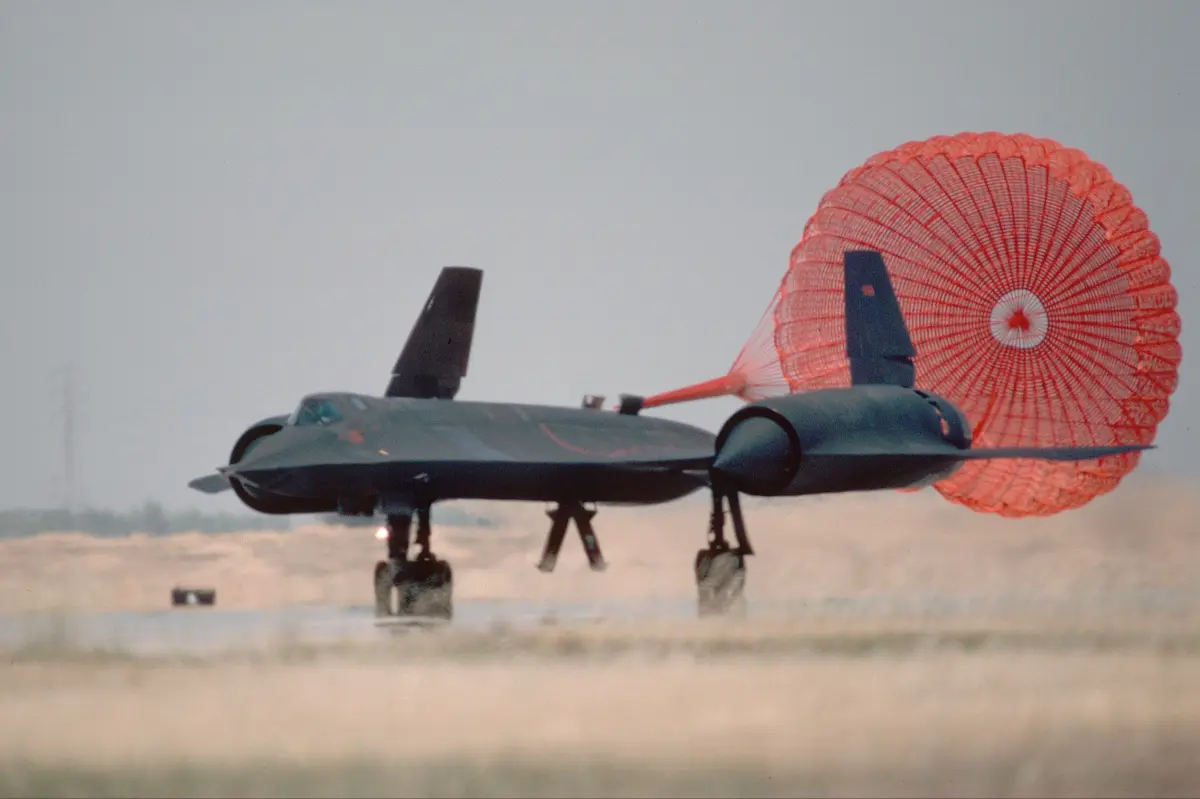

A famed spy plane has disappeared from a California military installation just as NASA unveils an enigmatic aircraft concept—prompting speculation that the two developments may be connected.
The aircraft is SR-71 Blackbird tail No. 844, which had spent years on display at NASA’s Armstrong Flight Research Center, located alongside Edwards Air Force Base.
Satellite images show that the Blackbird has been absent from its usual location since at least May 17, Aviation Week defense editor Steve Trimble reported after investigating the aircraft’s apparent removal.
The timing has drawn attention because NASA Administrator Jared Isaacman recently presented a silhouette with a distinctly SR-71-like shape during the All-In Summit in Los Angeles. He also said NASA is rebuilding its experimental X-plane fleet and returning its focus to flight at extreme speeds and altitudes.
“In the service of the first A [aeronautics] in NASA, we are rebuilding our X-plane fleet. The X-59 is researching quiet supersonic flight, but it’s just the beginning,” Isaacman told TWZ.
“It will not be long before NASA once again is flying as high and as fast as we had in decades past, and then even more,” he added.
The mystery deepened when the Blackbird-shaped image appeared during a live interview soon afterward. Isaacman responded with a teasing question—“You sure that’s a Blackbird?”—but did not explain what the image represented.
Tail No. 844 is a particularly important part of aviation history. Originally identified by U.S. Air Force serial number 61-7980, it was the final SR-71 built and the last Blackbird to take to the skies, completing its final flight in 1999.
For now, its location remains unknown. Sources cited by Aviation Week said the aircraft was transferred to a hangar earlier this year for inspection, but no public explanation has been given for its continued absence.
The combination of the missing aircraft and NASA’s Blackbird-like presentation has fueled speculation about a possible return-to-flight effort—more than 26 years after the SR-71 last flew.
NASA has not confirmed that such a program is underway. The agency has instead emphasized Isaacman’s broader plans to develop experimental aircraft that can advance research into high-speed and high-altitude aviation.
California’s Mojave Desert has long served as a testing ground for aviation’s most ambitious projects, and NASA continues to use the region to explore the boundaries of flight. Its experimental X-59 is currently being tested above the desert as part of an effort to make supersonic travel over land substantially quieter.
The streamlined aircraft has already exceeded Mach 1 during testing at Edwards Air Force Base. NASA plans additional flights to measure the softer “thump” generated by the X-59, replacing the powerful sonic boom produced by conventional supersonic aircraft.
The research could eventually support a new generation of commercial supersonic jets, potentially cutting hours from long-distance flights while avoiding the noise restrictions that have limited overland supersonic travel.