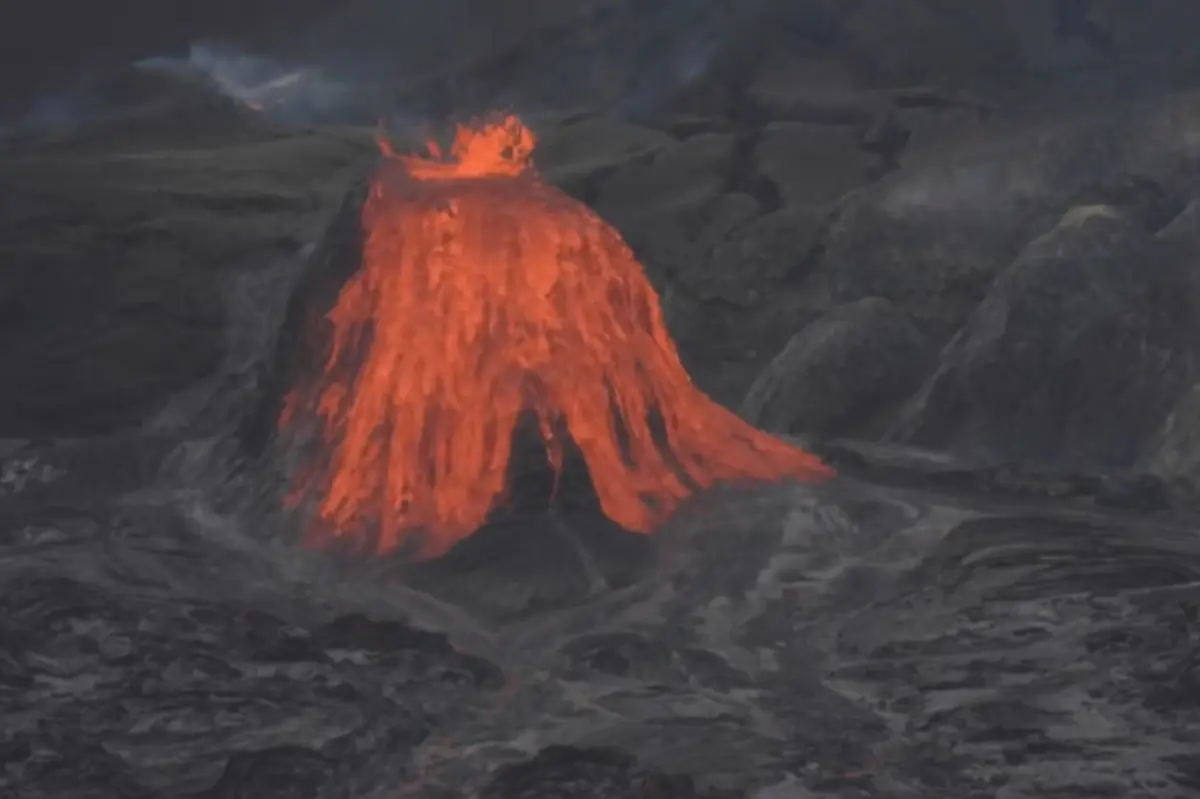

Renewed volcanic activity at one of Hawaii’s most visited attractions has led officials to temporarily shut sections of popular trails after hundreds of earthquakes and an increased risk of rockfalls.
The US Geological Survey (USGS) issued an updated notice this week for Kīlauea volcano in Hawaiʻi Volcanoes National Park, saying lava was once again spattering from two vents after fresh activity developed beneath the summit.
The National Park Service (NPS) said Wednesday that Halemaʻumaʻu Trail and a section of Byron Ledge Trail would close temporarily because of heightened seismic activity and the possibility of falling rocks.
Together, the closures cover about 1.3 miles of hiking trails.
More than 200 shallow earthquakes struck beneath Kīlauea’s summit over the past week, the NPS said, citing observations from the Hawaiian Volcano Observatory.
A magnitude-3.4 earthquake recorded Sept. 30 triggered several small rockfalls on the northern wall of the caldera.
As of Thursday, Kīlauea remained under the USGS’ ORANGE aviation color code, the second-highest category in the agency’s four-level warning system.
The alert reflects elevated volcanic unrest and the possibility of an eruption, or an ongoing eruption posing limited danger to aircraft.
Scientists believe an underground intrusion between Sept. 30 and Oct. 1 produced new fractures across the caldera floor.
Researchers said there is currently no way to determine when — or whether — Kīlauea’s 55th lava-fountaining episode will begin.
CONTINUE READING: Earl Spencer’s Third Wife Buys £3.6m Home 10 Miles From Althorp
“Forecast windows for episode 55 fountaining can no longer be modeled due to changes in conditions,” the USGS said in its advisory.
Officials are warning both residents and visitors about several potential hazards, including harmful volcanic gases and tiny glass-like fragments capable of irritating the skin and eyes.
“Small glassy volcanic fragments may be remobilized during windy conditions following recent eruptive episodes,” the statement said.
“Residents and visitors should minimize exposure to these fragments, which can cause skin and eye irritation.”
The NPS is also urging people to respect all closures and avoid unstable cliff edges, which may give way with little or no warning.
Kīlauea is considered one of the most active volcanoes on Earth and has erupted dozens of times since 1952, according to the USGS.
The volcano’s East Rift Zone experienced almost continuous eruptions from 1983 through 2018. That 35-year period ended with major eruptive activity and a summit collapse, the agency reported.
Since December 2024, intermittent eruptions have continued inside Halema’uma’u crater at the summit.
The NPS has reported a sharp rise in visitation during Kīlauea’s eruptive periods, as tourists flock to the park for a chance to witness the volcano in action.
NPS figures show that Hawaiʻi Volcanoes National Park welcomed more than 1.8 million recreational visitors in 2025.
Fox News Digital reached out to NPS for further details and comment.
MUST READ: Deloitte Consultant Inherits Multimillion-Dollar Fortune From Grandfather