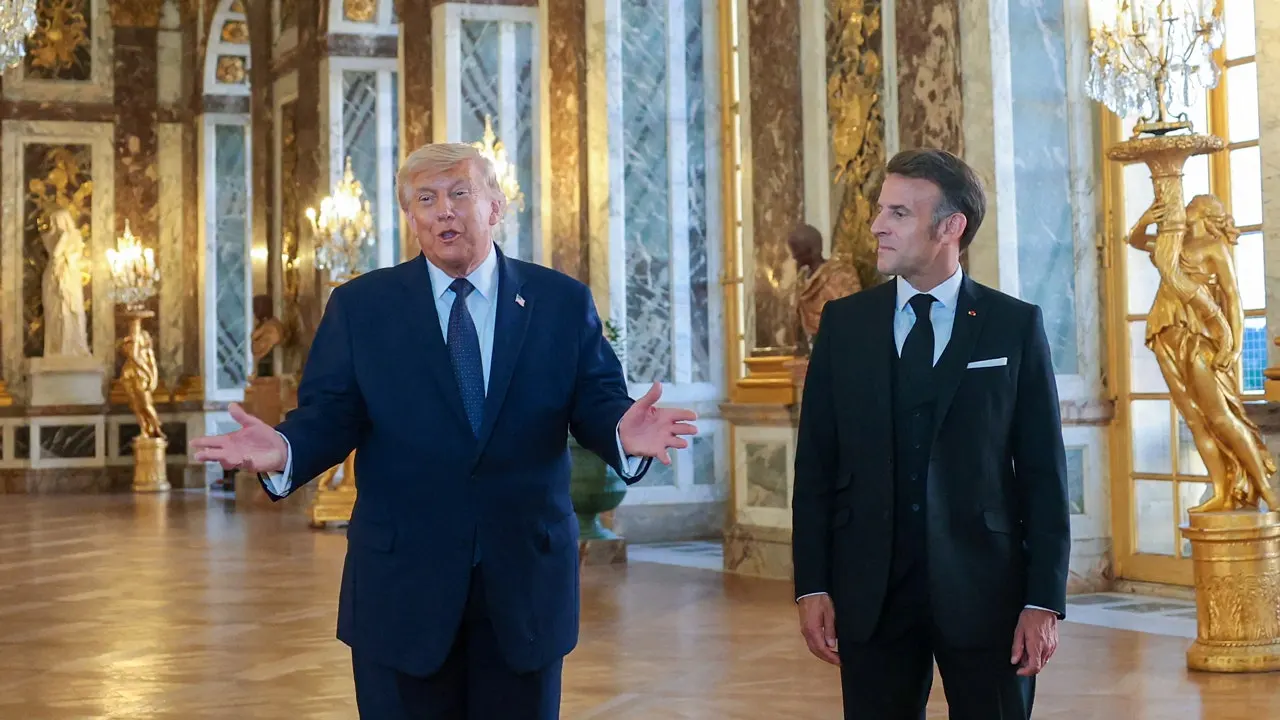

Embattled French President Emmanuel Macron on Sunday attributed part of the unrest, riots and looting sweeping France to the impact of the U.S.-led war against Iran’s terrorist regime.
The reference to the conflict in Macron’s televised address drew criticism from several experts. He said demonstrators had voiced concern over the cost of living and fuel prices, both of which he linked to “the conflict launched in the Persian Gulf”—a war France did not join but whose economic consequences, he said, the country is experiencing.
“I fully understand their concern,” Macron said, noting that similar grievances had emerged in other European capitals. He added that he had launched international efforts to secure fuel and gas supplies and stabilize energy markets. Macron also announced plans to visit three Gulf countries to discuss the escalating energy crisis.

Demonstrations over the rising cost of living brought students, climate activists, former “Yellow Vests” and farmers together ahead of the presidential election. Organizers estimated that 200,000 people participated nationwide, including 40,000 in Paris on October 17, 2026. (Kiran RIDLEY / AFP via Getty Images)
It remains unclear which demonstrators Macron was referring to when he cited concerns about fuel costs. News Outlet reported Monday on the organization behind the widespread unrest, noting that several of the groups involved have called for the abolition of the free-enterprise system.
Macron warned that anyone who had attempted “to bring down the republic” would be held responsible.
President Donald Trump told reporters Monday that he had cautioned Macron during their first meeting: “You got to close up your borders. You’re going to ruin your country.” Trump added, “They’ve ruined their country. It’s going to be hard to get it back. But hopefully France will come back.”
A French Foreign Ministry spokesman directed News Outlet to Macron’s televised address and referred additional questions to the Élysée press office. The presidential office had not responded by the time of publication.
Lisa Daftari, an Iran expert, told News Outlet that Macron was blaming the conflict while overlooking what she described as the direct cause of the fuel crisis. “Fuel is expensive because Iran’s regime closed the Strait of Hormuz and held the world’s energy supply hostage,” she said. Daftari also questioned whether the unrest was genuinely centered on students and fuel prices, citing fires at major infrastructure and landmarks, looting nationwide and nearly 2,400 arrests in a single day.
Daftari, the Foreign Desk Editor-in-Chief, said the scale of the violence went far beyond a conventional protest. “That’s not a protest over the price of diesel,” she said. “It’s organized lawlessness,” adding that Macron’s government had itself blamed ultra-left groups and criminals. France, she argued, is facing a domestic crisis that cannot be explained away by international events.
MORE ON THIS: New Details Emerge About Heroic Bystander

Protesters moved through central Paris as clashes, fires and a heavy police presence marked nationwide demonstrations over the rising cost of living. Paris, France, Oct. 17, 2026. (Firas Abdullah/Anadolu via Getty Images)
French Prime Minister Sébastien Lecornu accused the “ultra-left movement” of orchestrating “profound disorder” across the country in the run-up to the presidential election.
Barak Seener, an associate research fellow at London’s Henry Jackson Society, told News Outlet that illegal immigration from the Middle East, North Africa, sub-Saharan Africa, Afghanistan, Pakistan and Bangladesh had been used by some groups as a means of challenging Western societies. He said slogans including “globalize the intifada,” “Free Gaza” and “Stop the genocide” were being used, in his view, to undermine Western civilization and impose Sharia law. Seener said Macron continued to ignore that threat.

Crowds gathered at Paris’ Place de la République to assess the aftermath of a national day of mobilization over the high cost of living. Demonstrations on October 17 were marked by severe violence, looting and vandalism. Paris, France, Oct. 18, 2026. (Laurent Caron / Hans Lucas / AFP via Getty Images)
Vice President JD Vance also criticized France’s immigration policies in a social media post. Writing on X, Vance said, “Western liberals imported the third world into France and other countries in the name of diversity and compassion.”
“They ignored fundamental questions of assimilation and compatibility,” Vance continued. “They were told it would lead to this and they didn’t listen.”
Seener argued that France’s political establishment was now facing the consequences of its political correctness and what he called its unilateral support for Palestinian statehood. He also criticized Macron’s remarks at the 81st United Nations General Assembly, where the French president declared that Hamas “has never been active” in the West Bank. Seener said Macron was reshaping events to advance a political narrative.
Seener, who has written extensively on Iran, said Macron had chosen to address students, teachers, trade unions, lawmakers and business leaders while attributing higher oil prices to the U.S.-led war against Iran. “It is unrelated to this,” Seener said. He further accused Macron of overlooking what he called a Red-Green alliance behind the unrest, involving 38 left-wing and Muslim organizations and 16 student groups, including communist youth organizations and the Muslim Students of France.