
Share this @internewscast.com

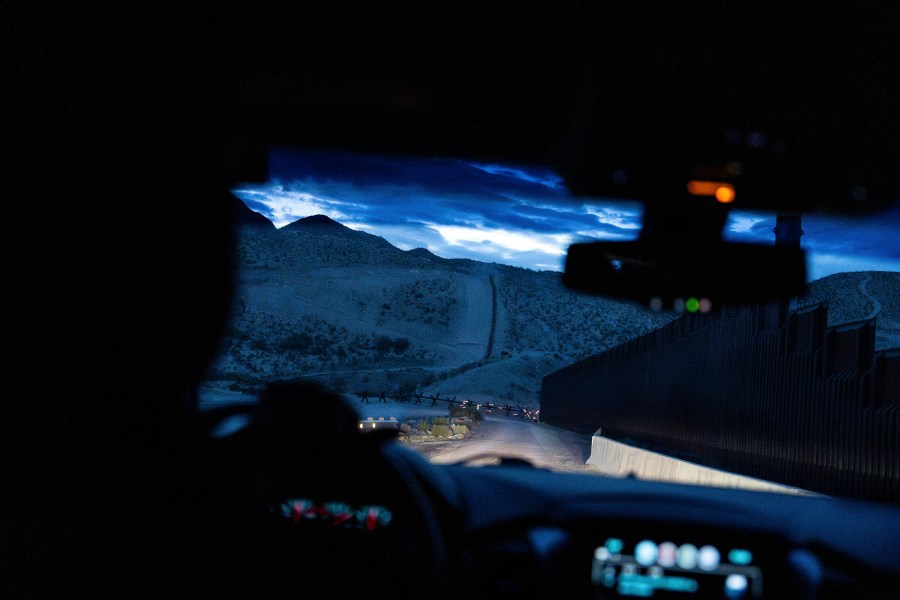
NOGALES, Ariz. (AP) — From within an armored vehicle, an Army scout maneuvers a joystick to position a long-range optical scope on a man stationed atop the U.S.-Mexico border wall, which spans the hills of this Arizona frontier town.
The individual begins descending towards U.S. territory, slipping through spirals of concertina wire. Raised voices echo, an alarm is triggered, and a U.S. Border Patrol SUV speeds toward the wall, a sufficient caution for the man to scurry back across it, vanishing into Mexico.
The encounter on Tuesday was one of merely two witnessed by the Army infantry unit monitoring this segment of the southern border, heightened by President Donald Trump’s emergency declaration that has placed the military at the forefront of discouraging migrant crossings outside of U.S. ports of entry.
“Deterrence is actually boring,” said 24-year-old Army Sgt. Ana Harker-Molina, voicing the tedium felt by some fellow soldiers over the sporadic sightings.
Still, she said she takes pride in the work, knowing that troops discourage crossings by their mere presence.
“Just if we’re sitting here watching the border, it’s helping our country,” said Harker-Molina, an immigrant herself who came from Panama at age 12 and became a U.S. citizen two years ago while serving in the Army.
U.S. troop deployments at the border have tripled to 7,600 and include every branch of the military — even as the number of attempted illegal crossings plummet and Trump has authorized funding for an additional 3,000 Border Patrol agents, offering $10,000 signing and retention bonuses.
The military mission is guided from a new command center at a remote Army intelligence training base alongside southern Arizona’s Huachuca Mountains. There, a community hall has been transformed into a bustling war room of battalion commanders and staff with digital maps pinpointing military camps and movements along the nearly 2,000-mile border.
Until now border enforcement had been the domain of civilian law enforcement, with the military only intermittently stepping in. But in April, large swaths of border were designated militarized zones, empowering U.S. troops to apprehend immigrants and others accused of trespassing on Army, Air Force or Navy bases, and authorizing additional criminal charges that can mean prison time.
The two-star general leading the mission says troops are being untethered from maintenance and warehouse tasks to work closely with U.S. Border Patrol agents in high-traffic areas for illegal crossings — and to deploy rapidly to remote, unguarded terrain.
“We don’t have a (labor) union, there’s no limit on how many hours we can work in a day, how many shifts we can man,” said Army Maj. Gen. Scott Naumann.
“I can put soldiers out whenever we need to in order to get after the problem and we can put them out for days at a time, we can fly people into incredibly remote areas now that we see the cartels shifting” course.
Patrols aimed at stopping ‘got-aways’
At Nogales, Army scouts patrolled the border in full battle gear — helmet, M5 service rifle, bullet-resistant vest — with the right to use deadly force if attacked under standing military rules integrated into the border mission. Underfoot, smugglers for decades routinely attempted to tunnel into stormwater drains to ferry contraband into the U.S.
Naumann’s command post oversees an armada of 117 armored Stryker vehicles, more than 35 helicopters and a half-dozen long-distance drones that can survey the border day and night with sensors to pinpoint people wandering the desert. Marine Corps engineers are adding concertina wire to slow crossings, as the Trump administration reboots border wall construction.
Naumann said the focus is on stopping “got-aways” who evade authorities to disappear into the U.S. in a race against the clock that can last seconds in urban areas as people vanish into smuggling vehicles, or several days in the dense wetland thickets of the Rio Grande or the vast desert and mountainous wilderness of Arizona.
Meanwhile, the rate of apprehensions at the border has fallen to a 60-year low.
Naumann says the fall-off in illegal entries is the “elephant in the room” as the military increases pressure and resources aimed at starving smuggling cartels — including Latin American gangs recently designated as foreign terrorist organizations.
He says it would be wrong to let up, though, and that crossings may rebound with the end of scorching summer weather.
“We’ve got to keep going after it, we’re having some successes, we are trending positively,” he said of the mission with no fixed end-date.
Militarized zones are ‘a gray area’
The Trump administration is using the military broadly to boost its immigration operations, from guarding federal buildings in Los Angeles against protests over ICE detentions, to assisting Immigration and Customs Enforcement in Florida to plans to hold detained immigrants on military bases in New Jersey, Indiana and Texas.
“It’s all part of the same strategy that is a very muscular, robust, intimidating, aggressive response to this — to show his base that he was serious about a campaign promise to fix immigration,” said Dan Maurer, a law professor at Ohio Northern University and a retired U.S. Army judge advocate officer.
“It’s both norm-breaking and unusual. It puts the military in a very awkward position.”
The militarized zones at the border sidestep the Posse Comitatus Act, an 1878 law that prohibits the military from conducting civilian law enforcement on U.S. soil.
“It’s in that gray area, it may be a violation — it may not be. The military’s always had the authority to arrest people and detain them on military bases,” said Joshua Kastenberg, a professor at the University of New Mexico School of Law and a former Air Force judge.
Michael Fisher, a security consultant and former chief of the Border Patrol from 2010-2016, calls the military expansion at the border a “force multiplier” as Border Patrol agents increasingly turn up far from the border.
“The military allows Border Patrol to be able to flex into other areas where they typically would not be able to do so,” he said.
The strategy carries inherent moral challenges and political risks.
In 1997, an 18-year-old U.S. citizen was shot to death while herding goats by a Marine Corps unit on a border anti-drug patrol in the remote Big Bend Region of western Texas. Authorities say Esequiel Hernandez had no connection to the drug trade and was an honor student.
The shooting stoked anger along the border and prompted an end to then-President Bill Clinton’s military deployment to the border.
In New Mexico, the latest restrictions barring access to militarized zones have made popular areas for hunting, hiking and offroad motorsports off-limits for recreation, leading to an outcry from some residents.
Naumann said adults can apply for access online, and by agreeing to undergo a criminal background check that he calls a standard requirement for access to military bases.
“We’re not out to stop Americans from recreating in America. That’s not what this is about,” he said.
Military-grade equipment
At daybreak Wednesday, Border Patrol vehicles climbed the largely unfenced slopes of Mt. Cristo Rey, an iconic peak topped by a crucifix that juts into the sky above the urban outskirts of El Paso and Mexico’s Ciudad Juárez — without another soul in sight.
The peak is at the conflux of two new militarized zones designated as extensions of Army stations at Fort Bliss in Texas and Fort Huachuca in Arizona. The Defense Department has added an additional 250-mile (400-kilometer) zone in Texas’ Rio Grande Valley linked to an Air Force base.
The Navy will oversee the border near Yuma, Arizona, where the Department of Interior on Wednesday ceded a 32-mile (50-kilometer) portion of the border to the military.
At Mt. Cristo Rey, the Homeland Security Department has issued plans to close a 1.3-mile (2-kilometer) gap in the border wall over the objections of a Roman Catholic diocese that owns much of the land and says a wall would obstruct a sacred refuge for religious pilgrimages.
From a nearby mesa top, Army Spc. Luisangel Nito scanned the valley below Mt. Cristo Rey with an infrared scope that highlights body heat, spotting three people as they crossed illegally into the U.S. for the Border Patrol to apprehend. Nito’s unit also has equipment that can ground small drones used by smugglers to plot entry routes.
Nito is the U.S.-born son of Mexican immigrants who entered the country in the 1990s through the same valleys he now patrols.
“They crossed right here,” he said. “They told me to just be careful because back when they crossed they said it was dangerous.”
Nito’s parents returned to Mexico in 2008 amid the financial crisis, but the soldier saw brighter opportunities in the U.S., returned and enlisted. He expressed no reservations about his role in detaining illegal immigrants.
“Obviously it’s a job, right, and then I signed up for it and I’m going to do it,” he said.
At Mt. Cristo Rey and elsewhere, troops utilize marked Border Patrol vehicles as Naumann champions the “integration” of civilian law enforcement and military forces.
“If there’s a kind of a secret sauce, if you will, it’s integrating at every echelon,” Neumann said.