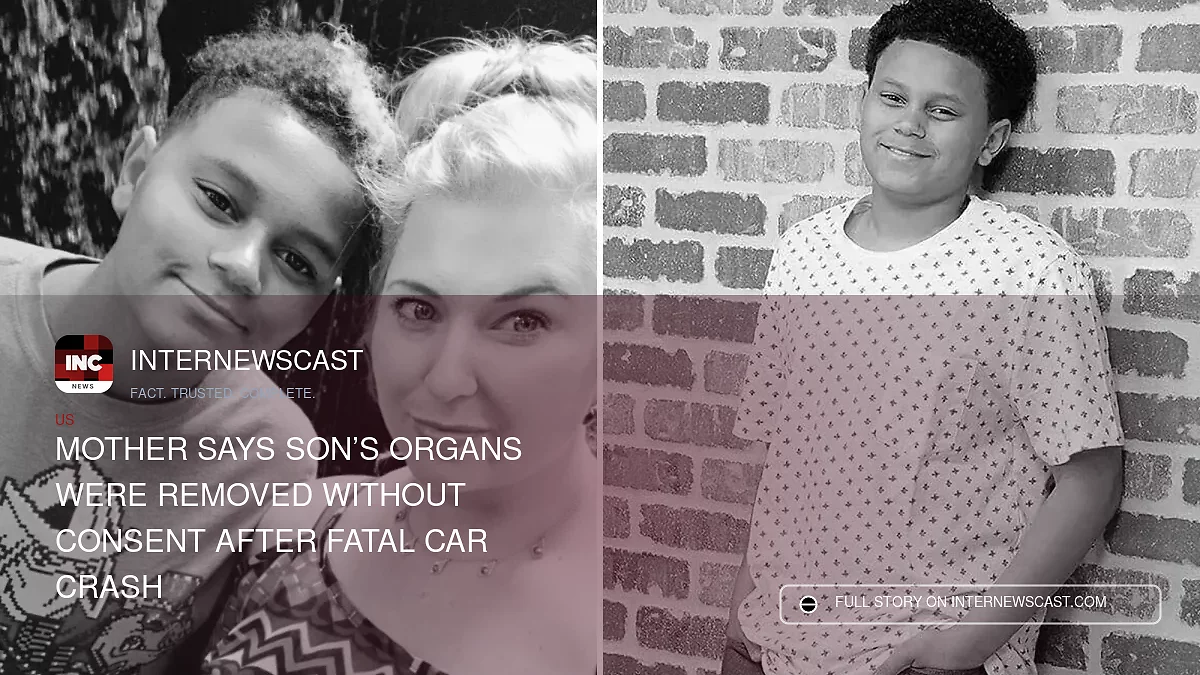

Andrea Mauk was thousands of miles from home when she learned her 18-year-old son, Damon, had died. But the Ohio mother says the heartbreak that awaited her after she returned was almost impossible to comprehend.
By the time she got back, she says, parts of Damon’s body had already been recovered as “anatomical gifts” — without her approval.
“I was completely devastated,” Mauk, 42, told The Post. “I went to the funeral home and couldn’t even look at him after they’d taken pieces of his body. They stole my son’s eyes. I didn’t want to remember Damon like that.”
Damon had recently graduated from high school and was preparing to earn his real-estate license when, on June 24, 2023, his car went off a rural road in Lucas, Ohio, and crashed into a tree, according to Mauk. She was in Costa Rica with her husband and friends when her parents called with the devastating news.
“They had to sedate me,” she recalled.
Mauk says she never received a call from the hospital, even though records identified her as Damon’s primary emergency contact. She also says Damon was not registered as an organ donor.
Instead, consent for tissue donation was secured from Damon’s biological father, whom Mauk says had played only a minimal role in their son’s life.
While the Organ Procurement Organization, or OPO, acted within the law, Mauk says her outrage stems from being left out entirely. She says she raised Damon without his biological father, her phone number was listed at the top of his records, and she was reachable — if anyone had simply called.
At the most devastating, heartbreaking moment in her life — when she could not get to her dead boy’s side — the fate of his body was ripped from her hands. She was left heartbroken and helpless in another country with no rights and no calls from the people busy tearing away at his body parts, Mauk said.
Damon’s eyes, skin, heart valves, ligaments and other tissue were recovered as “anatomical gifts,” according to Mauk. She says she later learned some tissue went to research or biologics organizations and his eyes were sent to Argentina.
“I loved Damon very deeply,” she said. “I had him when I was very young and we always joked that we brought each other up. We were incredibly close. A call to me was all I wanted. Decisions I didn’t get to take part in were made.”
Her grief became a mission.
Mauk contacted lawmakers and testified before the Ohio Senate about what she believes are flaws in the law. She also began a Change.org petition for “Damon’s Law,” intended to strengthen hospital procedures surrounding tissue donations.
The laws that exist now are not enough, said Mauk, and led to a situation where a loving mother who has watched over her son every day of his life was totally disregarded in his death.
“I believe in organ donation,” Mauk said. “This is not about ending the gift of life.”
Her allegations come amid growing federal scrutiny of the organ-procurement system.
On July 21, the US Dept. of Health and Human Services, under the leadership of Robert F. Kennedy Jr., announced a major initiative to begin reforming the organ transplant system to develop clear, enforceable policies to define donor eligibility criteria. Their initiative comes after an investigation revealed disturbing practices by a major organ procurement organization (OPO) serving Kentucky, Ohio and West Virginia.
The investigators found shocking cases in which patients may not have been deceased at the time organ procurement was initiated, poor neurologic assessments, lack of coordination with medical teams — and questionable consent practices.
“Health and Human Services Secretary [Robert F.] Kennedy is bringing to light horror stories about the dark corners of organ harvesting,” said Dr. Marc Siegel, a senior medical analyst for Fox News.
Organ and tissue donation are governed by overlapping state and federal rules, and federal law requires hospitals participating in Medicare or Medicaid to notify OPOs of deaths and imminent deaths — many within 60 minutes — even when a person isn’t a registered donor.
The OPOs are required to approach family members of potential donors. If they don’t, they are financially penalized, and so some of the organizations resort to pressure or expediency, leaving family members upset and bewildered.
For Mauk, her battle for reform began with the boy she still calls the light of her life.
“Damon deserved to have dignity in death,” she said.
And she signs every appeal the same way: “Forever Damon’s mother.”


