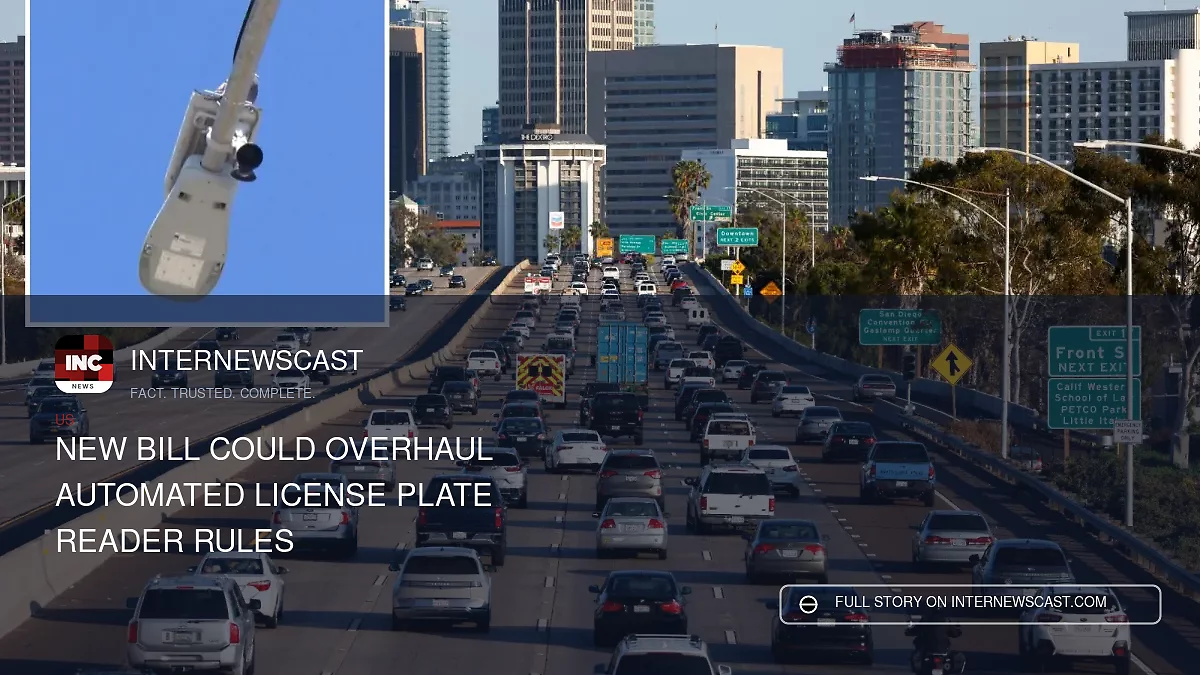

California lawmakers are weighing a new bill that could tighten the rules for public agencies using automated license plate readers, the camera networks widely associated with the surveillance technology company Flock Safety.
The technology has become a flashpoint in the debate over policing and privacy. Civil liberties groups warn that license plate reader systems can enable broad, dragnet-style surveillance, while police and sheriff’s departments argue the cameras are vital investigative tools for solving crimes and locating suspects.
Senate Bill 1013, introduced by state Sen. Sabrina Cervantes, would impose several new requirements on public agencies that deploy automated license plate readers. Agencies would have to train officers on proper use, keep records of database searches, submit to yearly audits by the California Department of Justice and purge license plate reader data after 30 days unless the information is connected to an active criminal investigation.
The measure has cleared the state Senate and is now being reviewed in the Assembly. To become law, SB 1013 must be approved by both chambers of the California Legislature before it can be sent to Gov. Gavin Newsom.
Whether the proposal can make it across the finish line is still unclear. Newsom vetoed a similar measure last year that would have required license plate reader data to be erased after 60 days, saying at the time that such a limit could undermine law enforcement investigations.
Flock Safety currently has more than 120,000 automated license plate readers installed across the United States, according to the company’s online map. More than 16,000 of those cameras are in California, giving the state the largest concentration of the devices in the country.
If enacted, Cervantes’ bill would create consistent statewide standards for how California public agencies operate and manage license plate reader systems.
Supporters in the privacy community say the legislation would bring much-needed oversight and accountability to a fast-growing surveillance tool.
“People are bothered by mass surveillance,” Seth Hall of the Trust SD Coalition, a network advocating for greater oversight of surveillance technologies, told CBS News 8.
Hall said the cameras are constantly collecting information on vehicles, raising concerns about the extent of government surveillance.
Cervantes said the bill is meant to balance privacy concerns with the use of the readers in law enforcement investigations.
“This bill is about one simple principle: protecting the privacy and safety of Californians while ensuring law enforcement tools are used responsibly,” Cervantes told CBS 8.
State Sen. Kelly Seyarto, a Republican whose district includes part of San Diego County, opposes the proposal because he believes it could limit investigative tools used by law enforcement.
“To me, that is not a very long timeline in the big scheme of things,” Seyarto told CBS 8 of the proposed 30-day data retention limit.
He added that the limit on data retention could pose public safety risks by restricting investigators’ ability to solve crimes.
The San Diego Police Department has about 500 Flock Safety cameras throughout the city and has said the technology has become an important investigative resource.
Lt. Kristopher McAndrew told CBS 8 that ALPR technology regularly allows officers to conduct their investigations.
“This thing’s helping us every single day,” he told CBS 8. “It’s helping us recover those stolen vehicles, it’s helping us get people into custody.”
McAndrew noted that the department already has its own 30-day limit on license plate reader data retention but is waiting to see what happens with SB 1013.