
Share this @internewscast.com
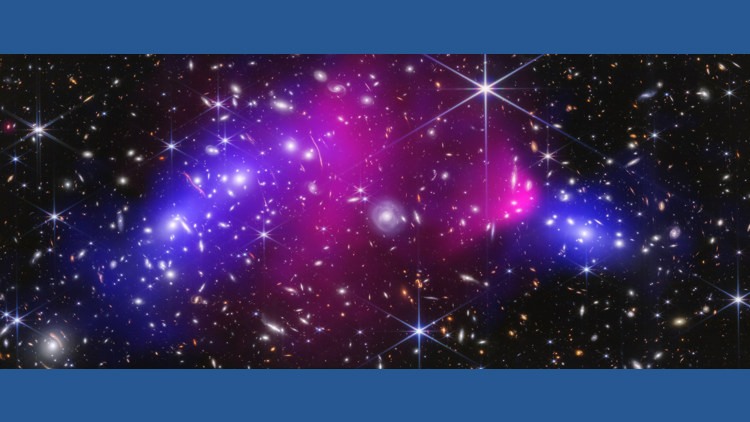
Dark matter remains elusive because it neither emits nor absorbs light, rendering it invisible to direct observation. However, scientists can infer its presence by examining its gravitational effects, notably how it distorts the light from celestial bodies.
NEW YORK — Scientists may soon unravel the enigma of an unseen force binding the cosmos, thanks to a groundbreaking, high-resolution map of galaxies far from our own.
The material world we interact with—comprising stars, planets, and living beings—constitutes a mere 5% of the universe. For years, researchers have aimed to decode the nature of dark matter, which makes up slightly more than a quarter of the universe. The remaining portion is attributed to dark energy, another enigmatic force.
Although dark matter can’t be observed directly due to its inability to emit light, its gravitational influence on the light from distant galaxies is detectable. By analyzing these gravitational distortions over vast cosmic expanses, scientists hope to shed light on dark matter and pinpoint where it resides.
The most recent map, crafted using images from NASA’s James Webb Space Telescope, offers an unprecedented level of detail over an extensive section of the sky. With twice the clarity of previous maps created with the Hubble Space Telescope, it encompasses hundreds of thousands of galaxies and spans the past 10 billion years.
“Our vision is sharper than ever,” remarked study leader Diana Scognamiglio from NASA’s Jet Propulsion Laboratory.
The latest map, published Monday in the journal Nature Astronomy, includes information on new galaxy clusters and the strands of dark matter that connect them. Piece by piece, these structures help form the skeleton of the universe. Scientists can study this map to see how dark matter has clumped up over billions of years.
Dark matter doesn’t have much of an impact on your midday lunch order or your nightly bedtime ritual. But it silently passes through your body all the time and has shaped the universe.
As humans, we’re naturally curious to know more about where we come from and that story can’t be told without dark matter, said astrophysicist Rutuparna Das with the Harvard-Smithsonian Center for Astrophysics
“Our home is the universe and we want to understand what the nature of it is,” said Das, who was not involved with the new study.
The Associated Press Health and Science Department receives support from the Howard Hughes Medical Institute’s Department of Science Education and the Robert Wood Johnson Foundation. The AP is solely responsible for all content.
Copyright 2025 Associated Press. All rights reserved. This material may not be published, broadcast, rewritten, or redistributed.