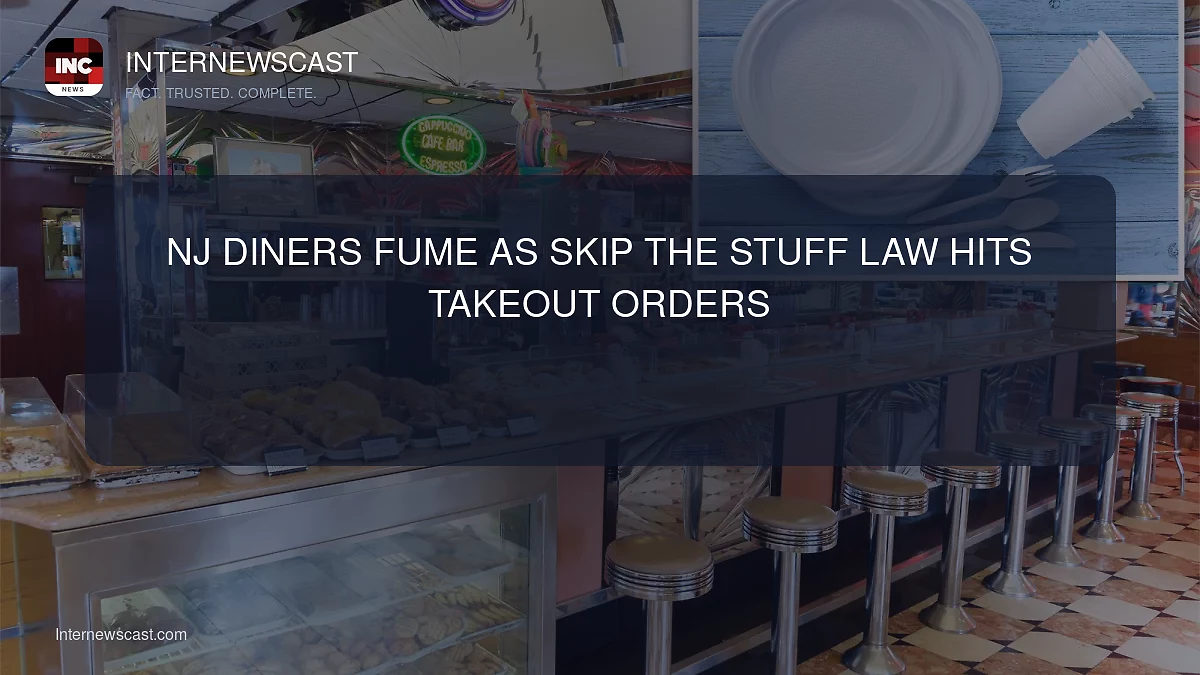

New Jersey takeout orders are getting a little lighter.
Under a new state law, New Jersey restaurants and food delivery services can no longer automatically include single-use plastic items such as forks, knives, spoons, straws, chopsticks and condiment packets with takeout meals unless customers ask for them — a change already drawing complaints across social media.
The measure, known as the “Skip the Stuff” law, ends the routine practice of packing to-go bags with disposable extras that many diners have long expected to receive without a second thought.
Signed by former Gov. Phil Murphy in January, the law officially took effect Aug. 1 as New Jersey continues its broader push to cut plastic waste and shrink the environmental impact of restaurants, delis and other food businesses.
The policy expands on earlier plastic-reduction measures in the Garden State, including the 2022 ban on single-use plastic carryout bags and polystyrene foam food containers, as well as 2021 restrictions on plastic straws.
The New Jersey Department of Environmental Protection said the purpose of the initiative is simple: to “reduce waste by only taking what you actually need.”
Unlike the state’s grocery stores, where plastic bags are no longer available even upon request, takeout customers can still receive disposable utensils, chopsticks and sauce packets for free — but they must specifically request them when placing an order.
Food delivery and online ordering platforms, including DoorDash and Instacart, must follow the same rule, meaning their systems are required to default to no utensils or extras unless customers actively opt in.

The restriction will also apply to eat-in restaurants with seating for at least 10 customers, which now can only provide washable utensils for patrons. They’ll also be required to only serve condiments in full-size bottles or resuable containers rather than packets.
RELATED: New Jersey Man, 32, Killed by Lightning During Severe Storms
NJDEP is asking customers do their part by only requesting the items needed, noting that approximately 95% of food packaging is discarded after one use, introducing unnecessary plastic into the ecosystem.
K-12 schools in the state both public and private are exempt from the new law, as are state correctional facilities and healthcare facilities.
Food court restaurants are exempt until Aug. 1, 2028.
NJDEP says restaurants will receive a warning for their first violation, but a second could bring fines of up to $100 per day, with each subsequent violation carrying penalties of up to $250 per day.
Social media opinion was largely in opposition to the new law, chalking it up to “virtue signaling” by Democratic politicians in the state.
“It’s obviously something Democrats came up with because it makes no sense,” one X user chimed in.
Another speculated it was another sign of communism slowly seeping its way into the American political mainstream.
“The truth is, under communism nothing is free, including the inalienable rights and freedoms provided by western society. Control always starts small and innocuous, like plastic utensil restrictions,” a commenter wrote.
Others expressed fear the prohibition would be a slippery slope.
“Next will be toilet paper in public bathrooms,” an X user mused.
Public opinion online wasn’t dead-set against the policy, however, with some praising the state for stopping short of an outright ban.
“Why not? Most of it gets tossed in the trash unused anyway,” one commenter pointed out.


