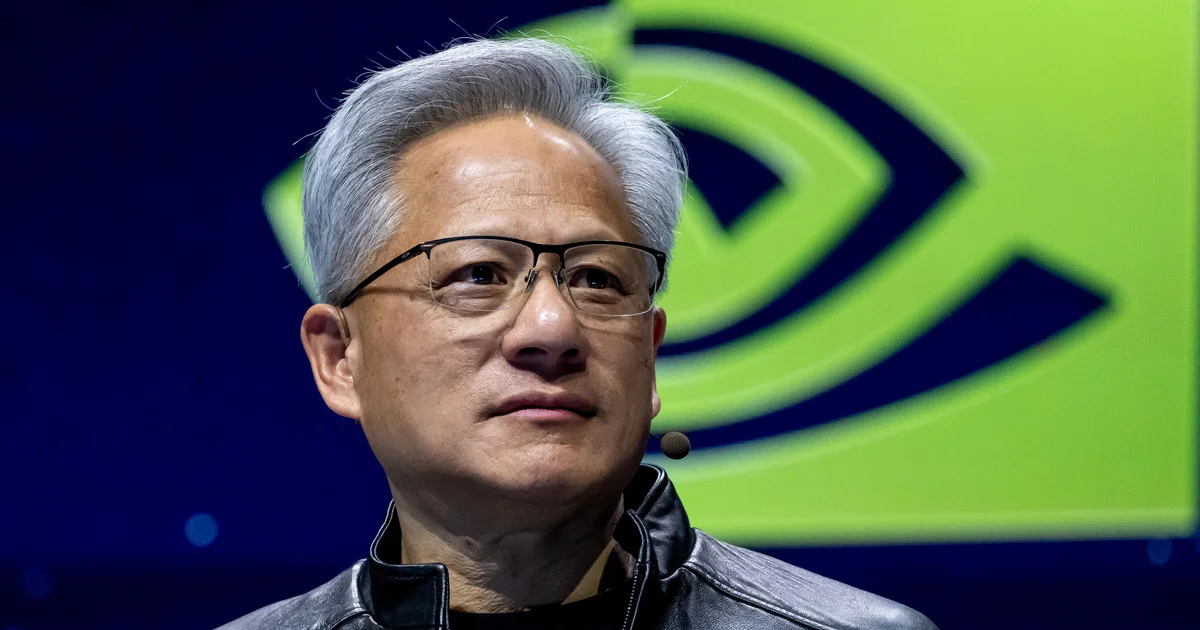

New allegations involving Nvidia CEO Jensen Huang and a suspected Chinese intelligence asset have rattled investors, sending the chipmaker’s market value down by $450 billion over two trading sessions.
The claims are now being examined by Nvidia, but they were anticipated in May by Christian Lamarco, a relatively obscure Wall Street short seller who runs New York-based Culper Research. In a 40-page report, Lamarco detailed Huang’s reported connections to Alice Huang, a former television journalist and financial-services executive who is not related to the Nvidia chief.
Short sellers seek to profit when a company’s share price falls. Culper disclosed that it had taken a bearish position in Nvidia, while arguing in its research that the company’s stock was overvalued. Such reports are typically designed to persuade other investors to sell, potentially pushing the price lower and increasing the short seller’s gains.
Lamarco, who did not immediately respond to requests for comment, said his Nvidia report drew on interviews with employees at Chinese companies, corporate records from Singapore and Malaysia, and social media posts that appeared to show Jensen Huang and Alice Huang attending social gatherings together.
The report also presented Culper’s case that Nvidia’s most advanced processors may have been redirected to China, despite U.S. restrictions prohibiting the sale of those chips to the People’s Republic on national-security and competitive grounds.
At the center of Lamarco’s research was Megaspeed International, a Singapore-based business that has become a key focus of the Nvidia scandal. Alice Huang, who was a senior executive at Megaspeed, is suspected by U.S. intelligence officials of acting as an asset for China’s Ministry of State Security.
“Uncomfortably close”
In his report, Lamarco characterized Jensen Huang’s apparent connection to Alice Huang—also known as Huang Le—as an “uncomfortably close relationship.”
“We believe Nvidia has a significant China problem,” Culper Research wrote in a May 13 social media thread. “Nvidia claims its China business went to ‘zero’ after April 2025 U.S. trade restrictions. We believe that in reality, over 20% of Nvidia’s FY 2026 compute revenues remained driven by China via illegal GPU diversion and Southeast Asian intermediaries.”
Culper further alleged that Chinese buyers relied on companies in Southeast Asia to obtain Nvidia processors. According to the research firm, corporate filings indicated that one such intermediary, Megaspeed, received funding from Alibaba, the Chinese e-commerce giant, to acquire the chips.
Nvidia did not immediately respond to a request for comment.
Culper was not the first group to raise concerns about China allegedly using front companies to purchase cutting-edge U.S. artificial-intelligence chips. In a March 23 letter to Commerce Secretary Howard Lutnick, Sens. Elizabeth Warren and Jim Banks warned of a “large-scale diversion of advanced American AI chips to China through Southeast Asian intermediaries.”
The senators urged the Commerce Department to immediately suspend existing export licenses covering Nvidia AI chips and servers shipped to China and to businesses in Southeast Asia, including Malaysia, Thailand, Vietnam and Singapore.
Megaspeed’s mega-speedy growth
Culper’s report said Megaspeed had “relatively few assets at year-end 2023,” yet spent $2.9 billion within the following year on servers equipped with Nvidia technology. The short seller said it had uncovered documents indicating that Alibaba supplied the Singaporean company with billions of dollars.
According to the report, Megaspeed and its Malaysian affiliate, Speedmatrix, purchased a combined $4.8 billion worth of Nvidia’s advanced AI hardware and processors over a three-year period.
“Megaspeed went from very little business to billions in a rapid time frame,” Culper wrote. “This is the exact sort of pattern that experts told us ought to raise alarm bells at Nvidia as indicative of diversion or circumvention activity.”
Although the report did not explicitly allege that Jensen Huang and Alice Huang were romantically involved, it featured photographs and video stills depicting the two together at several events.
“Nvidia CEO Huang has walked alongside Megaspeed at every step, and seems to have a close relationship with Megaspeed’s Alice Huang,” Culper said in its May 13 social media thread. “They partied together in June 2024 — same month as the Apex/Alibaba pledge, then dined together in May 2025 — just after U.S. trade restrictions.”
Culper Research, whose name references the Culper Spy Ring that gathered intelligence on British troop movements during the American Revolution, has recently revisited its earlier claims as new allegations about Jensen Huang, Megaspeed and Alice Huang surfaced this week. “We wrote about this in May,” the group said on Nov. 5.
When Culper released its report on May 13, Nvidia shares were trading at $225.83. By Tuesday’s close, the stock had fallen 25% from that level.
“Everyone was just mocking us, and now everyone is singing our praises,” Lamarco told The New York Times in a recent interview.


